
Reverse Mortgage for Aging Parent's Woodworking and Furniture Making Business
Turn your woodworking hobby into a retirement business. Fund tools, workshop setup, and inventory with reverse mortgage. Create custom furniture for $1,000-$5,000/month income.
Can your woodworking hobby generate meaningful retirement income while keeping you engaged and building beautiful pieces for your community? Yes—a home-based furniture workshop funded by a reverse mortgage can produce $1,000–$3,000/month through custom commissions, craft markets, and online sales. Woodworking combines physical activity, creative satisfaction, and strong income potential.
Many Ontario retirees with woodworking experience are discovering that custom furniture commands premium pricing ($1,500–$8,000 per piece) and consistent buyer interest. A reverse mortgage lets you invest in professional tools and workshop setup while maintaining creative independence.
Why Woodworking Businesses Thrive in Retirement
Strong market demand:
- Handmade furniture commands 200–400% markup vs. mass-produced equivalents
- Custom pieces (dining tables, desks, bookcases, bed frames) sell for $2,000–$8,000 easily
- Etsy, Instagram, and local craft communities provide steady client flow
- Corporate bulk orders (office furniture, built-in installations) provide higher-margin work
Income potential:
- Entry-level pieces (cutting boards, small boxes): $50–$200 retail
- Intermediate pieces (chairs, side tables): $400–$1,500 retail
- Complex pieces (dining tables, built-in cabinetry): $2,000–$8,000+ per project
- Full-time woodworker earnings: $50,000–$100,000/year depending on specialization and output
- Part-time retirement schedule: $800–$2,500/month achievable with 15–25 hours/week effort
Aging in place advantage:
- Home workshop eliminates commute and office politics
- Physical activity (hand planing, assembly, finishing) maintains fitness and flexibility
- Meditative, focused work engages mind and reduces stress
- Community through craft shows and collector relationships combats isolation
Equipment longevity:
- Quality woodworking tools last 20–50+ years
- Your startup investment is largely one-time (tools rarely need replacement)
- Ongoing costs are primarily materials (wood, hardware, finishing)

Woodworking Workshop Startup and Equipment Costs
| Equipment Category | Cost Range | Notes |
|---|---|---|
| Power Tools (Essential) | ||
| Table Saw (cabinet quality) | $1,500–$3,500 | 10" blade, dust collection; core tool |
| Miter Saw | $400–$1,000 | For crosscutting lumber precisely |
| Planer (thickness) | $400–$800 | Surfaces rough lumber |
| Jointer | $300–$800 | Flattens and straightens lumber |
| Drill Press | $300–$700 | Accurate hole boring |
| Hand Tools | $800–$1,500 | Quality chisels, planes, saws, measuring tools |
| Workshop Infrastructure | ||
| Workbenches (2–3) | $600–$1,500 | Solid surface for layout, assembly |
| Lumber Storage & Racking | $500–$1,200 | Organized storage for stock |
| Dust Collection System | $800–$2,000 | Essential for health and safety |
| Finishing Station | $400–$800 | Organized area for stains, finishes, brushes |
| Lighting & Electrical | $500–$1,500 | LED lighting, 220V circuits for large tools |
| Materials & Supplies (Initial) | ||
| Lumber Stock (hardwoods) | $1,000–$2,000 | Initial inventory of walnut, oak, maple, cherry |
| Hardware & Fasteners | $300–$600 | Hinges, knobs, bolts, glues, finishes |
| Total Beginner Setup | $8,000–$17,000 | Used tools can reduce cost by 40–50% |
| Total Quality Setup | $15,000–$25,000 | New, professional-grade tools |
Most retirees start with $10,000–$18,000 for a functional workshop in a garage, basement, or workshop space.
Reverse Mortgage Funding for Woodworking Workshop
Phased approach:
- Month 1: Draw $4,000–$6,000 for essential power tools (table saw, miter saw, planer)
- Month 2: Draw $2,000–$3,000 for workbenches, hand tools, and storage
- Month 3: Draw $2,000–$3,000 for dust collection, lighting, and workshop infrastructure
- Month 4: Draw $1,000–$2,000 for initial lumber stock and finishing supplies
- Months 5+: Draw $300–$500/month for ongoing materials and supplies as business generates revenue
- Total initial draw: $9,000–$14,000
Lender advantage: CHIP, HomeEquity Bank, and Equitable Bank approve workshop and tool-based draws readily. Interest accrues only on amounts drawn; as your woodworking business generates revenue, you can pause draws and begin repaying from profits.
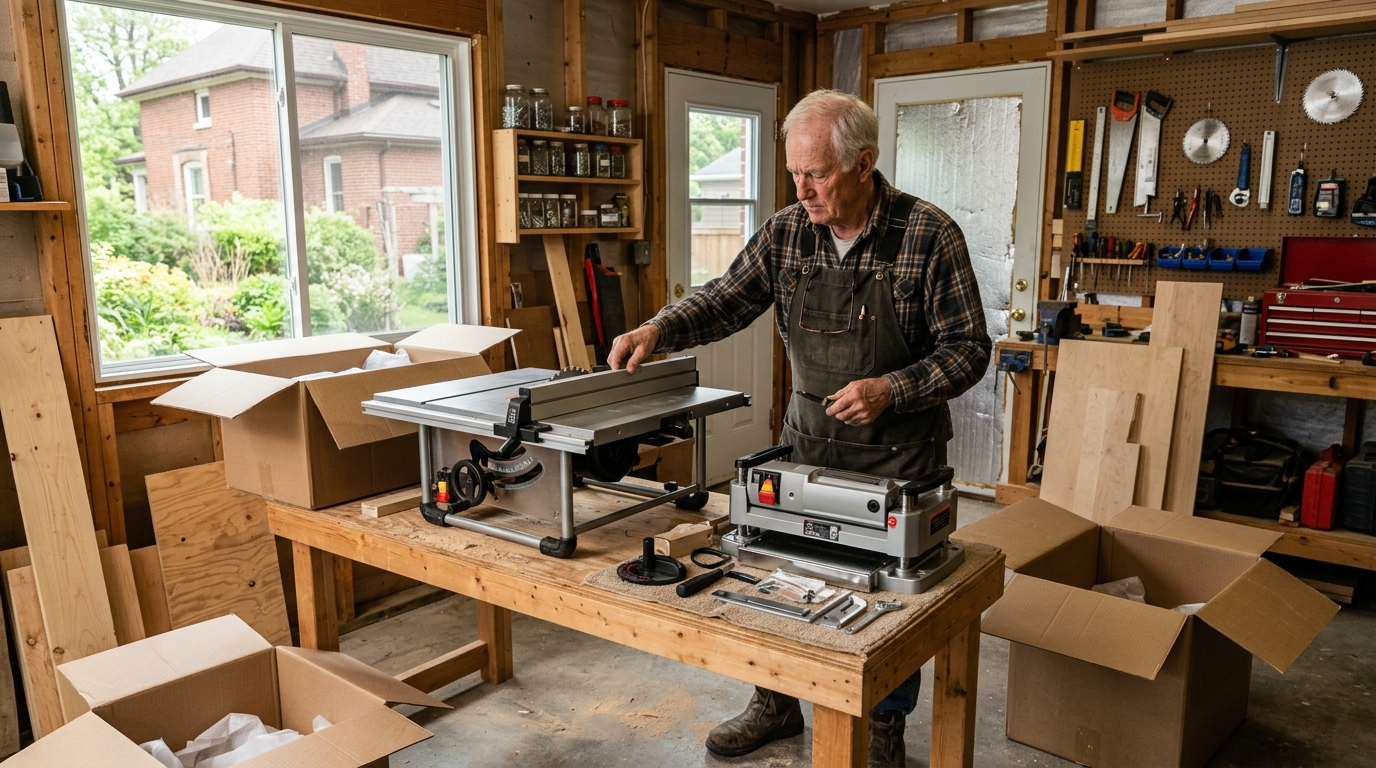
Revenue and Profit Breakdown for Furniture Making
| Project Type | Sale Price | Material Cost | Labor Hours | Profit |
|---|---|---|---|---|
| Cutting Board (Decorative) | $80–$150 | $15–$25 | 3–5 | $55–$125 |
| Small Jewelry Box | $150–$300 | $20–$40 | 5–8 | $110–$260 |
| Side Table (Solid Wood) | $600–$1,200 | $120–$180 | 25–35 | $420–$1,080 |
| Dining Table (6-Person) | $2,000–$4,000 | $300–$600 | 60–80 | $1,400–$3,700 |
| Custom Bookcase/Cabinet | $1,500–$3,500 | $250–$400 | 50–70 | $1,100–$3,250 |
| Part-Time Revenue (15–20 hrs/week) | Mixed | ~35% avg | Varies | $1,200–$2,500/month |
Most part-time retiree woodworkers achieve 60–65% profit margins after material costs (labor cost is self-provided time).
Case Study: Woodworking Workshop Launch in Retirement
Robert, 71, retired machinist, Ontario homeowner
Robert had woodworking as a serious hobby for 25 years—building furniture for himself, family, and friends. In retirement, friends consistently asked to commission pieces: "How much would you charge for a dining table like yours?" Robert realized his hobby could generate modest supplemental income ($1,000–$1,500/month).
Robert's plan:
- Upgrade his garage workshop with professional-grade tools (he currently had basic hand tools and a 10-year-old table saw)
- Produce custom furniture: dining tables, desks, bookcases primarily
- Target: $1,200–$1,800/month income through commissions and craft shows
- Produce 6–10 pieces/year (mixed sizes)
Robert's workshop needs: $12,000–$15,000 for quality tool upgrades and infrastructure
Robert had $280,000 home equity and $2,100/month CPP pension. He couldn't gift $15,000 in cash, but a reverse mortgage could bridge the gap.
Robert's reverse mortgage strategy:
- Applied for $20,000 reverse mortgage line of credit with CHIP at 5.85%
- Drew $3,500 for table saw upgrade (cabinet-quality saw, significant improvement)
- Drew $2,500 for planer, jointer, miter saw (essential tools for precision)
- Drew $2,000 for workbenches, hand tools, and organization
- Drew $2,000 for dust collection system and workshop electrical upgrade
- Drew $1,500 for initial hardwood lumber stock (walnut, oak, maple)
- Total draws Month 1–3: $11,500
Robert's Year 1 results:
- Months 1–3: Built 2 custom dining tables (commissions from friends): $7,000 revenue, $2,200 material cost, ~$4,800 profit
- Months 4–8: Built 4 smaller projects (desks, bookcases, chairs): $6,500 revenue, $2,000 material cost, ~$4,500 profit
- Months 9–12: Craft show season; built 5 smaller pieces (boxes, small tables): $2,800 revenue, $900 material cost, ~$1,900 profit
- Year 1 Total: $16,300 revenue, $5,100 materials cost, $11,200 net profit
Robert's outcome:
- Outstanding RM balance: $11,500 at 5.85% interest
- Year 1 profit: $11,200 (exceeded RM balance borrowed)
- Voluntary RM repayment Year 1: $8,000 (70% of profit)
- New outstanding balance: $3,500
Robert's projection:
- Year 2 revenue target: $18,000–$22,000 (more commissions, established reputation)
- Expected repayment Year 2: $5,000+
- RM payoff: Year 2 (within 18 months of launch)
- Ongoing sustainability: $1,200–$1,800/month income indefinitely (20 hours/week effort)
Benefits Robert experienced:
- Daily creative purpose and engagement
- Community through craft shows (relationships with collectors, other craftspeople)
- Physical activity (better health outcomes than inactive retirement)
- Income growth supporting travel and hobbies
- Legacy: His furniture is used and appreciated by friends and community
Specialization Strategies for Higher Income
Custom commissions (highest profit):
- Built-in cabinetry for kitchens/offices: $5,000–$15,000 per project
- Heirloom furniture (high-quality hardwoods, complex joinery): $2,000–$8,000 per piece
- Restoration/refinishing of antique pieces: $500–$3,000 per project
Niche markets (premium pricing):
- Sustainable/reclaimed wood furniture (eco-conscious buyers pay 30–50% premium)
- Accessible furniture design (height-adjustable desks, mobility-friendly): 40% premium pricing
- Heritage/period reproductions: specialty collectors pay $3,000–$10,000+
Production strategies (volume & efficiency):
- Repetitive small pieces (cutting boards, boxes, coasters): Lower per-piece profit but high volume
- Furniture kits (pre-cut, assembly-required): Lower price point, faster production
- Wholesale to galleries or furniture retailers: Lower individual piece price but consistent volume
Most successful retiree woodworkers blend commission work (high-value, limited volume) with production work (lower per-piece price, higher volume).
Tax and Benefit Implications
Reverse mortgage proceeds are not income: The $11,500 you borrow is a loan, not taxable. CPP and OAS remain unaffected.
Woodworking business income is taxable: When Robert earns $16,300 from furniture sales, he reports self-employment income. He deducts all business expenses: lumber, hardware, finishing supplies, tool depreciation, workshop utilities (proportional), equipment maintenance, craft show booth fees. After deductions (~$5,100 materials cost + ~$800 overhead), his taxable net income is ~$10,400.
CPP contributions: Self-employment income triggers CPP contributions (~9.9% of net income). This builds Robert's retirement benefits if he's under age 70.
Home workshop deduction: Robert can deduct a portion of home utilities, property tax, and maintenance (proportional to workshop square footage). If his workshop is 20% of garage space and garage is 25% of home, roughly 5% of utility costs and home maintenance are deductible.
According to the Canada Revenue Agency, home-based craft businesses are fully legitimate; proper deduction of workshop-related expenses is encouraged. Consult a CPA to optimize business tax position.
Key Takeaways
- Handmade furniture commands premium pricing: Custom pieces sell for $1,500–$8,000 vs. $400–$1,500 for mass-produced equivalents.
- Workshop startup is manageable: $10,000–$18,000 covers quality power tools, hand tools, and infrastructure for a garage-based operation.
- Part-time production is sustainable: 15–20 hours/week generating $1,000–$2,500/month is achievable without burnout.
- Reverse mortgage protects retirement income: No monthly payments; your CPP and pension remain unaffected while workshop generates supplemental income.
- Break-even occurs quickly: Most woodworking businesses become profitable within 12–18 months; Robert paid off the entire RM within Year 1 from profits.
- Specialization increases value: Heirloom furniture, sustainable wood, and custom commissions command 40–100% premium pricing.
Frequently Asked Questions
Do I need prior woodworking experience to start a commercial workshop?
Yes. Most successful retiree woodworkers have 10+ years of serious hobby experience before commercializing. If you're new to woodworking, take 1–2 years of intensive learning first (community college courses, mentorship), then invest in the workshop.
Can I set up a woodworking workshop in my garage without construction?
Yes. Most retiree workshops operate in standard garage spaces (1–2 car garage). Ensure electrical capacity for power tools (220V for table saw; consult electrician). Dust collection and ventilation are critical for health; a window-mounted exhaust fan ($300–$600) works.
What if I produce furniture but can't find buyers?
Woodworking has strong market demand through Etsy, Instagram, craft shows, and word-of-mouth. If custom commissions aren't flowing, pivot to production pieces (cutting boards, small boxes, jewelry boxes) at craft shows and online platforms. Revenue may be lower per-piece but more consistent.
Can my adult children help with the woodworking business?
Absolutely. Some retirees develop "woodworking classes" for grandchildren (birthday parties, weekend workshops, $50–$150/session). Others hire adult children as assistants ($15–$20/hour for sanding, finishing, assembly). This adds social benefit and potentially increases output capacity.
Will woodworking income disqualify me from government benefits?
Unlikely. Modest craft income ($10,000–$20,000/year) is generally below thresholds affecting CPP or OAS. If you're on GIS, check the earnings exemption (usually $3,500–$4,500/year). Most woodworking retirement businesses stay below benefit-affecting income levels.
Can I deduct depreciation on my woodworking tools?
Yes. Tools are capital assets that depreciate over time. You can deduct depreciation (CCA—Capital Cost Allowance) on power tools, machinery, and workbenches. Consult a CPA about proper capital asset accounting; it reduces your taxable income over tool lifespan.
What if my workshop takes up rental/investment property space?
If you own rental property with workshop space, consult a CPA about properly allocating workshop expenses vs. rental property expenses. Commingling costs creates tax complications; separate accounting prevents issues.
Ready to launch your woodworking furniture business in retirement? Contact Rick Sekhon Reverse Mortgages for a consultation on funding workshop setup with zero-payment home equity access.
Ready to Learn More?
Find out exactly how much you could unlock from your home — free and no obligation.
Related Articles
Reverse Mortgage for Aging Parent's Home-Based Pottery and Ceramic Art Studio Business
Launch a home-based pottery business in retirement. Fund kiln, wheel, supplies, and studio setup with reverse mortgage. Create art, income, and community in your home.
Read →Reverse Mortgage for Aging Parent's Farmers Market Business: Artisan Food Production
Retire with purpose: Fund your artisan jam, preserve, or baked goods business with reverse mortgage equity. Create income and legacy through farmers market entrepreneurship.
Read →Reverse Mortgage for Emergency Home Accessibility: Sudden Wheelchair Use Requires Complete Retrofit
When your adult child becomes wheelchair dependent, home modifications are urgent. Fund complete retrofit—ramps, widened doors, accessible bathroom—with zero-payment reverse mortgage.
Read →