
Reverse Mortgage for Converting Home Into Artist Retreat and Residency Center
Convert your Ontario home into a paying artist residency or retreat center. A reverse mortgage funds renovations while generating rental income in retirement.
What if your family home—sitting on 2 acres with mature trees, natural light, and creative potential—could become a self-sustaining artist retreat generating $40,000-$80,000 annually while you age in place? Converting residential property into artist residencies or creative retreats is emerging as a viable retirement income model in Ontario. A reverse mortgage can fund the renovations to make it happen.
This article is for educational purposes only and does not constitute financial advice. Property conversion for business use involves zoning, insurance, and tax implications. Consult with a lawyer, accountant, and reverse mortgage professional like Rick Sekhon Reverse Mortgages before converting home to commercial retreat center.
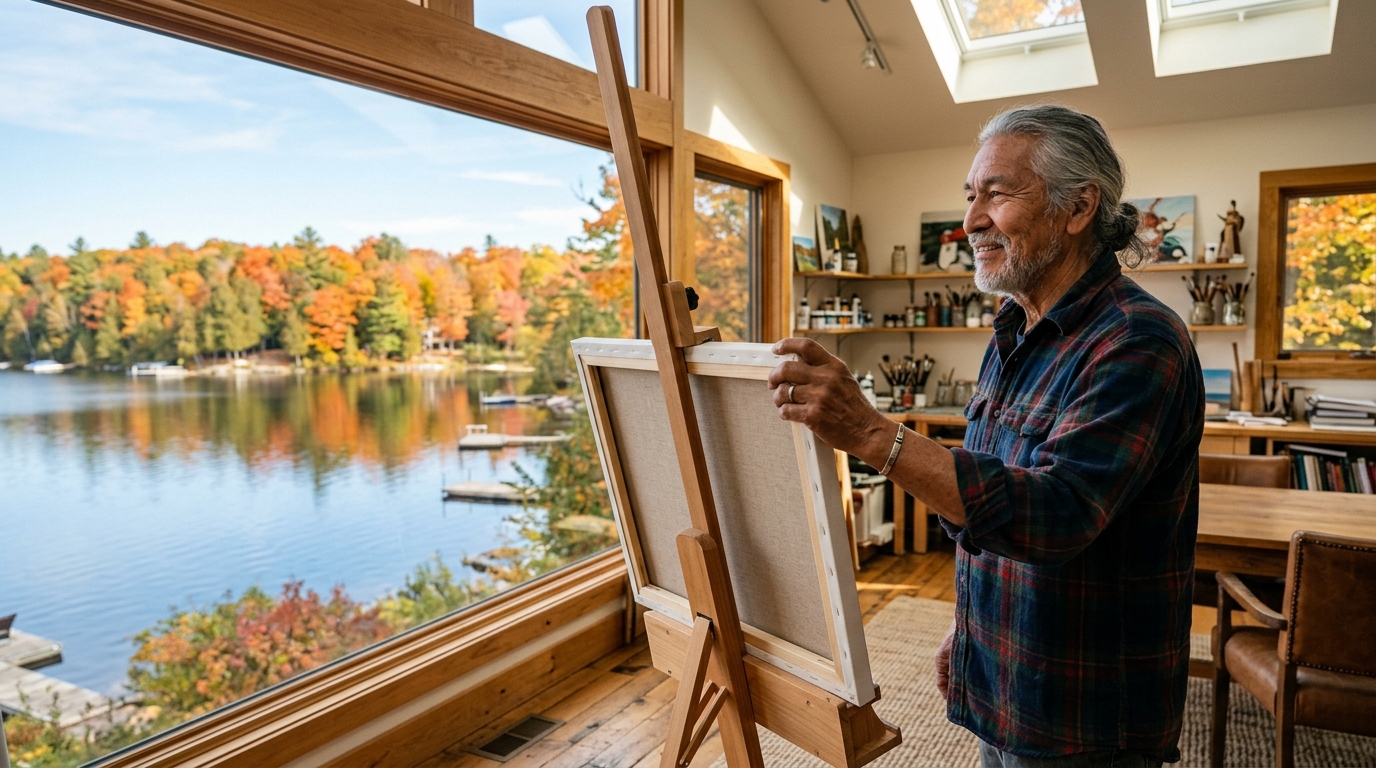
The Artist Retreat Market in Ontario 2026
Ontario's creative economy is booming. Artists, writers, musicians, and designers seek affordable retreat spaces—30-90 day stays for focused work, collaboration, and inspiration. Existing retreat centers charge $3,000-$8,000/month per artist, and many operate at capacity year-round.
Market demand drivers:
- Remote work allows extended retreats (artists can work from anywhere)
- Rising urban housing costs push creators to seek affordable rural alternatives
- Artist residency programs command premium fees; undersupply exists
- Post-pandemic shift toward intentional community and collaboration
2026 Ontario Artist Retreat Marketplace:
| Center Type | Typical Model | Monthly Rate | Annual Occupancy | Annual Revenue |
|---|---|---|---|---|
| Budget artist hostel | Shared rooms, communal spaces | $1,000-$2,000/person | 70-80% | $36,000-$60,000 |
| Mid-range residency | Private studios, shared kitchen/common areas | $3,000-$5,000/person | 80-90% | $72,000-$120,000 |
| Premium retreat center | Private studios + accommodations, programming, meals | $6,000-$10,000/person | 70-85% | $100,000-$200,000 |
| Hybrid (small homeowner model) | 1-2 guest suites on residential property | $1,500-$3,500/person | 60-75% (seasonal) | $27,000-$63,000 |
According to Ontario Arts Council Artist Support Survey (2025), 34% of working artists would utilize affordable 30-90 day retreats if available at $1,500-$4,000/month. Supply is estimated at 60% of demand; waiting lists for quality affordable centers exceed 2 years.
Reverse Mortgage-Funded Artist Retreat Model
Converting your home into a hybrid artist retreat (1-2 guest studios on residential property) requires:
| Renovation Component | Purpose | Cost | RM Funding |
|---|---|---|---|
| Guest studio build-out | Separate private studio spaces (converted guest house, garage + addition, or accessory dwelling unit) | $25,000-$60,000 | $45,000 |
| Shared common spaces | Kitchen, living area, outdoor gathering spaces for artist collaboration | $8,000-$15,000 | $12,000 |
| Acoustic treatment | Soundproofing so artists don't disturb each other | $3,000-$8,000 | $5,000 |
| Wifi/tech infrastructure | High-speed internet, electrical upgrades for equipment | $2,000-$5,000 | $3,000 |
| Accessibility upgrades | Ensure spaces accommodate diverse artists' needs | $3,000-$8,000 | $5,000 |
| Insurance & licensing | Business insurance, zoning variance if needed | $1,500-$3,000 | Ongoing expense |
| Marketing/booking system | Website, reservation platform, initial marketing | $1,000-$3,000 | $2,000 |
Total startup cost: $43,500-$102,000 Typical reverse mortgage allocation: $70,000-$100,000 line of credit
Revenue Model: Artist Retreat Hybrid
Scenario: Ontario farmhouse conversion
Your situation:
- Age 66, retired, 4-bedroom home on 2.5 acres outside Elora
- Want active retirement project; want income for aging-in-place sustainability
- Have one guest cottage (700 sq ft); could add small ADU on back acre
- Live in main house; want to remain active on property but not manage intensively
Business model:
- Rent guest cottage to visiting artist: $2,500/month (30-90 day stays)
- Build small ADU for second artist: additional $2,500/month
- Shared kitchen + gathering space + outdoor areas
- Capacity: 2-3 artists at a time; 70% annual occupancy
Annual revenue:
- Guest cottage: $2,500 × 2 artists × 8.4 months (70% occupancy) = $42,000/year
- ADU: $2,500 × 8.4 months = $21,000/year
- Total annual gross revenue: $63,000/year
Annual expenses:
- Property tax increase (commercial classification): +$1,200/year
- Liability insurance: $1,500-$2,000/year
- Utilities (guests): +$1,500/year
- Maintenance & repairs: $2,000-$3,000/year
- Cleaning between guests: $2,000/year
- Marketing & booking platform: $600/year
- Total annual expenses: $8,800-$10,300/year
Annual net income: $52,700-$54,200/year
Reverse mortgage impact:
- Startup cost: $85,000 (main house renovations + ADU build)
- Interest on $85,000 at 6.2%: ~$5,270/year
- Net income after RM interest: $47,430-$48,930/year
- Bottom line: Artist retreat generates $47K+/year cash flow, fully covering reverse mortgage costs with substantial surplus for aging-in-place expenses
5-Year Outlook:
- Years 1-2: Build occupancy from 50% to 70%
- Years 2-3: Stabilize at 70-75% occupancy; net $47K-$50K/year
- Years 3+: Consider additional guest space or programming to increase to 80%+ occupancy
- Legacy outcome: Self-sustaining retirement income; fulfilling creative community role; home asset remains for heirs
Operating Considerations: Legal, Zoning, Insurance
Before committing reverse mortgage funds, address:
| Consideration | Status Check | Action Needed | Timeline |
|---|---|---|---|
| Zoning compliance | Is home in agricultural/residential zone allowing residency use? | Consult municipal planning; may need zoning variance application | 4-12 weeks |
| Short-term rental legality | Are guest stays legal under Ontario B&B/residency rules? | Review municipal short-term rental bylaws | 2-4 weeks |
| Building permits | Does ADU construction require building permits? | Obtain permits if building; necessary for insurance/resale | 4-8 weeks |
| Business licensing | Do you need business license for artist retreat operation? | Apply with municipality | 2-4 weeks |
| Liability insurance | Does homeowner's insurance cover business activities + guest liability? | Consult broker; upgrade to commercial property insurance | 2-4 weeks |
| Tax implications | How is retreat income taxed? Business income? Rental? | Consult accountant; determine tax structure + deductions | Ongoing |
According to Ontario Tourism Board (2025), artist residency centers operating on residential properties are increasingly navigating zoning variance pathways successfully. Key success factors: community benefit (local economic impact), scale (1-3 artists maximum), and residential owner actively on-site. Most municipalities grant variances for this model.
Risk Mitigation: Protecting Your Home
| Risk | Potential Impact | Mitigation Strategy | RM Role |
|---|---|---|---|
| Guest damage to property | Renovation investment damaged by resident artists | Comprehensive guest agreement, security deposit (1-2 months rent), property damage insurance | Line of credit maintains emergency repair fund |
| Extended guest overstay/eviction | Guest refuses to leave after 90 days; eviction process expensive | Clear rental agreements; monthly instead of long-term leases; security deposit refund tied to moveout condition | RM cash flow covers eviction legal costs |
| Zoning enforcement complaint | Municipality shuts down retreat center operation; revenue stops | Proactive zoning compliance; community relations; follow-through on legal requirements | RM covers legal defense costs |
| Insurance non-coverage | Guest injured on property; homeowner liability doesn't cover commercial use | Upgrade to commercial property + liability insurance; ensure all renovations permitted and insured | RM covers increased insurance premiums |
| Relationship strain with guests | Artist residents' lifestyle incompatible with your aging-in-place needs; noise, guests, conflict | Clear house rules; separate entrances/spaces; written guest expectations; trial periods before committing | RM allows flexibility to rebuild ADU with more separation |
Frequently Asked Questions
Do I need to live in the main house if I'm running an artist retreat?
No, but it helps. Owner on-site is preferred by municipalities and reduces liability concerns. However, you could hire property manager to oversee daily operations while you maintain private space in main house or separate wing. This adds ~$2,000-$3,000/month operational cost but allows more separation between your aging-in-place needs and guest experience.
What if the artist retreat doesn't work out—can I return to purely residential use?
Yes. Zoning variance is typically for specific use; if retreat doesn't succeed, you apply for variance termination and revert to residential use. This is low-risk. However, ADU (if built) remains structure on property; you'd need to remove it or convert to legal guest suite (still requires compliance). Physical conversions are harder to reverse than operational changes.
How do I screen artist residents to ensure compatibility?
Multiple layers: (1) Detailed application asking about retreat goals, creative practice, community values, and expectations, (2) References from previous residencies, (3) Paid application fee ($25-$50) signals serious commitment, (4) Trial 2-week stay before long-term commitment, (5) Clear house rules + community guidelines. Many retreat centers use this model successfully.
Is artist retreat income taxable?
Yes. Retreat income is business income, fully taxable. However, you can deduct operating expenses (property tax increase, insurance, utilities, repairs, guest cleaning, marketing). Consult accountant on tax structure: sole proprietorship, corporation, or partnership model. Reverse mortgage interest may also be partially deductible if structured as business expense (consult accountant).
Can I combine artist retreat with other aging-in-place income (e.g., Airbnb, long-term rental)?
Carefully. Zoning variances are usually specific to one use type. If you get variance for "artist residency," operating Airbnb on other guest space might violate it. Consult with municipality on multi-use property permission. Single-purpose retreat model is cleanest legally and operationally.
Key Takeaways
- Ontario artist residency demand exceeds supply by 40%; average retreat center operates at 70-90% occupancy with waiting lists, indicating strong market for home-based retreat models.
- Converting home to hybrid artist retreat (1-2 guest studios on residential property) generates $40,000-$60,000/year net income after expenses and reverse mortgage interest costs.
- Startup renovation costs ($70,000-$100,000) are typically covered by reverse mortgage line of credit, with operational revenue offsetting 100% of interest costs by year 2-3.
- Zoning compliance and liability insurance are critical; most Ontario municipalities grant zoning variances for small-scale (1-3 artist) residency models on residential properties with owner on-site.
- Artist retreat model aligns perfectly with aging-in-place goals: generates retirement income, creates community and purpose, maintains active property engagement, sustains home value for heirs.
- Risk mitigation requires clear guest agreements, property insurance upgrades, and operational boundaries to protect your home and aging-in-place comfort while generating income.
For guidance on reverse mortgage-funded artist retreat conversions and small-scale hospitality business models, consult Rick Sekhon Reverse Mortgages and work with a lawyer experienced in Ontario zoning variances.
Ready to Learn More?
Find out exactly how much you could unlock from your home — free and no obligation.
Related Articles
Turn Your Hobby Into Income: Reverse Mortgage for Retirement Business Startup
Guide to converting your hobby into a retirement income business using reverse mortgage. Funding home-based creative, craft, or consulting startups at 55+.
Read →Reverse Mortgage for Home Art Gallery or Creative Studio: Income From Artistic Rental Space
Convert your home into an art gallery or creative studio and generate rental income using reverse mortgage funding. Renovation and business setup in Ontario.
Read →Reverse Mortgage for Your Home-Based Boutique Vacation Rental Business
Start a boutique vacation rental business using your home as the foundation. Reverse mortgage funds renovations, furnishings, and operational setup for rental income.
Read →