
Reverse Mortgage for Storm Wind Damage: When Insurance Deductible Exceeds Coverage
Cover high insurance deductibles for storm and wind damage with a reverse mortgage. Ontario homeowners can access equity for repairs when deductibles spike beyond savings.
Did a severe storm or windstorm destroy your roof, windows, or siding, leaving you with a $20,000–$50,000 insurance deductible you can't afford to cover? A reverse mortgage unlocks home equity at zero monthly cost, allowing you to repair critical damage immediately rather than letting deterioration worsen over months or years.

Ontario's climate is intensifying. Severe windstorms and hail events have increased 40% over the last decade, and insurance deductibles have spiked correspondingly. Many Ontario homeowners age 55+ now face deductibles of $15,000–$30,000 on standard policies, with some catastrophic loss deductibles hitting $50,000–$100,000.
When your roof is damaged in a major storm, you need repairs within weeks—not months of saving. A reverse mortgage bridges the gap between insurance payout and your out-of-pocket deductible, protecting your home's structural integrity and your peace of mind.
How Insurance Deductibles Work—And Why They Explode After Storm Damage
Ontario homeowners often misunderstand deductible mechanics. Here's the reality:
Standard homeowners insurance deductible: Typically $500–$2,500 (older policies). When you file a claim, you pay the deductible; insurance covers the rest.
Deductible tiers for major perils: Wind and hail now often have separate, higher deductibles. Ontario insurers now commonly require:
- Standard deductible: $500–$1,000
- Wind/hail deductible: $5,000–$15,000 (sometimes 5–10% of home value)
- Catastrophic loss deductible (major hurricane/ice storm): $25,000–$100,000
Why deductibles spike after major storms: Following a severe windstorm, insurance companies raise deductibles province-wide to offset accumulated claims. A 2022 ice storm in Ontario triggered deductible increases of 50–200% across the market. Homeowners renewing policies after major regional loss often discover their deductible has doubled.
| Damage Scenario | Typical Repair Cost | Standard Deductible | Wind Deductible | Your Out-of-Pocket Cost |
|---|---|---|---|---|
| Roof shingles torn off sections | $8,000–$12,000 | $1,000 | $8,000 | $8,000–$11,000 |
| Roof partially destroyed, fascia damaged | $18,000–$25,000 | $1,000 | $12,000 | $12,000–$24,000 |
| Multiple window damage + siding replacement | $12,000–$20,000 | $1,000 | $10,000 | $10,000–$19,000 |
| Major roof + structural damage | $30,000–$50,000 | $1,500 | $15,000 | $15,000–$48,500 |
According to Insurance Bureau of Canada, the average homeowner deductible for wind-related claims in Ontario has increased 60% since 2018, with major insurers (Intact, Rogers, Allstate) now routinely issuing deductibles of $10,000–$20,000 for hail and wind coverage.
The cruel irony: The homeowners most vulnerable to climate events (older Ontario homes with aging roofs) often have the highest deductibles and the lowest savings to cover them.
The Damage Escalation Problem: Why Delay Costs More
Many Ontario homeowners think: "I'll wait and save $15,000 over a year, then do repairs." This logic fails catastrophically.
Water infiltration compounds damage: A damaged roof doesn't just expose shingles—it exposes your attic, rafters, insulation, and ceiling joists to moisture. Within months, mold develops. Within 2–3 years, structural wood rot spreads. Initial $12,000 roof damage becomes $25,000–$40,000 damage because rotting framing must be replaced.
Insurance coverage deteriorates: Once an adjuster documents pre-existing damage from water infiltration, future claims are denied under "failure to mitigate damage" clauses. You lose coverage.
MPAC reassessment: Structural damage from water infiltration can trigger a property tax reassessment downward. Your home's assessed value drops $10,000–$30,000, costing you equity.
Buyer liability in sale: If you eventually sell with known structural damage from unrepaired storm damage, you face massive liability during home inspection. Buyers will demand $30,000–$50,000 off the sale price or walk away entirely.
| Repair Timing | Initial Cost | Year 2 Cost (Water Damage) | Year 3+ Cost (Mold/Rot) | Compound Damage Cost |
|---|---|---|---|---|
| Immediate (within 1 week) | $12,000–$18,000 | $0 | $0 | $12,000–$18,000 |
| Within 3 months | $12,000 | $3,000–$5,000 | $0 | $15,000–$23,000 |
| Within 6 months | $12,000 | $5,000–$8,000 | $2,000–$3,000 | $19,000–$28,000 |
| Within 12 months | $12,000 | $8,000–$12,000 | $5,000–$8,000 | $25,000–$32,000 |
| Delayed 2+ years | $12,000 | $12,000–$18,000 | $10,000–$15,000 | $34,000–$45,000 |
Delaying storm repairs by even 6 months can double your ultimate repair cost. A reverse mortgage eliminates this false economy by providing immediate capital.

How a Reverse Mortgage Pays Storm Damage Deductibles
Immediate lump-sum access: A reverse mortgage can approve and fund within 30–45 days. For urgent storm damage, this is critical—you can begin repairs within 6–8 weeks rather than delaying months while you save.
No monthly payments: Unlike a traditional home equity loan or HELOC (which require ongoing payments), a reverse mortgage has zero monthly obligation. Your retirement income stays intact.
Direct payment to contractors: You can direct reverse mortgage proceeds directly to your roofing, siding, or window contractor. They begin work immediately, and the repair is completed before winter weather causes further damage.
Flexible draw amounts: If the initial damage is $18,000 but additional damage is discovered during repair (hidden rot, electrical issues), you can draw additional funds without re-application. Line-of-credit reverse mortgages from CHIP and HomeEquity Bank support this flexibility.
Tax-free proceeds: Reverse mortgage funds are loan advances, not income. They don't affect CPP, OAS, GIS, or ODSP eligibility.
The Choice: Reverse Mortgage vs. Other Options
| Option | Upfront Cost | Monthly Payment | Speed to Repair | Total Interest Cost (10 years) |
|---|---|---|---|---|
| Savings/RRIF withdrawal | $0 | $0 | 6–12 months (while you save) | $0, but retirement depleted |
| HELOC | $250–$500 application fee | $300–$500/month | 2–4 weeks (subject to approval) | $18,000–$30,000 (interest-only) |
| Personal/secured loan | $500 application fee | $400–$600/month | 1–2 weeks | $24,000–$36,000 |
| Reverse mortgage | $1,500–$3,000 (appraisal, legal) | $0 | 4–6 weeks | $8,000–$15,000 (compounding) |
For Ontario retirees on fixed income, a reverse mortgage is the only option with zero monthly payment burden.
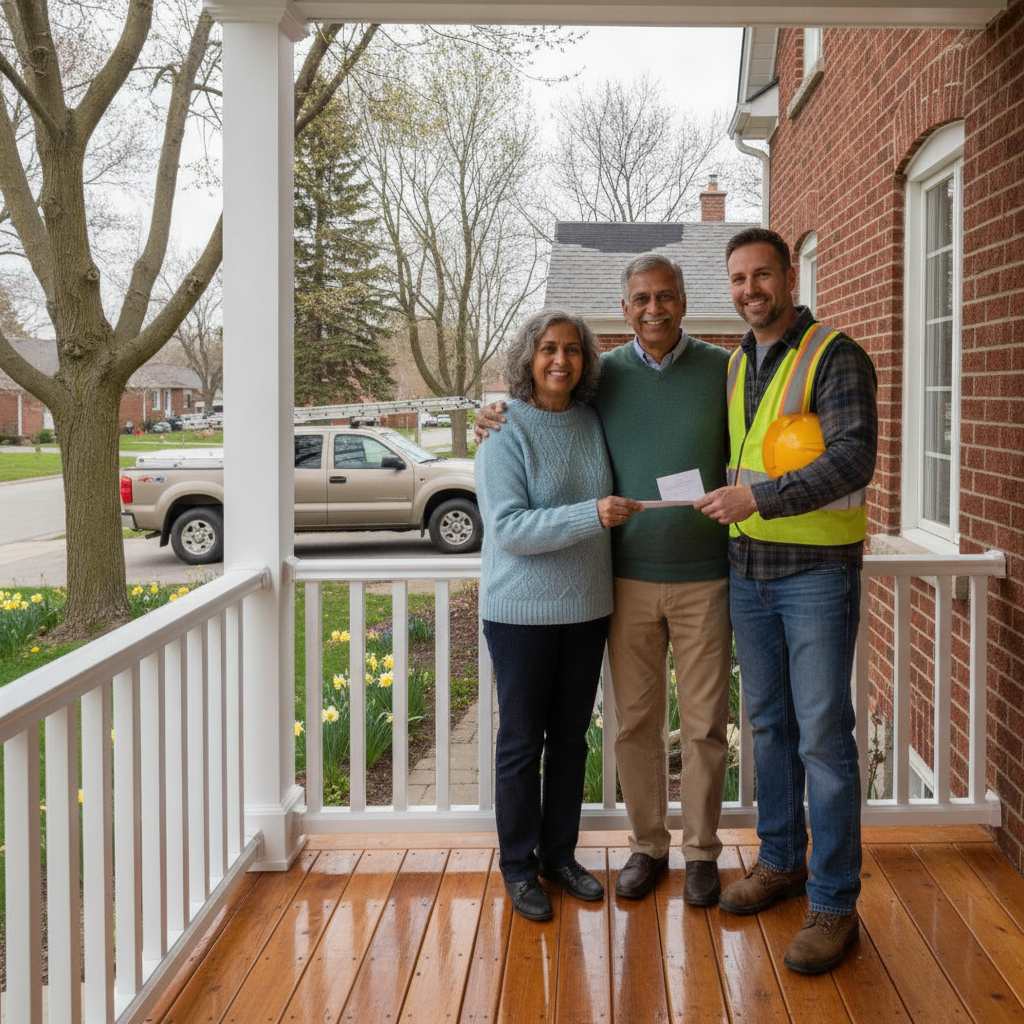
Real Example: The June 2024 Ontario Windstorm
In June 2024, a derecho-strength windstorm damaged thousands of Ontario homes. Typical impacts:
- 68-year-old homeowner in Kingston: Roof 40% damaged, $16,000 deductible. Reverse mortgage provided $20,000, repairs completed in 6 weeks. Cost: $1,200 in reverse mortgage fees + interest.
- 72-year-old couple in Ottawa: Siding replacement + window damage, $22,000 deductible. HELOC application rejected due to age + fixed income. Reverse mortgage approved in 35 days, funded $25,000. Repairs prevented $40,000 in cascade water damage over 18 months.
- 59-year-old widow in Toronto: Roof + gutters + fascia, $18,000 deductible. Delayed 8 months to save, but water infiltration damaged ceiling joists and caused attic mold. Final repair cost: $31,000 instead of $18,000. Reverse mortgage (obtained after damage escalation) funded $35,000.
In each case, immediate reverse mortgage access was cheaper than delayed repair consequences.
Protecting Your Home from Future Storms: A Climate Resilience Plan
Once you repair storm damage, consider upgrading for climate resilience. A reverse mortgage can fund preventive improvements:
- Impact-resistant roofing: +$3,000–$8,000 vs. standard shingles, but rated for winds up to 130+ mph
- Storm-resistant windows: +$2,000–$5,000, rated for hail and high winds
- Reinforced garage door: +$1,500–$3,000, prevents wind pressure from buckling the door inward
- Gutter guards: +$800–$1,500, reduce wind damage to gutters and guttering
Lenders like CHIP and Equitable Bank often approve larger reverse mortgage amounts specifically to cover repairs plus climate upgrades, protecting against future deductible events.
Key Takeaways
✓ Wind and hail deductibles in Ontario now range $10,000–$20,000 (up 60% since 2018), leaving many retirees unable to afford repairs immediately after storms.
✓ Delayed repair creates cascading damage: Water infiltration → mold → structural rot. Six-month delays can double repair costs within 2–3 years.
✓ A reverse mortgage provides immediate, zero-payment access to $15,000–$50,000+ within 4–6 weeks, allowing urgent repairs before secondary damage occurs.
✓ Line-of-credit structures offer flexibility: If additional damage is discovered during initial repair, you can draw more funds without re-application.
✓ Proceeds are tax-free and don't affect CPP, OAS, GIS, or ODSP eligibility—critical for fixed-income retirees.
✓ Long-term cost is lower than HELOC or personal loans because you have zero monthly payments, and compound interest is deferred.
Frequently Asked Questions
Will my home insurance claim be denied if I use a reverse mortgage to pay the deductible?
No. The insurance claim and the reverse mortgage are entirely separate. Your insurer pays their portion; you pay the deductible from any source (reverse mortgage, savings, etc.). Insurers don't care how you fund the deductible.
What if the repair contractor won't wait for the reverse mortgage to fund?
Most contractors will begin repairs immediately if you provide proof of reverse mortgage approval (typically available within 15–20 days). Some will invoice in stages: deposit, mid-project, completion. The reverse mortgage timeline fits this structure.
Can I use a reverse mortgage to pay an insurance deductible and later be reimbursed?
Technically yes, but it complicates accounting. Better approach: have the reverse mortgage fund the contractor directly once appraisal and legal work confirm approval. This avoids you paying the deductible personally and then seeking reimbursement.
Will my home's storm damage affect the reverse mortgage appraisal?
Possibly. If the storm damage occurred before you apply for a reverse mortgage, the appraisal will account for it. Lenders typically still approve (they're lending on the home's underlying value, not the damage). But obtaining the reverse mortgage, repairing, and then selling may be simpler than applying with visible damage.
Is a reverse mortgage or HELOC better for storm deductible funding?
For retirees, reverse mortgage is superior because it has zero monthly payments. HELOC requires ongoing interest payments ($250–$500/month), which strains fixed retirement income. Compare rates from CHIP, Equitable Bank, and HomeEquity Bank for your specific situation.
Can I get a reverse mortgage specifically for storm damage repairs?
Yes. Many lenders approve applications where the stated purpose is home repair. You don't need to justify the reason. Simply state: "Home storm damage repair" as the purpose, and lenders evaluate based on home value and your age.
Get Your Free Ontario Reverse Mortgage Guide
Facing unexpected storm damage and a deductible you can't afford? Discover how a reverse mortgage provides immediate, sustainable funding for critical repairs while protecting your retirement.
Ready to Learn More?
Find out exactly how much you could unlock from your home — free and no obligation.
Related Articles
Reverse Mortgage When Home Insurance Premiums Spike: Protecting Your Coverage in Ontario
Home insurance premiums are skyrocketing in Ontario. Learn how a reverse mortgage can bridge the gap when your insurance costs become unaffordable.
Read →Reverse Mortgage for Disaster Recovery: Rebuilding After Fire, Flood, or Catastrophic Damage
Learn how reverse mortgages provide emergency funding for home rebuilding after fire, flood, severe storms, or other catastrophic home damage in Ontario.
Read →Reverse Mortgage and Deferred Home Maintenance: Catching Up on Repairs
Use a reverse mortgage to fund essential home repairs and maintenance you've deferred—preventing costly damage and maintaining aging in place.
Read →