
Reverse Mortgage for Sandwich Caregiving: Supporting Both Aging Parent AND Aging Sibling Financially
Reverse mortgage strategy for mid-life adults supporting aging parent AND aging sibling. Multi-relative caregiving costs and planning.
You're 62, supporting your 85-year-old mother with assisted living costs AND your 70-year-old brother with disability housing. You thought "sandwich generation" meant parent-and-child caregiving. But you're sandwiched between two older generations with different needs—and your own retirement approaches. A reverse mortgage can fund this complex multi-relative scenario.
The traditional "sandwich generation" model misses an important reality: many mid-life adults support aging parents and aging siblings simultaneously. This post explores reverse mortgages as funding vehicles for this expanded caregiving burden.
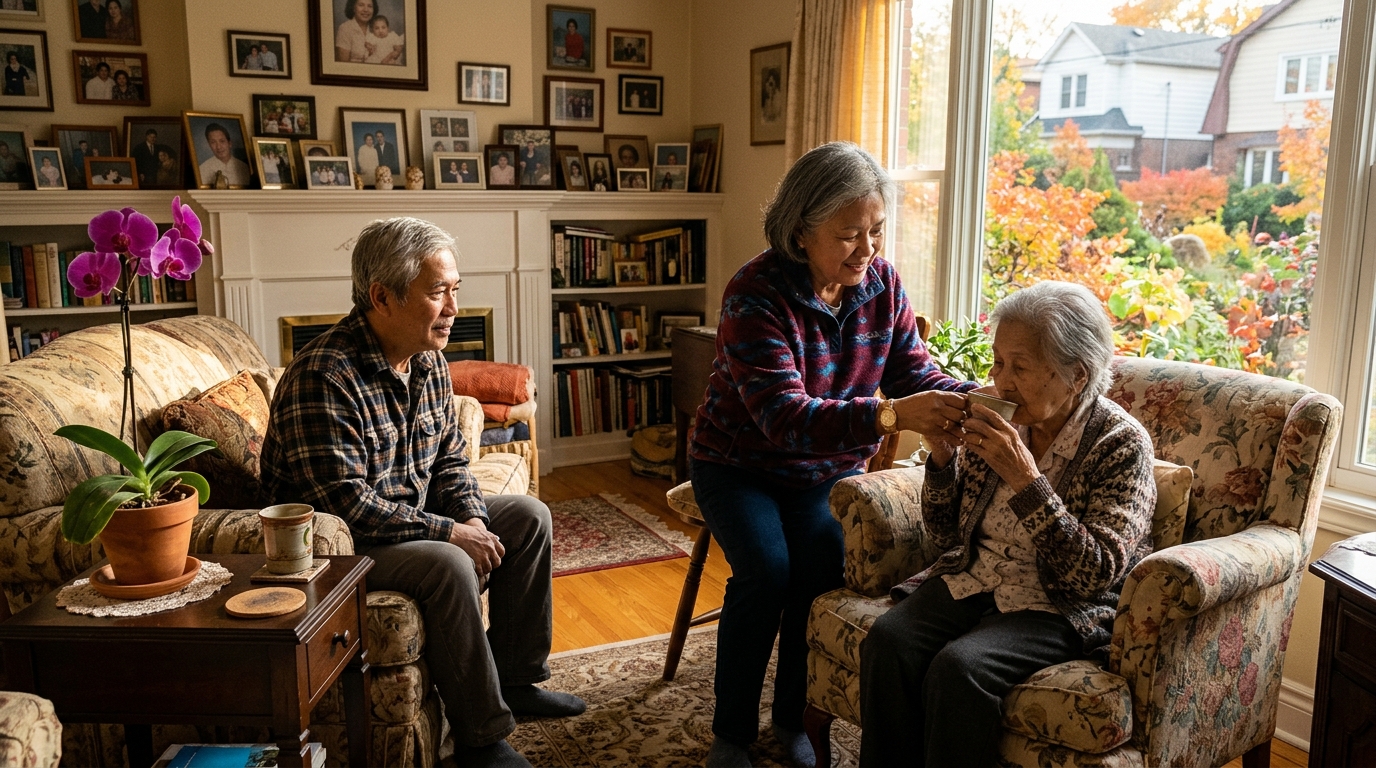
The Three-Generation Sandwich: You, Your Parent, Your Older Sibling
This is the hidden caregiving crisis. Statistics Canada reports that 15% of Canadian adults age 50–65 provide financial support to aging parents and aging siblings. This differs from the standard parent-child sandwich because:
- Your sibling often has disabilities or chronic illness requiring ongoing subsidies (not temporary crises like adult children face)
- Your parent is oldest and most dependent; your sibling is "middle-old" but still vulnerable
- You're the "strong one"—often the only sibling with stable income
- Caregiving extends 15+ years, not the typical 5–10 year parent-focused window
The Three-Generation Financial Model
| Person | Age | Financial Situation | Your Annual Support |
|---|---|---|---|
| Your mother | 85 | Assisted living ($4,000/month = $48,000/year); pension $18,000/year | Gap: $30,000/year you cover |
| Your brother | 70 | Disability, rents ($1,500/month); CPP-D $15,000/year | Gap: $3,000/year you cover |
| You | 62 | Employed, $65,000/year; own home $550,000 | Provide: $33,000/year from your income |
| Total caregiving burden on YOU | — | — | $33,000/year (50% of gross income) |
This is unsustainable. At 62, you have 5–10 years of full employment left. Then what?
Annual Multi-Relative Caregiving Costs: Realistic Breakdown
| Expense Category | Mother (85, Assisted Living) | Brother (70, Disability Housing) | Other Costs | Annual Total |
|---|---|---|---|---|
| Housing supplement | $30,000 | $3,000 | — | $33,000 |
| Medical/therapy | $4,000 | $2,000 | — | $6,000 |
| Medication/equipment | $2,000 | $1,500 | — | $3,500 |
| Incidentals (visits, transport) | $1,000 | $500 | — | $1,500 |
| Your own caregiving: stress, lost income | — | — | $2,000 (conservative) | $2,000 |
| Total Annual Need | $46,000 |
Your current income allocation:
- $65,000 salary
- Pay $33,000 to mother and brother
- Keep $32,000 for your own living (mortgage, food, utilities, healthcare)
- Result: Perpetually tight; no savings, no retirement buffer
Why This Requires a Reverse Mortgage (Not Alternatives)
| Alternative | Why It Doesn't Work | Reverse Mortgage Better Because |
|---|---|---|
| Ask siblings for cost-sharing | Other siblings may be estranged, disabled, or just refuse; you can't force them | You're not asking others; you're accessing your own equity to support your family |
| Personal line of credit / bank loan | Lenders won't approve large loans ($200K+) on $65K salary with caregiving obligations; too risky | Reverse mortgage is secured by home equity; no income qualification needed |
| Downsize your home now | Too early at 62; emotional; reduces safety net and independence | Reverse mortgage lets you stay in your home while accessing equity; downsizing later is an option |
| Ask mother/brother to downsize | Mother's assisted living is already minimal; brother can't manage a move due to disability | Unfair to push them; your home equity is your resource |
A reverse mortgage is the only realistic vehicle for funding 15+ years of multi-relative support while maintaining your own housing security.

Reverse Mortgage Structuring for Ongoing Multi-Relative Support
Strategy: Line of Credit (Not Lump Sum)
For your situation, a reverse mortgage line of credit is ideal—not a lump sum.
Why:
- Mother's needs may change (move to long-term care, unexpected passing)
- Brother's employment or housing situation may improve (less need)
- You have 15–20 years ahead; flexibility is critical
- Interest only accrues on drawn amounts, not the full approved LOC
Scenario at age 62:
- Home value: $550,000
- Reverse mortgage approved: $200,000+ available
- You establish line of credit for $160,000
- Each month, you draw $2,500–$3,000 for mother and brother
- Interest accrues only on what you've drawn (~$30,000–$36,000/year at 6.2%)
Comparison: Lump Sum vs. LOC
| Metric | Lump Sum $160,000 | Line of Credit (draw $30K/year) | Winner |
|---|---|---|---|
| First-year interest cost | $9,920 | $1,860 | LOC (5x cheaper) |
| 10-year interest cost | $127,000 | $28,000 | LOC ($99K savings) |
| Flexibility if needs drop | None; debt sits there growing | Reduce draws; preserve equity | LOC |
| Flexibility if needs increase | Limited; max already drawn | Additional draws available | LOC |
| Simplicity | Simple; done once | Requires discipline; monthly draws | Lump Sum |
Verdict: Line of credit wins for multi-relative caregiving. Your needs are predictable but changing; LOC adapts naturally.
Alternative Strategy: Hybrid (Partial Lump Sum + LOC)
Some caregivers prefer a hybrid approach:
- Draw $60,000 lump sum immediately to pay down mother's immediate assisted living debt (she's 85, may need it immediately)
- Establish $120,000 LOC for ongoing 15-year support
- This covers both immediate crisis and long-term sustainability
Pros:
- Gives mother immediate relief (her debt cleared)
- Maintains LOC for ongoing brother support
- Psychological win: immediate action taken
Cons:
- Interest on full $60,000 from day one
- Less total flexibility than pure LOC model
Government Benefits and Multi-Relative Support
Critical: Does Your Support Trigger Benefit Clawbacks?
For your BROTHER (CPP-D, possibly ODSP):
| Scenario | CPP-D Impact | ODSP Impact | Action Required |
|---|---|---|---|
| You gift $500/month to brother | No impact; CPP-D doesn't care about gifts | CRITICAL: Could disqualify if he's on ODSP (asset limit $40,000) | Structure support as you paying his rent directly to landlord, NOT gifting money to brother |
| You pay brother's rent directly to landlord | No impact on CPP-D | No impact on ODSP (you paid rent, not brother's asset) | CORRECT approach |
| You fund brother's living costs via reverse mortgage | No impact on CPP-D | No impact on ODSP if structured correctly | Ensure reverse mortgage proceeds never reach brother's hands |
According to FSRAO: "Caregivers supporting disabled siblings must be very careful about gift structures. Direct payment to third parties (landlords, service providers) is safe; cash gifts to the disabled person can trigger benefit loss."
For your MOTHER (OAS, possibly GIS):
| Scenario | OAS Impact | GIS Impact | Action |
|---|---|---|---|
| Reverse mortgage draws for mother's care | No impact (not income to you) | No impact (not income to her) | Safe structure |
| You gift lump sum to mother | Potential impact if mother's assets exceed $40,000 threshold | Potential clawback | Discuss with mother's benefits advisor |
| You pay mother's assisted living directly to facility | No impact on either | No impact on either | BEST approach |
Best practice: Pay care providers directly from your reverse mortgage draws. Don't give cash to family members; pay facilities, landlords, and service providers yourself. This avoids any benefit complications.
CPP-D for Your Brother: Does Your Support Affect His?
No. CPP-D is not means-tested. Your financial support doesn't reduce your brother's CPP-D benefits. However, if your brother receives ODSP, it is means-tested, so be careful (see above).
Case Study: Robert, 62, the "Default Caregiver"
The situation:
- Mother Margaret, 85: In assisted living ($48,000/year); pension $18,000/year; Robert covers $30,000
- Brother Peter, 70: Disability, rent ($18,000/year); CPP-D $15,000/year; Robert covers $3,000
- Two other siblings: One lives in BC (estranged), one has their own young family (can't help)
- Robert: De facto sole caregiver by geography and circumstance
- Robert's job: Stable, $65,000/year; 3 years to planned retirement at 65
- Robert's home: $550,000, fully paid
- Robert's retirement plan: Was supposed to retire at 65; now uncertain
The crisis: "I'm 62. I wanted to retire at 65. But mother's assisted living costs might increase (she's declining). Peter's disability might worsen. I'm literally unable to retire as planned because I'm supporting two people on half my income. A reverse mortgage would let me stay employed part-time if I want, and fund their needs without guilt."
Robert's solution:
- Apply for reverse mortgage at 62 (while still employed—easier qualification)
- Establish line of credit for $150,000
- Draw $2,500–$3,000/month ($30,000–$36,000/year) to cover mother and brother
- This covers $33,000 annual caregiving gap, replacing what his salary was supplying
- Now his $65,000 salary goes entirely to his own retirement saving and healthcare
- At 65, he can retire; reverse mortgage LOC funds ongoing caregiving indefinitely
Financial projection to age 85:
- RM draws over 20 years: ~$600,000 total (at $30,000/year)
- RM balance at 6.2% interest: ~$485,000 (accumulated debt)
- Home value at age 82: ~$800,000–$900,000 (1.5% annual appreciation)
- Estate after RM payoff: $315,000–$415,000
- Robert maintained mother and brother's dignity for 20 years AND left substantial inheritance
- Family did not collapse under stress of unequal caregiving ✓
Estate Planning for Multi-Relative Caregivers
When you're supporting multiple older relatives, your will needs clarity about what you intended vs. what actually happened.
Will Provision Example
"I supported my mother Margaret and brother Peter during their later years, funding portions of their housing and care costs via reverse mortgage. These outlays are not characterized as 'loans' and my siblings should not expect repayment from their estates. My remaining estate is distributed equally among my three children, with a note that I prioritized supporting parents and siblings during my earning years."
This prevents confusion post-death and clarifies that your caregiving was a personal choice, not an obligation of your siblings.
Coordination with Reverse Mortgage
| Planning Element | Interaction | Best Practice |
|---|---|---|
| Your will | RM debt is paid from estate at death | Ensure estate has enough liquidity; consider life insurance to cover RM balance |
| Mother's will | If mother predeceases, her assets may pay back some RM costs | Review mother's will; understand what's being inherited |
| Brother's guardianship | If brother is on ODSP with government guardianship, notify guardian of your RM plan | Transparency prevents conflicts; guardian may appreciate knowing caregiving is funded |
| Power of attorney | Name someone to manage your RM if you decline cognitively | Executor needs access to RM account; document how to manage it |
According to FSRAO: "Caregivers supporting multiple older relatives should update their wills and POA documents to clarify that reverse mortgage draws were for others' care, not personal enrichment. This protects your integrity and clarifies your estate's purpose."

Key Takeaways
- Multi-relative caregiving (parent + sibling) costs $30,000–$50,000/year—beyond what one person's salary can sustain long-term without reverse mortgage.
- Line of credit model is ideal for multi-relative support—pay interest only on drawn amounts; flexibility if needs change over 15+ years.
- Pay providers directly, never gift cash to family—avoids ODSP/GIS clawback complications and protects siblings' benefits.
- Apply for reverse mortgage at 62 while employed—lenders prefer active income; approval is faster and easier.
- Update your will to explain caregiving rationale—prevent sibling resentment about inheritance and your lifetime caregiving choices.
- You can still retire at 65—reverse mortgage LOC lets you stop working while continuing family support; independence maintained.
Frequently Asked Questions
If I'm supporting my brother on ODSP, will my financial help disqualify him from benefits?
Only if structured wrong. If you gift him $500/month in cash, yes—his assets exceed the $40,000 limit and he loses ODSP. Instead, pay his rent directly to the landlord, buy his medications, pay for therapy—third-party payments don't count as his assets. Your reverse mortgage draws should go to providers, not to your brother's hands.
What if my mother passes away suddenly and the caregiving burden drops? Do I have to repay the reverse mortgage immediately?
No. The reverse mortgage stays in place. If mother's death means your caregiving costs drop, you simply reduce your monthly draws from the line of credit. The approved LOC remains available; you pay interest only on what you've drawn. No acceleration of repayment.
Should I tell my siblings I'm taking a reverse mortgage to support mother and brother?
Yes, for transparency. A simple conversation: "Mother's assisted living costs exceed her pension. I'm accessing home equity via reverse mortgage to bridge the gap for the next 15+ years. This is my choice; I don't expect repayment from any of you. My will explains this." Most siblings appreciate honesty and won't resent your caregiving choice.
Can I take a reverse mortgage to support my sibling if they're not blood-related (adopted, stepsibling)?
Yes. The reverse mortgage is your financial choice. You can use proceeds for any purpose—supporting adopted or step-siblings is absolutely valid. The lender doesn't dictate who benefits from your home equity.
What if my brother outlives my mother by a decade? Is long-term support sustainable via reverse mortgage?
Yes. A reverse mortgage LOC is sustainable for 20–30 years of draws (as long as you remain in your home). Brother's support at $3,000/year is modest. The real cost driver is mother's assisted living; once she passes, your total caregiving obligation drops dramatically and is easily sustainable from RM LOC remaining balance.
If my brother is on disability benefits and I'm supporting him, does this affect my own OAS or GIS at retirement?
No. Your reverse mortgage draws are not income. Your own CPP/OAS is unaffected by supporting your brother. Your caregiving generosity doesn't reduce your government benefits.
Sandwiched between aging parent and aging sibling? Contact Rick Sekhon Reverse Mortgages to structure a line of credit that funds long-term multi-relative caregiving while protecting your own retirement security. Ontario caregivers deserve solutions that honor their family obligations without sacrificing their independence.
Ready to Learn More?
Find out exactly how much you could unlock from your home — free and no obligation.
Related Articles
Reverse Mortgage When You Previously Gifted Home Down Payment to Adult Child: Reclaiming Equity for Aging in Place
Reverse mortgage strategy when aging in place after gifting down payment to adult child. Recover equity for home modifications and care.
Read →Reverse Mortgage When Supporting Multiple Adult Children With Disabilities: Protecting Long-Term Financial Obligations
Reverse mortgage strategy for aging parents as primary breadwinner for multiple disabled adult children. Secure long-term caregiving costs.
Read →Reverse Mortgage for Adult Child's Emergency Housing After Shared Custody Loss During Separation
Reverse mortgage for aging parent funding emergency housing and legal support when adult child loses custody. Immediate family crisis response.
Read →