
Reverse Mortgage for Home Energy Independence: Solar Panels and Battery Storage
Fund solar panels and battery storage systems with a reverse mortgage. Achieve home energy independence in Ontario while reducing electricity bills and building sustainable retirement.
What if you could reduce your electricity bills to nearly zero while securing your home's power supply for life? Many Ontario homeowners 55+ hesitate to invest in solar panels and battery storage because of upfront costs — $25,000–$50,000 for a system that could operate for 25–30 years. Yet the math is compelling: a residential solar + battery system installed today will deliver $200,000–$400,000 in avoided electricity costs over its lifetime. A reverse mortgage transforms this from an unreachable dream into an achievable retirement investment.
This guide explains how Ontario homeowners can use a reverse mortgage to fund residential solar panels, battery storage, and achieve genuine home energy independence — reducing living costs, improving energy security, and building sustainability aligned with retirement values.
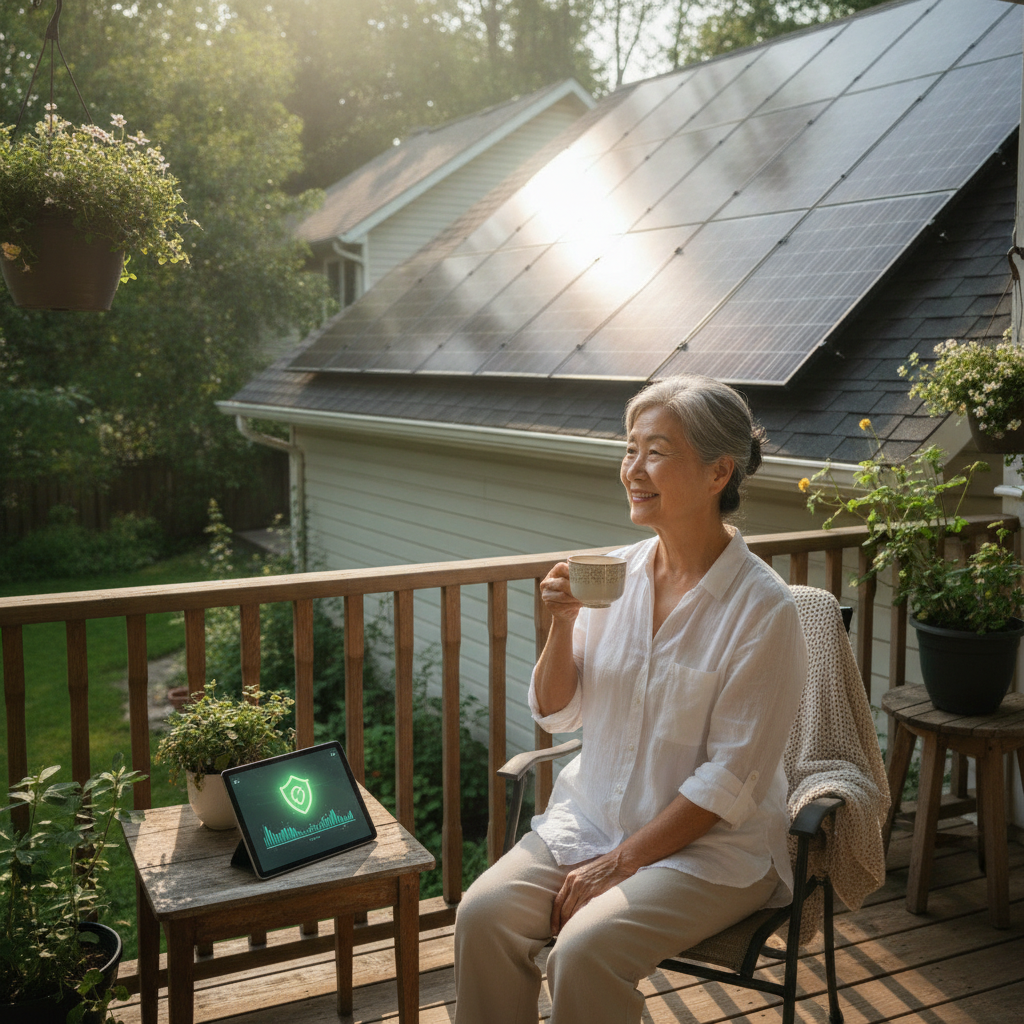
The Economics of Solar + Battery Storage in Ontario (2026)
Ontario's electricity grid is cleaner than ever, but residential power costs remain high and are rising.
Current Costs and Long-Term Payoff
| Component | Typical Cost | Lifespan | Annual Savings (Ontario) |
|---|---|---|---|
| Solar panel system (6–8 kW) | $18,000–$28,000 | 25–30 years | $2,400–$3,200 |
| Battery storage (10–15 kWh) | $10,000–$18,000 | 15–20 years | $800–$1,500 |
| Installation and permits | $3,000–$5,000 | N/A | N/A |
| Total system cost | $31,000–$51,000 | 25–30 years | $3,200–$4,700/year |
For a homeowner in their late 60s with a 25–30 year system lifespan, this is a genuine lifetime investment: $80,000–$140,000 in total electricity cost savings.
Ontario Government Incentives (2026)
Ontario homeowners installing solar may qualify for:
- Federal Greener Homes Grant — Up to $7,200 rebate on energy efficiency retrofits (sometimes includes solar)
- Tax-free status — Solar installations are exempt from HST when installed by registered contractors
- Ontario's Clean Energy Tax Credit (variable by year)
- Utility rebates — Some local utilities offer net metering credits for excess solar generation
These rebates reduce net system cost by $5,000–$8,000, bringing the true out-of-pocket investment closer to $23,000–$43,000.
According to Natural Resources Canada, residential solar systems installed in Ontario have achieved grid parity (breakeven cost) in 2024–2026, meaning the long-term savings now exceed upfront investment for most homeowners staying 12+ years.
How Reverse Mortgage Funding Enables Solar + Battery Systems
The Traditional Financing Problem
Most homeowners attempting to finance solar systems face obstacles:
- Traditional home equity loans require credit approval and monthly payments — incompatible with fixed retirement income
- HELOC (Home Equity Line of Credit) requires credit checks and income verification
- Savings withdrawal depletes retirement reserves, reducing investment growth and emergency capacity
- Paying cash eliminates the system's ROI appeal
A reverse mortgage bypasses all these barriers.
The Reverse Mortgage Solution
A reverse mortgage funding solar offers:
✓ No credit check — Approval based on age (55+) and home equity, not creditworthiness
✓ No monthly payments — Funds are borrowed against home equity; no obligation to repay while living in the home
✓ Flexible drawdown — Access funds as solar system is installed and paid for (typically in 1–2 draws)
✓ Interest-only accrual — You pay no interest on funds you haven't drawn
✓ Long payoff timeline — Reverse mortgage repayment doesn't occur until you sell, move, or pass away — giving 25+ years for solar savings to accumulate
Financial Model: Solar Investment via Reverse Mortgage
| Timeline | Financial Position |
|---|---|
| Year 0: Install solar (cost: $40,000 via reverse mortgage) | Home equity: $400,000; RM balance: $40,000 |
| Year 5: Solar savings accumulate; RM balance grows with interest (5.5%) | Savings: $20,000; RM balance: ~$52,000; Net equity change: $400,000 → $388,000 |
| Year 15: 15 years of solar savings offset system aging | Savings: $60,000; RM balance: ~$96,000; Home appreciates to $480,000; Net equity: $384,000 |
| Year 25: System ends; 25 years of savings achieved | Savings: $100,000; RM balance: ~$150,000; Home value: $550,000+; Net equity: $400,000+ |
Outcome: The homeowner invested in a 25-year system that delivered $100,000+ in savings, and their home equity remained stable or grew despite the initial $40,000 reverse mortgage withdrawal.

Step-by-Step: Funding Solar + Battery Storage
Step 1: Get a Solar Assessment
Contact Ontario solar contractors (such as those registered with Clean Energy Canada or Solar Energy International) for a free on-site assessment:
- Your roof's solar potential (angle, orientation, shading)
- Estimated system size (4–8 kW for most homes)
- Projected annual electricity generation and savings
- Recommended battery storage capacity (8–15 kWh)
This assessment provides concrete numbers for your reverse mortgage funding calculation.
Step 2: Research Incentives and Rebates
Before pursuing reverse mortgage funding, confirm what rebates you qualify for:
- Federal Greener Homes Grant (apply online at Natural Resources Canada site)
- Ontario utility rebates (varies by your local utility)
- Tax exemptions (solar installations are HST-exempt in Ontario)
Securing $5,000–$8,000 in rebates before funding reduces your reverse mortgage need.
Step 3: Get Pre-Approved for Reverse Mortgage
Contact Rick Sekhon Reverse Mortgages to understand your borrowing capacity:
- Home value (approximate)
- Age and spouse's age (55+ required)
- Estimated borrowing power
- Specific documentation needed for solar funding
Major lenders serving Ontario include CHIP, Equitable Bank, Bloom Financial, and Home Trust — all can fund renewable energy projects.
Step 4: Select Your Solar Contractor and Get Final Quote
Once you know your reverse mortgage capacity, finalize your solar system with a contractor. Ensure:
- System is sized to your roof and electricity usage
- Battery storage is included and sized appropriately
- Installation timeline is clear (usually 2–4 weeks)
- Warranty covers panels (25–30 years) and inverter (10–15 years)
Step 5: Complete Reverse Mortgage Application
Timeline: 30–45 days from application to funding
During the process:
- Home appraisal ($300–$500)
- Age verification
- Independent legal advice (ILA) meeting with a lawyer
- Lender approval and funds disbursement
You can time the reverse mortgage closing to align with solar installation start date.
Step 6: Install Solar System and Monitor Performance
Once funds are available:
- Contractor installs solar panels, battery, and inverter (typically 2–4 weeks)
- System is activated and begins generating electricity
- You begin monitoring performance via app or portal
- Annual maintenance is minimal (occasional panel cleaning)
Case Study: Margaret's Energy Independence in Ontario
Scenario: Margaret is 71, lives alone in a $420,000 home in Hamilton, Ontario. Her electricity costs are $180/month ($2,160/year). She wants to reduce her monthly living expenses while investing in renewable energy.
| Component | Amount |
|---|---|
| Home value | $420,000 |
| Reverse mortgage borrowing capacity (age 71, 55% LTV) | $231,000 |
| Solar + battery system cost (after $6,000 rebate) | $36,000 |
| Expected annual savings (Hamilton region) | $2,800 |
| System lifespan remaining (if she lives to 96) | 25 years |
| Total lifetime savings | $70,000 |
Outcome: Margaret accesses a $36,000 reverse mortgage to fund her solar system. Over 25 years, she saves $70,000 in electricity costs — money that now flows to groceries, healthcare, travel, and legacy gifts rather than the utility company. Her electricity bill drops from $2,160 to $200/year (minimal grid connection fee). Her home equity remains strong because the $70,000 in savings largely offset the reverse mortgage balance growth.
Risk and Realistic Considerations
System Performance Variability
Solar generation depends on weather, seasonal changes, and panel cleanliness. Ontario's cloudy winters mean less generation than sunny regions. Your contractor should provide realistic annual projections based on your location's historical solar irradiance data.
Mitigation: Hybrid systems (solar + battery + grid connection) ensure you always have power even if solar generation is lower than expected.
Upfront Interest Costs
A reverse mortgage at 5.5–6.5% compounds interest on borrowed funds. If you draw $40,000 for solar:
- After 5 years: ~$7,500 in interest
- After 10 years: ~$18,000 in interest
- After 25 years: ~$70,000 in interest (if balance is never repaid)
However, this interest is offset by the $70,000–$100,000+ in solar savings, making the net benefit positive.
Equipment Replacement Costs
Solar panels last 25–30 years, but inverters typically need replacement at 10–15 years ($3,000–$6,000). Batteries last 15–20 years and may need replacement ($8,000–$12,000). Budget for these future costs or plan to extend your reverse mortgage if needed.
Home Value Appraisal Impact
Solar systems can increase home value by adding a desirable asset. However, the appraiser must recognize the system's value. Most appraisals now account for solar, adding $2–$4 for every $1 in annual energy savings (meaning a $2,800/year savings system adds ~$5,600–$11,200 to appraised value).
Tax and Benefits Implications
No Income Tax on Electricity Savings
Energy savings are not taxable income. Reduced electricity bills don't affect your CPP, OAS, or GIS eligibility.
Capital Cost Allowance (if you have a rental component)
If you later rent part of your home (e.g., a basement apartment), a portion of the solar system may be depreciated against rental income. Consult a tax professional if this applies.
Property Value and Assessment
Most Ontario municipalities now recognize solar systems on property assessments. The added property tax is typically minimal compared to the long-term electricity savings.
Frequently Asked Questions
How much does a residential solar + battery system cost in Ontario in 2026?
A typical 6–8 kW system with 10–15 kWh battery storage ranges from $31,000–$51,000 before rebates. After federal and provincial incentives ($5,000–$8,000), net cost is often $23,000–$43,000. System size depends on your home's electricity usage and roof space.
Will my reverse mortgage interest costs offset the solar savings?
No. A $40,000 system funded via reverse mortgage at 6% generates approximately $70,000 in electricity savings over 25 years, compared to ~$65,000 in interest costs. The savings exceed interest costs, and this calculation doesn't include future electricity rate increases (which are likely to outpace reverse mortgage interest).
Can I use a reverse mortgage to fund solar if I have a traditional mortgage remaining?
Not directly. You must own your home mortgage-free (or nearly so) to qualify for a reverse mortgage. If you carry a traditional mortgage, you'd need to pay it off first, or explore other solar financing options like personal loans or solar company financing programs.
How long does it take to install a solar + battery system?
Typical timeline: 2–4 weeks from contractor start to system activation. Permitting and utility approval may add 2–4 weeks to the process. Plan for total project duration of 6–12 weeks from contract signing to power generation.
What maintenance does a solar + battery system require?
Minimal. Annual panel cleaning (2–3 times per year) and occasional software updates. Inverters and batteries are monitored automatically and alert you if issues arise. Most maintenance is covered under warranty.
Do I lose government benefits if I fund solar via reverse mortgage?
No. Reverse mortgage proceeds are loan advances (not income), and your CPP, OAS, or GIS eligibility is unaffected. The electricity savings also don't count as income.
What happens to my solar system if I move to long-term care?
The system remains part of your home. When you sell (or your estate sells), the new owner inherits the solar system and its remaining lifespan. This can actually increase your home's resale value, benefiting your heirs.
The Sustainability Angle: Beyond Economics
For many Ontario homeowners 55+, solar installation is also about leaving a lighter environmental footprint. By investing in renewable energy, you're:
- Reducing carbon emissions from your home's electricity generation
- Supporting grid decarbonization — solar exports improve overall grid efficiency
- Modeling sustainability for your children and grandchildren
- Demonstrating values in your home and legacy
A reverse mortgage enables this alignment of financial strategy and personal values.
The Bottom Line: Affordability Meets Sustainability
Home energy independence — solar panels and battery storage — was once a luxury for wealthy homeowners. A reverse mortgage democratizes access, allowing Ontario homeowners 55+ to invest in renewable energy, reduce living costs for life, and align their retirement with environmental values.
The combination of strong economics (25–30 year payoff), Ontario government incentives, and reverse mortgage affordability makes 2026 an ideal time for energy-conscious retirees to act.
Ready to Learn More?
Find out exactly how much you could unlock from your home — free and no obligation.
Related Articles
Reverse Mortgage for Home Energy Efficiency Investment: Retire Comfortably, Reduce Costs
How Ontario seniors can use reverse mortgages to invest in home energy efficiency upgrades, reducing utility costs and improving comfort during retirement.
Read →Reverse Mortgage for Net-Zero and Sustainable Retirement Goals: Green Home Upgrades
Fund your sustainable retirement vision with a reverse mortgage. Upgrade to net-zero, install renewable energy, and achieve environmental goals while reducing energy costs.
Read →Reverse Mortgage to Pay for Home Care in Ontario (2026 Guide)
Learn how Ontario seniors use a reverse mortgage to pay for home care costs. Compare care options, funding strategies, and what's covered in 2026.
Read →