
Reverse Mortgage for Adult Child's Athletic Coaching: Professional Sports Training Business
Fund your adult child's athletic coaching business, certification, and personal training studio with a reverse mortgage. Launch their sports career without debt.
Does your adult child have the coaching talent but lack the startup capital to launch a personal training or athletic coaching business? A reverse mortgage can fund certifications, equipment, studio rental deposits, and marketing—letting them build a sustainable career without personal debt or pressure on your retirement.
Athletic coaching and personal training is a $38-billion North American industry with high earning potential. Yet the path from certification to profitable business typically requires 18–36 months of unprofitable investment. Your home equity can bridge that gap, allowing your child to build their coaching practice while you remain secure in retirement.
Why Athletic Coaching Careers Require Upfront Capital
Unlike salaried positions, coaching and personal training businesses require significant startup investment before revenue flows in:
- Professional certifications: ACE, NASM, CSCS, or sport-specific coaching credentials ($1,500–$5,000)
- Liability insurance: Professional indemnity and client injury coverage ($500–$2,000/year)
- Studio or gym rental deposit: First/last month's rent plus deposits ($3,000–$10,000)
- Equipment and furnishings: Weights, mats, mirrors, cables, cardio equipment ($8,000–$25,000)
- Marketing and branding: Website, social media, personal training ads, local partnerships ($2,000–$8,000)
- Business formation: LLC/corporation setup, accounting software, legal consultation ($1,500–$3,000)
According to the International Sports Sciences Association, 63% of new personal trainers operate at a loss for the first 24 months. A reverse mortgage covers these startup costs while revenue builds.
Capital Requirements by Coaching Niche
| Coaching Type | Startup Costs | Revenue Potential (Year 2) | Reverse Mortgage Need |
|---|---|---|---|
| Personal Training (1-on-1) | $5,000–$15,000 | $30,000–$60,000 | $10,000–$20,000 |
| Group Fitness Coaching | $10,000–$30,000 | $40,000–$80,000 | $20,000–$35,000 |
| Sports-Specific Coaching (youth) | $8,000–$20,000 | $25,000–$55,000 | $15,000–$30,000 |
| Strength & Conditioning Coach | $12,000–$35,000 | $50,000–$100,000 | $25,000–$50,000 |
| Nutrition & Wellness Coaching | $3,000–$10,000 | $20,000–$50,000 | $8,000–$15,000 |
How Reverse Mortgage Funding Works for Coaching Businesses
Unlike traditional small business loans (which require your child to have established income), a reverse mortgage is secured against your home and doesn't depend on your child's credit or business track record.
Line of Credit Structure: Access funds as your child's business needs them. Draw $2,000 for certifications in month 1, $5,000 for studio deposit in month 3, $3,000 for marketing in month 5. You only pay interest on amounts drawn.
Monthly Payment Advantage: Zero required payments until you sell your home or pass away. Your retirement budget stays protected while your child builds revenue.
Lender Options: CHIP, HomeEquity Bank, Equitable Bank, and Bloom Financial all offer flexible draw structures ideal for business launch scenarios.
Reverse Mortgage vs. Traditional Small Business Funding
| Funding Method | Interest Rate | Monthly Payments | Your Child's Debt Obligation | Qualification Ease |
|---|---|---|---|---|
| Reverse Mortgage (your equity) | 5.50–6.50% | None until sale/death | None—parent owes, not child | High (home value only) |
| SBA Small Business Loan | 6.50–9.00% | Yes (3–5 years) | Your child is primary debtor | Medium (requires business plan) |
| Business Line of Credit | 7.00–10.00% | Yes (monthly interest) | Your child is primary debtor | Low (bank-dependent) |
| Crowdfunding | 0.00% (investment) | Dilutes ownership | Investors own stake | Very low (popular concept) |
| Co-Signed Bank Loan | 6.50–8.50% | Yes (your child pays, you guarantee) | Shared liability | Medium (requires both incomes) |
Why reverse mortgage wins: Your child has zero personal debt obligation, no monthly payment pressure on you, and lenders don't require a 3-year business plan or proof of past income.
Case Study: Building a Strength & Conditioning Practice
Daniel, 66, Ontario homeowner, retired from construction
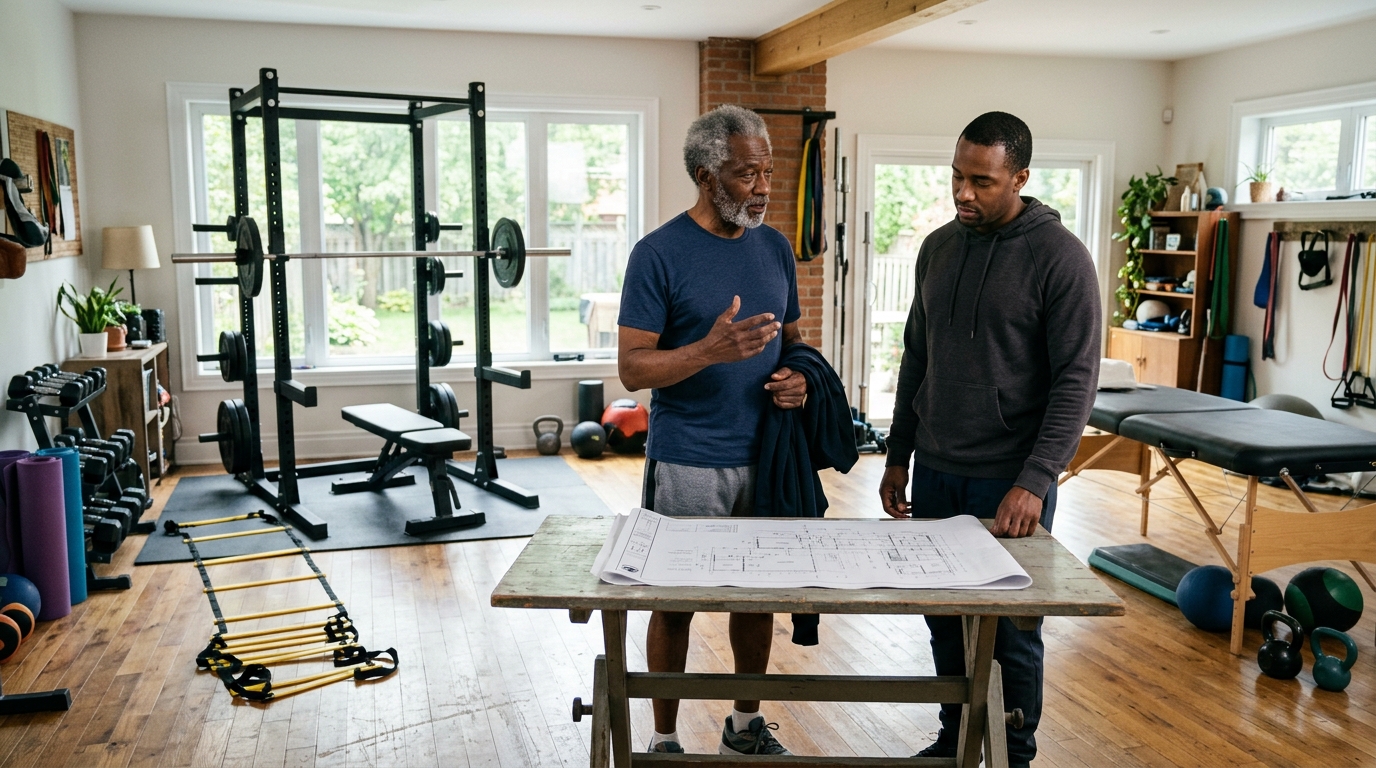
Daniel's adult daughter Emma had her ACE personal training certification and wanted to open a specialized strength and conditioning studio in her local community. Target: become the go-to coach for post-surgical rehab and athletic performance training.
Start-up needs: $35,000 (studio rent deposit + 3 months operating costs, weight equipment, insurance, marketing).
Emma had zero business credit history and only 8 months of freelance training revenue ($800/month). Traditional banks rejected her SBA loan application. Daniel had $320,000 in home equity.
Daniel's reverse mortgage strategy:
- Secured a $50,000 reverse mortgage line of credit with Equitable Bank at 5.95%
- Drew $8,000 upfront for certifications and business legal setup
- Funded $5,500 studio deposit (first month + security deposit)
- Set up automatic $3,500/month draws for rent and payroll for 12 months
- No monthly payments—Daniel's CPP continued unaffected
- Created a family agreement: if Emma's revenue hits $3,000/month, she begins repaying $1,500/month; if revenue drops below $1,500/month, draws pause
Year 1 result: Emma's studio acquired 28 regular clients, generating $2,200/month revenue. Daniel reduced monthly draws to $1,500.
Year 2: Emma's revenue hit $4,200/month. She began repaying $2,000/month to Daniel's reverse mortgage account. By Year 3, she'd repaid $18,000 of the original $42,000 borrowed.
Estate outcome: Daniel's home remains his retirement asset. When he passes, the outstanding RM balance (~$24,000) is paid from his estate, and Emma inherits the home.
Setting Boundaries and Protecting Your Retirement
According to FCAC (Financial Consumer Agency of Canada), 34% of parents who loan money to adult children report conflict when repayment expectations aren't clear. A simple written agreement prevents this entirely.
Essential protections:
-
Family Loan Agreement: State the amount ($X), interest rate (usually 0% for family), repayment timeline, and milestones. Rick Sekhon recommends: "Make this a one-page document signed by both of you. It eliminates ambiguity and protects your relationship."
-
Draw Schedule: Agree on maximum monthly draws to prevent unlimited spending. If Emma needs more, she must ask—you retain control.
-
Revenue Milestones: Tie continued funding to business progress: "If revenue hits $2,000/month, we stay on track. If it drops below $1,000/month for 2 consecutive months, we pause draws and reassess."
-
Repayment Trigger: Define when your child starts repaying you. Many parents say: "After Year 1, if revenue exceeds $X, redirect 30% to repayment."
-
Succession Clause: Clarify what happens if your child's business fails or they decide to exit coaching. Does the debt forgive? Does it become a formal loan to the estate?
Tax and Government Benefits Considerations
Reverse mortgage disbursements are not income: Money you provide to your child is a loan, not taxable income to either of you. CPP and OAS are unaffected.
Your child's business income is taxable: When Emma earns $2,200/month from coaching, that's her taxable business income. She'll need to file business taxes and may owe GST/HST if her revenue exceeds $30,000/year.
Repayments don't create tax deductions: If Emma repays you $2,000/month, that's not a business expense and doesn't reduce her taxable income. However, it's a personal loan repayment, not subject to tax.
Your child's liability insurance is deductible: The cost of professional indemnity insurance is a legitimate business expense Emma can deduct from her taxable business income.
Key Takeaways
- Athletic coaching is a $38 billion industry: Personal training, strength coaching, and sports-specific training have strong earning potential once revenue builds.
- Startup is expensive but time-limited: 18–36 months of unprofitable investment before your child reaches sustainable income ($3,000+/month).
- Zero monthly payments protect your retirement: Unlike co-signing a business loan, a reverse mortgage doesn't require payments and protects your fixed income.
- Your child avoids personal debt: They have zero personal debt obligation; you maintain ownership and control.
- Professional guidance matters: Rick Sekhon can help structure draws to match your child's business milestones.
- Clear agreements prevent family conflict: A simple loan agreement removes ambiguity and protects both generations.
Frequently Asked Questions
What if my adult child's coaching business doesn't become profitable?
You still own your home and the reverse mortgage debt. If the business fails, your child has zero personal debt obligation—the RM remains your debt secured against your home. It rolls into your estate when you pass, and your child inherits what remains after the lender is paid.
Can I require my child to repay me from the coaching business profits?
Yes, if you document it in writing. Create a family loan agreement stating repayment begins when revenue hits a specific threshold (e.g., $3,000/month) and specify the monthly repayment amount. This is legally enforceable between family members and creates accountability.
How does a reverse mortgage affect my CPP, OAS, or GIS?
A reverse mortgage disbursement is a loan, not income. CPP and OAS are unaffected. If you're on Guaranteed Income Supplement (GIS), consult FCAC because GIS has asset limits that may impact your eligibility. Generally, the reverse mortgage itself doesn't reduce GIS, but the home equity already counted against you.
What if my child wants to scale the business beyond my original loan amount?
If the business succeeds and Emma needs $20,000 more for a second location, she can now qualify for her own business loan (she has 2+ years of revenue history). Your reverse mortgage has done its job: bridged the startup gap. She can then access traditional financing independently.
Are there tax deductions for me as the lender?
No. You're not running a lending business, so there are no tax deductions. If you charge Emma interest, you'd need to report that as income (most families charge 0%). Consult a CPA if you want to formalize interest-bearing terms.
Can I get a reverse mortgage if my home has a mortgage?
Yes. The lender will pay off your existing mortgage from the reverse mortgage proceeds, and you'll owe the balance on the reverse mortgage. This works well: you eliminate a monthly mortgage payment (protecting your retirement budget) while accessing funds for your child's business.
Ready to fund your adult child's athletic coaching career? Contact Rick Sekhon Reverse Mortgages for a no-cost consultation on structuring equity access for small business launch.
Ready to Learn More?
Find out exactly how much you could unlock from your home — free and no obligation.
Related Articles
Reverse Mortgage for Adult Child's Veterinary Technology Program and Career Support
Fund your adult child's veterinary technician or vet assistant certification program. Support their healthcare career without student loans or personal debt.
Read →Reverse Mortgage for Adult Child's Renewable Energy and Solar Technician Certification
Fund your adult child's solar and renewable energy technician certification. Support a green careers transition without personal student debt. Fast-growing, high-earning field.
Read →Reverse Mortgage for Aging Parent's Home-Based Pottery and Ceramic Art Studio Business
Launch a home-based pottery business in retirement. Fund kiln, wheel, supplies, and studio setup with reverse mortgage. Create art, income, and community in your home.
Read →