
Funding Your Deferred Dream: Reverse Mortgage for Completing Your University Degree
Never too late to finish. Reverse mortgage funding for aging parents completing college/university education and career certification in retirement.
You spent 50 years putting everyone else's education first. Now, at 65, you finally want to finish your degree — but the tuition terrifies you. A reverse mortgage can unlock the home equity you've built to fund the credential that could change your retirement income and sense of purpose.
The Unfinished Degree: A Growing Trend for Older Canadians
Across Ontario, more seniors are returning to university — not for "enrichment," but to complete a degree interrupted by life circumstances. Whether you dropped out in 1985 to raise kids, changed careers three times, or were told "girls don't study engineering," the unfinished degree represents 40+ years of untapped potential.
Statistics Canada reports that 12% of Canadian adults ages 60+ are engaged in formal education. Many are completing credentials left hanging from youth.
The financial barrier: A bachelor's degree in Ontario costs $6,000–$15,000/year for tuition alone (plus books, housing if needed, lost income). For a senior on a fixed pension, this is impossible without help.
The opportunity: Your home equity can fund this — and the degree itself might increase your retirement income or consulting opportunities.
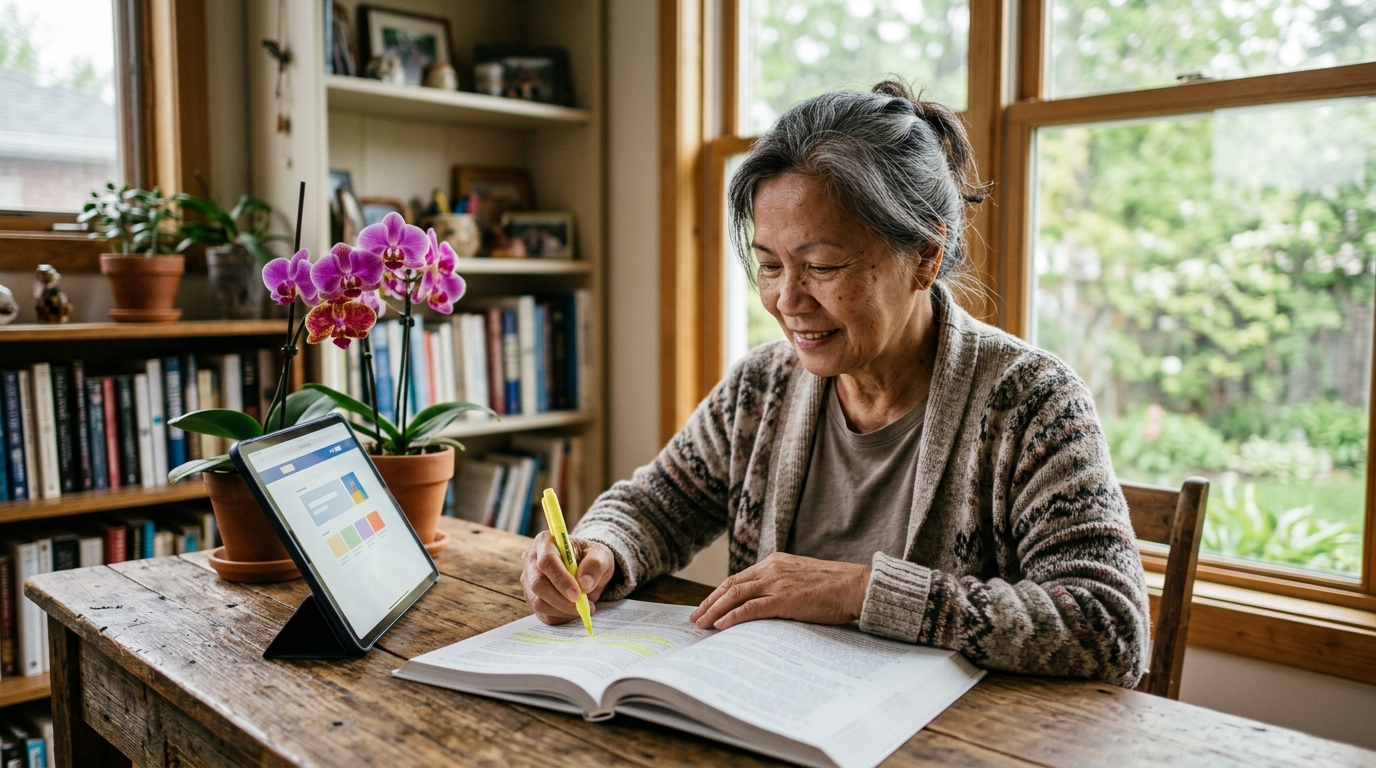
Why Aging Adults Are Returning to School
The reasons vary:
- Credential gap: You've worked 40 years in a field but never got the official degree. Your experience has value, but employers or clients want the paper.
- Passion deferred: You always wanted to study philosophy, history, environmental science. Retirement is finally your chance.
- Career transition: You're retiring but want to teach, consult, or work part-time in a new field that requires credentials.
- Sense of completion: Psychologically, finishing what you started — even at 68 — matters. It's about dignity and achievement.
According to CMHC research on aging-in-place and life satisfaction, seniors who pursue meaningful goals (including education) report higher engagement and life satisfaction. Education completion is correlated with better mental health outcomes in retirement.
The True Cost of Deferred Degrees in Ontario
Here's what a typical aging student faces:
| Scenario | Tuition (2 yrs) | Books/Tech | Residence (if needed) | Lost Part-Time Income | Total Cost |
|---|---|---|---|---|---|
| Part-time, commuting | $10–14K | $2K | $0 | $4K (opportunity) | $16–20K |
| Full-time, living on campus | $15–20K | $3K | $18K | $15K (foregone work) | $51–56K |
| Online/hybrid degree | $12–16K | $1.5K | $0 | $2K | $15–19K |
| Certification program (1 yr) | $5–8K | $1K | $0 | $0 (evening/weekend) | $6–9K |
For someone on a $30K pension, financing even the cheapest option ($16K) requires a loan they can't service.
A reverse mortgage solves this without debt service payments.
How a Reverse Mortgage Funds Your Education
A reverse mortgage accessed as a lump sum can pay tuition upfront. Here's the math:
Example: Michael, 66, Ottawa
- Home value: $475K
- Available equity: ~$190K
- Reverse mortgage lump sum (at 5% rates, 2026): $95K approved
- Cost: Tuition for 2-year part-time degree + books + tech
Michael uses $18K for his education, keeps the rest as an emergency fund. The reverse mortgage interest compounds at ~5%/year on the amount borrowed. In 10 years, the total owed is roughly $29K on the $18K borrowed — manageable if Michael's home appreciates (typical Ontario: 3–4%/year).
The degree allows Michael to launch a consulting side business, earning $8–12K/year in retirement. It pays for itself within 3–4 years.
Key Takeaways
- Ontario universities and colleges welcome mature students; many offer accelerated and online options for working adults
- A reverse mortgage can provide $15K–$50K+ without monthly payments during your study years
- The loan doesn't come due until you move or pass away (if you have a home)
- Completing a degree can improve mental health, sense of purpose, and retirement income potential
- Unlike student loans, reverse mortgage proceeds are NOT counted as income for government benefits (per CRA)
Real Story: Sandra's Comeback
Sandra, 68, London, Ontario
Sandra left nursing school in 1982 to raise three kids. By the time her youngest graduated high school, she'd built a 35-year career as a medical office administrator — good income, good benefits. But no degree. Healthcare employers began asking: "Do you have your diploma?" Not her experience. Her diploma.
At 67, Sandra wanted to retire but felt unfinished. She also wanted to teach part-time at a nursing college — a dream that required an official nursing credential.
The problem: Re-entering a 4-year nursing program at 68 was unrealistic. But a 2-year RN to BScN bridging program was available. Cost: $16K tuition + $3K for books and technology.
Sandra's pension: $2,200/month. She couldn't afford to borrow $19K on a traditional student loan (income too low) or take a home equity line of credit (banks required her adult child to co-sign, which she refused to ask).
The solution: A reverse mortgage approved for $80K lump sum. Sandra accessed $19K for her degree, kept the rest as a safety net.
Result: Sandra completed her degree at 70, got her RN credential, and now teaches part-time at Fanshawe College ($400/class, 2–3 classes per semester). Her "extra" income: $3,200/year, which offsets the reverse mortgage interest and funds her grandchildren's education.
More importantly, Sandra feels complete.
Choosing Your Program Wisely
Not all degrees are equal for aging students. Consider:
| Program Type | Duration | Cost | Career Upside | Best If |
|---|---|---|---|---|
| Bachelor's (full-time) | 4 years | $20–50K | High (new career) | You want major transition |
| Part-time degree (evening/weekend) | 4–6 years | $18–35K | Medium (credential upgrade) | You want to keep working |
| Diploma/certificate (1–2 years) | 1–2 years | $6–15K | Medium (niche skills) | You want specific credential |
| Online bachelor's | 2–3 years | $14–28K | Medium–High (flexible) | You prefer independence |
| Professional designation (CPA, PMP, etc.) | 1–2 years | $8–20K | High (consulting income) | You have work experience |
The best choice for aging adults is usually a professional designation or credential that leverages existing experience and can be completed in 1–2 years. The ROI (return on investment) is faster, and the income potential is higher.
Frequently Asked Questions
Will my reverse mortgage affect my student loans or eligibility for grants?
Reverse mortgage proceeds are personal loans against your home, not income. They won't affect student loan eligibility or grants for low-income students. However, if you're applying for grants based on financial need, the reverse mortgage lump sum might be counted as a "liquid asset." Verify with your school's financial aid office before applying.
Can I get a reverse mortgage specifically for education, or must I use it for other purposes?
You can use a reverse mortgage lump sum for ANY purpose, including education. Lenders (CHIP, HomeEquity Bank, Equitable Bank) don't restrict how you use the money. However, the loan is tied to your home, so if you must move for any reason before the degree is complete, you'll owe the balance.
What if I don't finish the degree?
The reverse mortgage obligation continues regardless. If you complete 1 year of a 2-year program and then stop, you still owe the full amount borrowed, plus accumulated interest. Make sure you're genuinely committed before proceeding. Many older students find evening programs or online options more sustainable than full-time study.
Will completing a degree affect my OAS or GIS eligibility?
No. OAS and GIS eligibility is based on age, residency, and income thresholds. The reverse mortgage itself doesn't create "income" for these programs. However, if your new degree leads to earning part-time consulting income, THAT income could affect GIS. Plan accordingly with your accountant.
Are there scholarships or bursaries for older students?
Yes, many. Organizations like AARP Canada, various provincial governments, and individual universities offer programs for mature and returning students. Search "mature student scholarships Ontario" to find programs specific to your age and field of study. These can reduce the amount you need to borrow.
How do I explain a reverse mortgage on a mortgage application if my adult child wants to buy a home?
A reverse mortgage on your property won't affect your adult child's mortgage application, as it's YOUR debt, not theirs. However, it WILL reduce the home equity available to them as inheritance, which might matter for estate planning. Discuss this with your adult children before proceeding.
Taking the First Step
Completing your degree isn't frivolous or self-indulgent — it's claiming the future you deferred for 40+ years.
Talk to an education advisor at your preferred Ontario university or college. Explain that you're a returning mature student and want to understand program options for adults. Many schools have specific pathways and cohorts for students like you.
Then, speak with a reverse mortgage specialist (Rick Sekhon Reverse Mortgages offers consultations) to clarify: How much equity can you access? What would monthly interest costs look like? Is a lump sum or line of credit better for your situation?
Your home equity is yours. Your unfinished degree is your dream. This is the time to merge them.
Ready to Learn More?
Find out exactly how much you could unlock from your home — free and no obligation.
Related Articles
Reverse Mortgage for Online Course Instruction and Academic Teaching: Building a Digital Education Business in Retirement
Teach online courses for universities, platforms, or direct students. Create scalable digital content; reverse mortgage funds setup, platform development, and marketing.
Read →Reverse Mortgage to Fund Adult Child's Acting and Film Career: Building a Performance Dream
Help your adult child pursue professional acting with a reverse mortgage. Fund headshots, coaching, and early career breaks while keeping home equity liquid.
Read →Reverse Mortgage for Home-Based Craft Distillery and Artisan Spirits Production
Launch a licensed craft distillery from home. Fund equipment, licensing, and inventory with a reverse mortgage to build a premium spirits legacy business.
Read →