
Reverse Mortgage for Widow Caring for Adult Child: Managing Dual Roles
Navigate the financial pressure of widowhood while supporting an adult child. A reverse mortgage bridges dual family obligations in Ontario.
What happens to your finances when you become a widow AND need to support an adult child? Widowhood is a financial crisis on its own—you lose spousal income, face increased living costs, and must navigate CPP survivor benefits that may be lower than your household's previous combined income. But for many widows in Ontario, the crisis deepens: their adult child becomes dependent at exactly the wrong moment. Perhaps the child loses their job during the widow's grief. Perhaps the child has disabilities and relied on the late spouse's income to help with support costs. Perhaps the widow must take on direct caregiving for an adult child while managing her own grief and changed financial situation. A reverse mortgage can bridge both obligations—maintaining the widow's housing security while supporting the adult child through this critical transition.
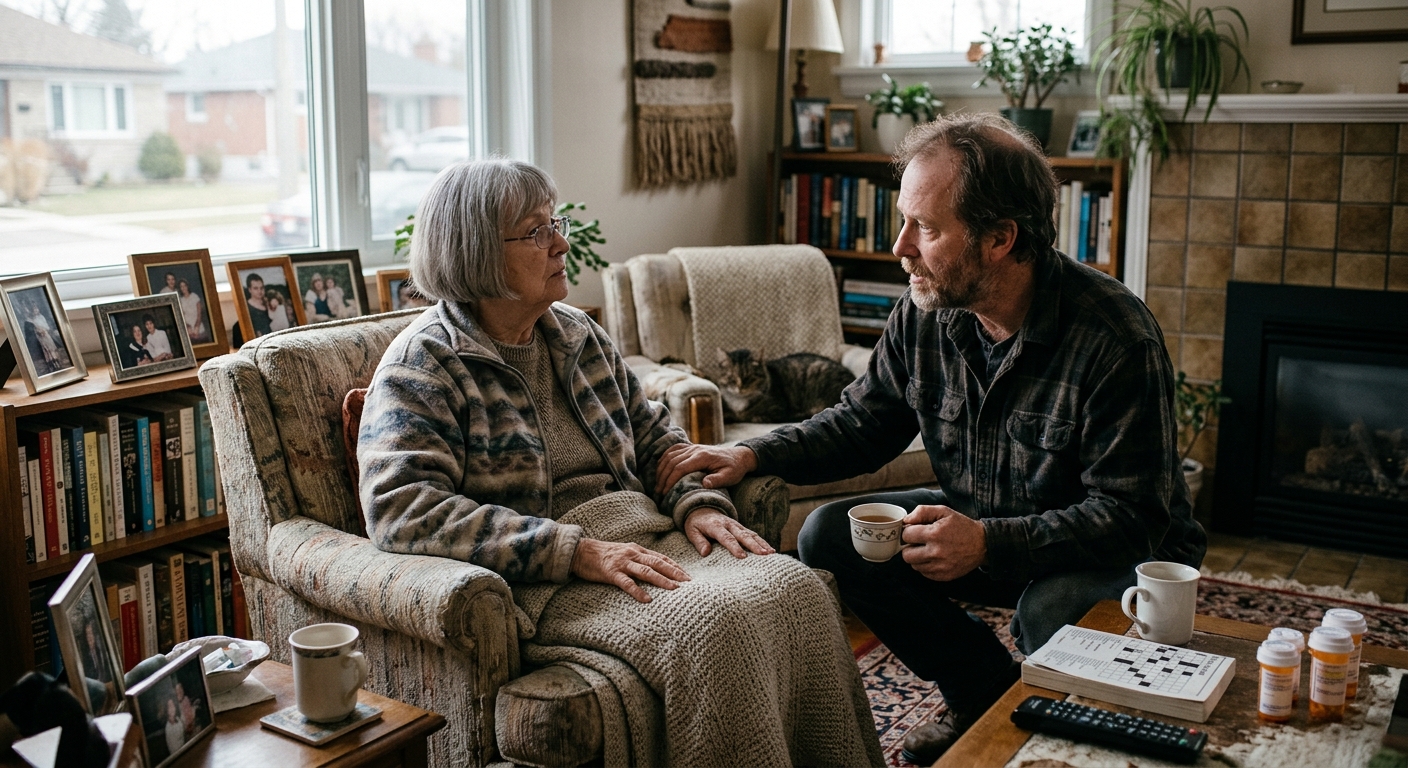
The Widow-Plus-Adult-Child Crisis
Widowhood creates an immediate financial shock, and adding adult child support amplifies it:
Immediate widowhood impacts
| Income Change | Amount | Impact |
|---|---|---|
| Loss of spouse's CPP | $12,000–$18,000/year | 30–40% of household income gone |
| Loss of spouse's pension or employment income | Variable ($30K–$60K) | May eliminate household's primary earner |
| CPP survivor benefit received | $6,000–$12,000/year | Partial replacement, not full income |
| Loss of spouse's health benefits | $200–$500/month | Widow must purchase private coverage |
| Increased household costs | $200–$400/month | Grief support, therapy, legal/estate costs |
| Net monthly impact | –$1,500–$3,000 | Severe cash flow crisis |
For many widows, this income shock means:
- Cutting essential healthcare (can't afford private health insurance or medications)
- Delaying home repairs (aging-related maintenance ignored)
- Losing housing security (can't afford mortgage payments or property taxes alone)
When adult child support adds to widow's burden
If the widow must simultaneously support an adult child:
| Support Scenario | Monthly Cost | Annual Impact | Combined with Widowhood |
|---|---|---|---|
| Adult child job loss; temporary support | $500–$1,000/month | $6,000–$12,000 | Total shortfall: $22,000–$39,000/year |
| Adult child disability; ongoing caregiving | $800–$1,500/month | $9,600–$18,000 | Total shortfall: $27,600–$39,000/year |
| Adult child mental health crisis; housing | $1,000–$2,000/month | $12,000–$24,000 | Total shortfall: $27,000–$48,000/year |
| Widow becomes caregiver; loses own work ability | $0–income loss | $15,000–$30,000 lost | Total shortfall: $30,000–$60,000/year |
For a widow on CPP + survivor benefits ($24,000–$30,000 annually), a $30,000–$60,000 annual shortfall represents a 100–200% increase in required spending. Without intervention, the widow faces forced home sale or dependent neglect.
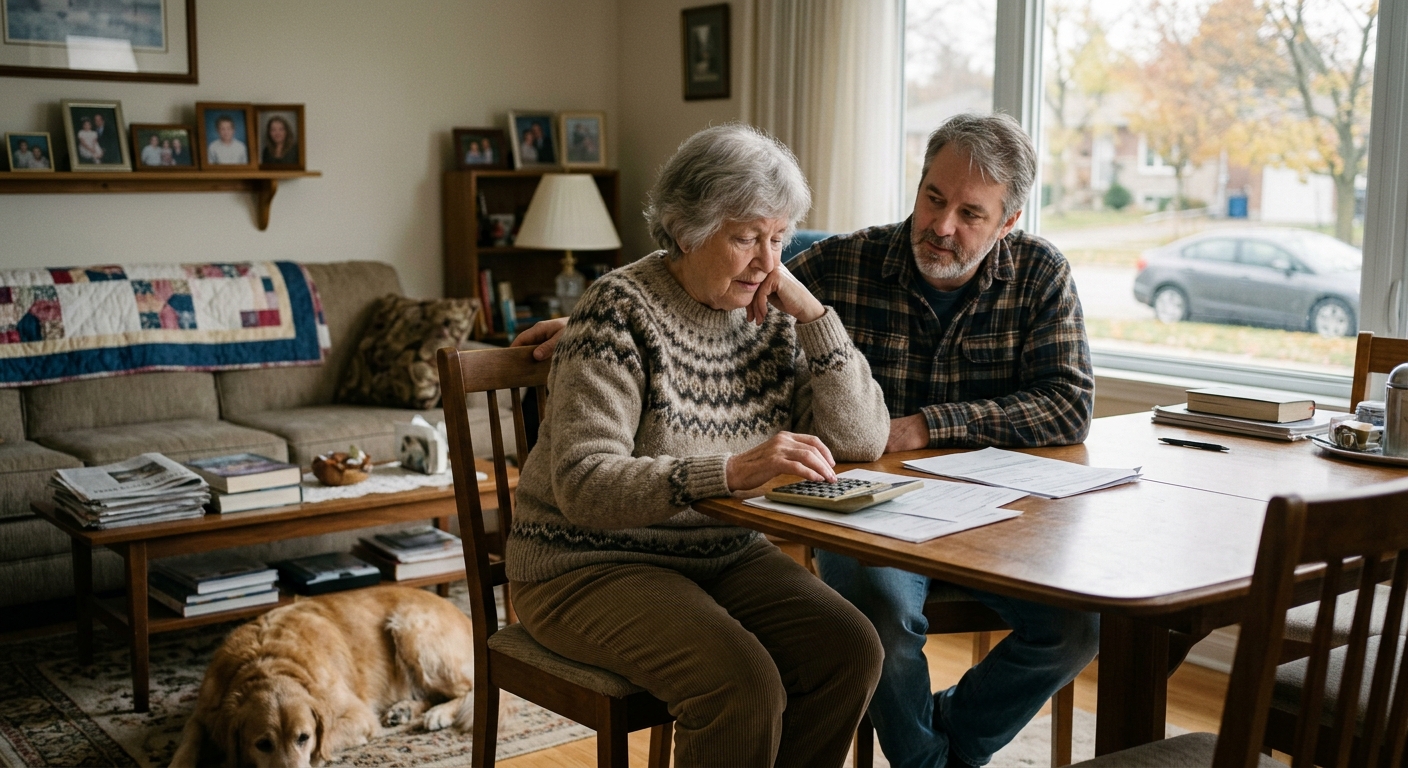
Reverse Mortgage as Dual-Role Financial Bridge
A reverse mortgage lets a widow maintain her housing security while supporting an adult child through crisis. It bridges both obligations simultaneously:
How it works: Income replacement + adult child support
Scenario: Sarah becomes a widow at 68. Her late husband's pension ($24,000/year) and his CPP contribution to household income ($18,000/year) = $42,000 lost annually. Sarah receives widow's CPP benefits ($10,000/year), reducing net loss to $32,000/year. Meanwhile, her adult son Marcus loses his job; Sarah must help with his housing ($1,200/month = $14,400/year) while he retrains.
Total gap: $46,400/year ($32,000 from widowhood + $14,400 adult child support)
Sarah's situation:
- Own CPP: $18,000/year
- Widow's CPP: $10,000/year
- Combined retirement income: $28,000/year
- Required living expenses + Marcus support: $74,400/year
- Shortfall: $46,400/year (~$3,867/month)
Without reverse mortgage: Sarah must either:
- ✗ Sell her home (loses housing security, community, family home)
- ✗ Reduce Marcus's support (he becomes homeless or moves away; relationship fractures)
- ✗ Return to work (physically impossible due to arthritis; emotionally impossible due to grief)
- ✗ Ask adult children for financial help (emotional burden, family dynamics stress)
With reverse mortgage: Sarah accesses a $180,000 reverse mortgage against her home equity. Strategy:
- $2,000/month draws for 3 years (Marcus's retraining period) = $72,000
- $1,500/month draws for 2 years (post-retraining, partial support) = $36,000
- Remaining balance: $72,000 for future care, emergencies, aging costs
Outcome: Sarah maintains her home, bridges her widowhood income loss, AND supports Marcus through retraining. When Marcus re-enters workforce, draws reduce. When Sarah eventually passes or moves to long-term care, the reverse mortgage is repaid from home sale proceeds or estate. Marcus's inheritance is not compromised; it's simply accessed earlier via RM draws rather than waiting until Sarah's death.
Real-world example: Widow + caregiver adult child
Jennifer, 72, is widowed after 45 years of marriage. Her late husband Mark earned $55,000/year as a retiree (consulting). Jennifer's own pension is modest ($18,000/year). Together they lived on $55,000–$65,000/year. After Mark's death:
Jennifer's income:
- Own pension: $18,000/year
- Widow's CPP: $12,000/year
- OAS (age 72): $19,000/year
- Total: $49,000/year (compared to $65,000 when Mark was alive)
- Shortfall: $16,000/year
The complication: Jennifer's adult daughter Emma (40, disabled from birth) lived independently with support from Mark's income. After Mark's death, Emma can't afford her apartment alone. She moves in with Jennifer, requiring:
- Accessible bedroom renovation ($15,000)
- Ongoing care support ($400/month = $4,800/year)
- Medical expenses + mobility equipment ($1,000/year)
- Transportation assistance ($2,000/year)
Emma's total cost: $22,800/year
Jennifer's new total need: $38,800/year shortfall ($16,000 from widowhood + $22,800 from Emma's care)
Reverse mortgage solution: Jennifer accesses $140,000 in reverse mortgage funds:
- $15,000 lump sum for Emma's bedroom renovation
- $2,000/month draws ($24,000/year) for Emma's ongoing care
- Remaining $101,000 for future aging-in-place modifications, healthcare, long-term care bridge
Outcome: Jennifer and Emma stay in their home together. Emma receives necessary support without becoming a financial burden on other family members. Jennifer's remaining reverse mortgage balance ($64,000 after 3 years of draws) is still far below her home's equity, preserving Emma's eventual inheritance. Jennifer's dignity is maintained; Emma's safety and care are secure.
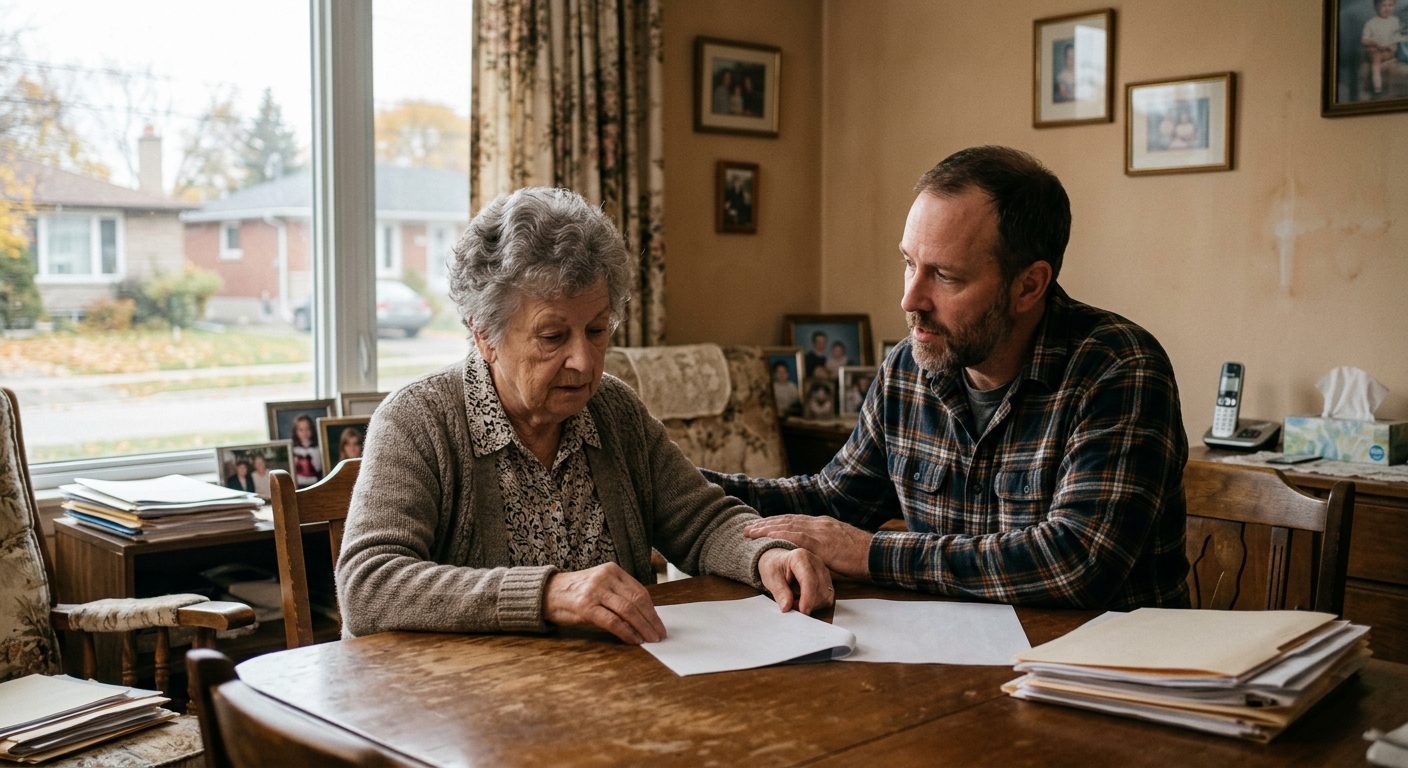
Widow Finances: CPP, OAS, and Survivor Benefits
Understanding widow's benefits is crucial for reverse mortgage planning.
| Benefit | Description | Typical Amount | Widow Eligibility |
|---|---|---|---|
| Survivor's CPP | Portion of deceased's CPP transferred to widow | 60–100% of spouse's amount ($8K–$18K/year) | All ages at death; amount depends on widow's own CPP |
| CPP Death Benefit | One-time lump sum to estate | Max $2,500 | Automatic; claimed through CRA |
| OAS Allowance (Widow/Widower) | Special benefit for low-income widow 60–64 | Up to $18,000/year | Spouse deceased after 55 |
| GIS Widow Benefits | Guaranteed Income Supplement for widow 60–64 | Variable (asset/income tested) | Low-income only |
According to Service Canada, widow's benefits are complex and often underutilized. Many widows don't apply for all benefits they're entitled to, or they receive incorrect amounts. A consultation with Service Canada is recommended within 6 months of spouse's death.
Critical tax consideration for widow's CPP:
When a widow receives her late spouse's CPP, the amount depends on her own CPP entitlement:
- If widow has zero CPP contributions: She receives full survivor's benefit (up to 100% of spouse's amount)
- If widow has high CPP contributions: She receives reduced survivor's benefit (offset by her own contributions)
This affects widow's total retirement income planning. A reverse mortgage can compensate if widow's CPP entitlement is low.
Reverse Mortgage vs Other Widow Support Options
When facing dual widowhood + adult child support, widows have limited options:
| Option | Capital | Adult Child Impact | Widow Housing Security | Timeline |
|---|---|---|---|---|
| Reverse mortgage (LOC) | $100K–$200K | Provides ongoing monthly support | Home preserved | 2–3 weeks to access |
| Downsize/sell home | $200K–$400K | Provides lump sum for adult child | Lose home; relocate | 3–6 months |
| Return to work (part-time) | Wages $1,500–$2,500/mo | Income may be insufficient for both | Home preserved if possible | Immediate but physically risky |
| Ask adult children for help | Variable | Shifts burden to other children | Dependent on goodwill | Uncomfortable; may damage relationships |
| Liquidate savings/investments | $50K–$150K | One-time injection | Home preserved temporarily | Immediate but depletes reserves |
| Borrow from family/friends | Variable | Relationship-dependent | Home preserved | Days–weeks; relationship risk |
Reverse mortgage is the strongest option for widow + adult child support because:
- ✓ Provides ongoing income (not one-time capital)
- ✓ Preserves home (widow's emotional and financial security)
- ✓ No monthly repayment pressure (widow on fixed income can't afford debt service)
- ✓ Flexible draws (match widow's actual needs month-to-month)
- ✓ Transparent to adult child (no hidden financial dependence or shame)
Key Takeaways
✓ Widowhood creates $16,000–$32,000 annual income loss (spouse's CPP, pension, wages eliminated), leaving many widows 30–50% below pre-death household income
✓ Supporting an adult child during widowhood amplifies the crisis — widow may face $30,000–$60,000 combined annual shortfall, forcing home sale or dependent neglect without intervention
✓ Reverse mortgages provide ongoing monthly draws ($1,500–$2,500) bridging both widowhood income loss AND adult child support simultaneously
✓ Widow's CPP benefits are complex and often underutilized — consult Service Canada within 6 months of spouse's death to ensure all benefits are claimed correctly
✓ Reverse mortgage funds are tax-free and don't affect OAS/GIS eligibility, making this the cleanest way to bridge widow's income gaps
✓ Adult child lives with widow and receives necessary support — rather than being forced into independence or burdening siblings — preserving family relationships and dignity
Frequently Asked Questions
Will accessing a reverse mortgage affect my widow's CPP or other benefits?
No. Reverse mortgage proceeds are loan advances, not income. According to the CRA, widow's benefits (CPP, OAS, GIS) are unaffected by reverse mortgage draws. The only caveat: if your total household income (from all sources) is very high, it might trigger OAS clawback, but this is rare for widows.
What if my adult child's situation improves and they become independent?
Excellent. You can pause or stop reverse mortgage draws immediately. No penalties for early repayment. As your adult child's income stabilizes, your monthly draws can reduce or cease, extending your reverse mortgage reserves for your own aging-in-place needs.
Can I name my adult child as a co-borrower on the reverse mortgage to explain the funds?
Typically no. Reverse mortgages are secured against your home; having a non-homeowner co-borrower complicates the mortgage. However, you can gift draws to your adult child or simply explain the reverse mortgage to them (transparency is healthier than secrecy). The reverse mortgage is your financial tool; how you use proceeds is your decision.
If my adult child lives with me and I move to long-term care, what happens to their housing?
The reverse mortgage becomes due when you move to long-term care. Your home is typically sold, and reverse mortgage balance is repaid from sale proceeds. If your adult child is living with you, they would need to relocate (emotional challenge). However, reverse mortgage funds could have been allocated toward securing your adult child's future housing before you move to care. This is a reason to plan proactively: use reverse mortgage to establish your adult child's housing security before you enter long-term care.
Should I delay CPP to age 70 as a widow?
Depends on your health and adult child's needs. Early CPP (60–62) gives you lower lifetime benefits but higher immediate cash flow (useful if you're supporting adult child now). Delayed CPP (70) gives +36% lifetime benefits but requires surviving on reverse mortgage draws for 5–8 years. Most widows with adult child obligations take CPP earlier (62–65) and use reverse mortgage for the income gap to age 70.
Are there widow-specific reverse mortgage programs in Ontario?
No formal "widow programs," but Rick Sekhon Reverse Mortgages and lenders like CHIP, HomeEquity Bank, and Equitable Bank recognize widow scenarios as common and straightforward. Simply explain your situation (widowhood, adult child support) during application. No discrimination; straightforward underwriting.
Ready to explore reverse mortgage options for your widow's situation? Get your free Ontario Reverse Mortgage Guide →
Ready to Learn More?
Find out exactly how much you could unlock from your home — free and no obligation.
Related Articles
Reverse Mortgage When Spouse Dies: Managing Income Crisis and Family Reorganization
Spouse's death creates sudden income loss and housing reorganization needs. Reverse mortgage bridges crisis for surviving spouse and adult children in Ontario.
Read →When Your Adult Child Becomes Your Caregiver: Managing Income Loss With a Reverse Mortgage
Your adult child quit their job to care for you. Learn how a reverse mortgage can bridge the income gap they've sacrificed.
Read →Reverse Mortgage for DEI Consulting Practice: Launching Diversity, Equity, and Inclusion Consulting in Retirement
Start a diversity and inclusion consulting practice. Help corporations and nonprofits build equitable cultures; reverse mortgage funds training, business setup, and market entry.
Read →