
Reverse Mortgage for Relocating From Apartment to Accessible Suburban Home in Ontario
Moving from urban apartment to an accessible home? Reverse mortgage funds down payment, closing costs, renovations, and relocation expenses in one financing solution.
What happens when you realize your apartment building has no elevator and climbing four flights of stairs threatens your independence? For urban Ontario seniors renting apartments, accessibility crises often force sudden relocations. But relocating while aging—buying a new home, making it accessible, managing relocation costs—requires significant capital. A reverse mortgage can fund the entire transition: down payment, closing costs, renovations, and moving expenses in one integrated financing solution.
Many urban seniors live in older apartment buildings without elevators. As mobility declines, stairs become barriers to remaining in the neighborhood they love. The only solution: buy an accessible home. But affording down payment, closing costs, accessibility renovations, and relocation simultaneously on a fixed retirement income is financially impossible—unless you access your existing wealth through a reverse mortgage.
The Urban Accessibility Crisis
Ontario's older apartment stock creates accessibility barriers for aging residents:
According to Statistics Canada housing data:
"Approximately 35% of Ontario apartment buildings built before 1990 lack elevators. In neighborhoods like downtown Toronto, Kitchener, and Ottawa, the proportion rises to 50%+. Seniors living in these buildings face escalating mobility barriers as they age."
| Building Type | Accessibility Challenge | Typical Aging Impact | Relocation Trigger |
|---|---|---|---|
| Old apartment (no elevator) | Stairs to unit | Becomes impossible at 70–75 | Mobility decline |
| Walk-up rental (3–4 stories) | Multiple flights daily | Pain, falls, isolation | First fall or injury |
| Older condo (dated bathroom) | Narrow accessibility | Shower/toilet hazards | Need for grab bars, level shower |
| Basement apartment | Entrance stairs, low ceilings | Safety, moisture issues | Water damage or flooding |
| Aging townhouse | Narrow doorways, steep stairs | Multiple barriers | Accumulation of issues |
Why Reverse Mortgage Financing Works for Relocation
Relocation for accessibility requires multiple large payments simultaneously:
| Expense Category | Amount | Timeline | Notes |
|---|---|---|---|
| Down payment (5%) on $350,000 home | $17,500 | At purchase closing | Non-recoverable, reduces mortgage needed |
| Closing costs (legal, land transfer tax, inspection) | $8,000–$15,000 | At purchase closing | Ontario land transfer tax significant |
| Home renovations (accessibility) | $20,000–$50,000 | After purchase | Grab bars, bathroom reno, widened doorways |
| Moving costs (professional movers) | $3,000–$8,000 | Moving day | Full home move or partial belongings |
| New property taxes (estimated) | $200–$400/month | Ongoing | Must budget for year 1 |
| TOTAL FIRST-YEAR COSTS | $48,500–$82,000 | Within 3–6 months | Combined burden is substantial |
Traditional mortgages don't work because:
- You're downsizing from renting (no home equity to borrow against)
- Age 70+ makes mortgage qualification difficult
- Debt-servicing on fixed retirement income is impossible
- Multiple simultaneous needs exceed traditional mortgage flexibility
A reverse mortgage solves this because:
- No income qualification required
- No debt-servicing requirement (interest accrues, paid at end)
- Access lump sum + line of credit for phased expenses
- Age 55+ only requirement
Real Relocation Scenario
Patricia's Accessibility Transition (Age 73):
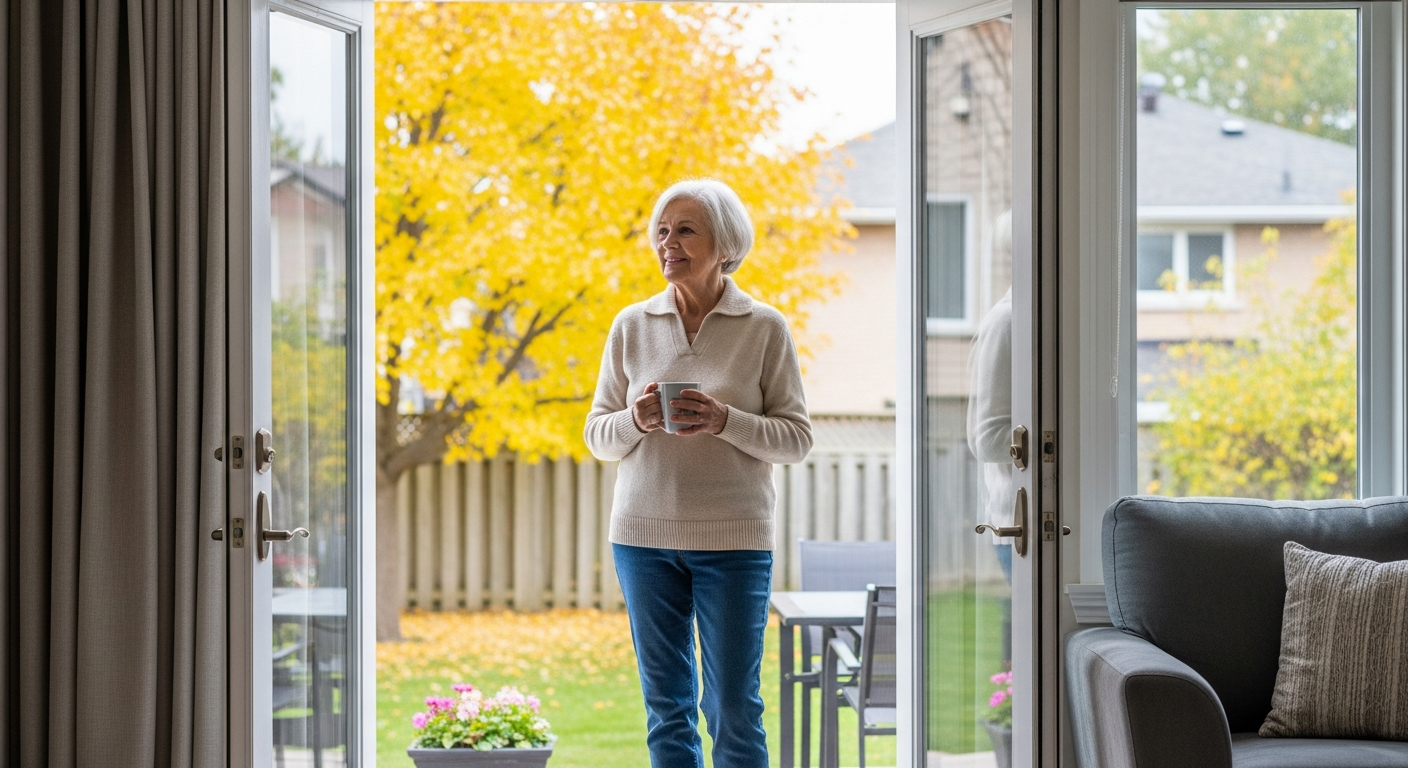
Patricia rented a third-floor walkup apartment in Toronto. For 20 years, the building and neighborhood were perfect. But at 73, climbing stairs became painful, dangerous. Her doctor warned: "One fall could be catastrophic."
Her situation:
- Renting apartment: $1,400/month
- No ownership equity to access (renting)
- Fixed income: $28,000 CPP/OAS annually
- Owns cottage in Muskoka (unencumbered, worth $450,000)
Her plan:
- Sell cottage (will take 3–6 months minimum)
- Buy accessible bungalow in Mississauga (wheelchair-accessible, ground-floor bedroom)
- Make remaining renovations (improved bathroom, accessible entryway)
- Relocate before winter
The problem: Cottage takes 4–6 months to sell, but Patricia needs to move in 6 weeks (before winter, before health further declines). She has no liquid capital for down payment, closing costs, renovations, or moving.
Traditional solutions fail:
- Bank mortgage: Age 73, self-employed income history, limited debt servicing capacity = mortgage declined
- Family loan: Children have limited resources
- HELOC: Can't get against rental apartment
- Home equity loan: Same problem
Reverse mortgage solution:
- Patricia puts cottage up for sale (as planned)
- Obtains reverse mortgage against cottage ($75,000 approved)
- Uses reverse mortgage funds for:
- Down payment: $17,500 (5% of $350,000 purchase price)
- Closing costs: $12,000
- Accessibility renovations: $30,000 (bathroom, entryway, grab bars)
- Moving costs: $5,000
- Reserve: $10,500 (emergency buffer)
Timeline:
- Week 1–2: Apply for reverse mortgage against cottage
- Week 2–4: Cottage appraises, legal review
- Week 4–6: Reverse mortgage funds, Patricia closes on bungalow purchase
- Week 6–8: Renovations begin while cottage is listed for sale
- Week 8–12: Renovations complete, Patricia moves into accessible bungalow
- Month 4–6: Cottage sells; proceeds repay reverse mortgage completely
Cost analysis:
- Reverse mortgage cost: $75,000 at 5.99% = $4,495 annual interest
- Duration: 4–6 months = $1,500–$2,250 interest cost
- Patricia's cottage eventually pays off mortgage upon sale
- Patricia transitions to accessible home before winter ✓

Comparing Down Payment Funding Strategies
| Funding Strategy | Timeline | Cost | Suitability for Relocation |
|---|---|---|---|
| Personal savings | Immediate | None | Only if you have $50,000+ liquid |
| Family loans | 1–2 weeks | None (interest-free, usually) | Only if family can help |
| Personal line of credit | 1–2 weeks | Prime + 1–2% | Limited amount ($10,000–$25,000) |
| Home equity line of credit (HELOC) | 2–4 weeks | Prime + 0.5–1% | Only if you own current home; lengthy qualification |
| Reverse mortgage | 2–3 weeks | 5.99–7.49% | Best for 55+ seniors, immediate large need |
| Sell other asset (cottage, investments) | 4–12 weeks | Market risk | Works if you have time; risky if urgent |
Selecting the Right Accessible Home in Ontario
When searching for accessible homes during relocation, prioritize:
| Feature | Why Important | Typical Upgrade Cost if Missing |
|---|---|---|
| Ground-floor bedroom | Accessibility, falls prevention | $15,000–$30,000 to renovate |
| Main-floor bathroom | Safety, independence | $10,000–$20,000 to renovate |
| Accessible entrance (no steps, ramp) | Entry safety, wheelchair access | $3,000–$8,000 if needed |
| Wide doorways (36"+ interior) | Walker/wheelchair passage | $2,000–$5,000 per doorway |
| Single-story or accessible stairs | Mobility independence | $5,000–$25,000 (stair lift or renovation) |
| Attached garage | Weather protection, mobility aid | $15,000–$30,000 if adding |
Reverse mortgage strategy: Include accessibility upgrade budget ($20,000–$50,000) in your reverse mortgage so you can afford a home that's "close" to accessible, then renovate it perfectly.
Renovation Priorities for Relocated Homes
Once you've relocated to your new accessible home, prioritize renovations strategically:
Phase 1 (Weeks 1–4): Safety-Critical Modifications
- Install grab bars in bathroom: $2,000–$3,000
- Improve bathroom flooring (non-slip): $1,000–$2,000
- Add handrails on stairs: $800–$1,500
- Improve entry-level lighting: $1,500–$2,500
- Phase 1 cost: $5,300–$9,000
Phase 2 (Months 2–4): Accessibility Renovations
- Bathroom renovation (accessible shower): $8,000–$15,000
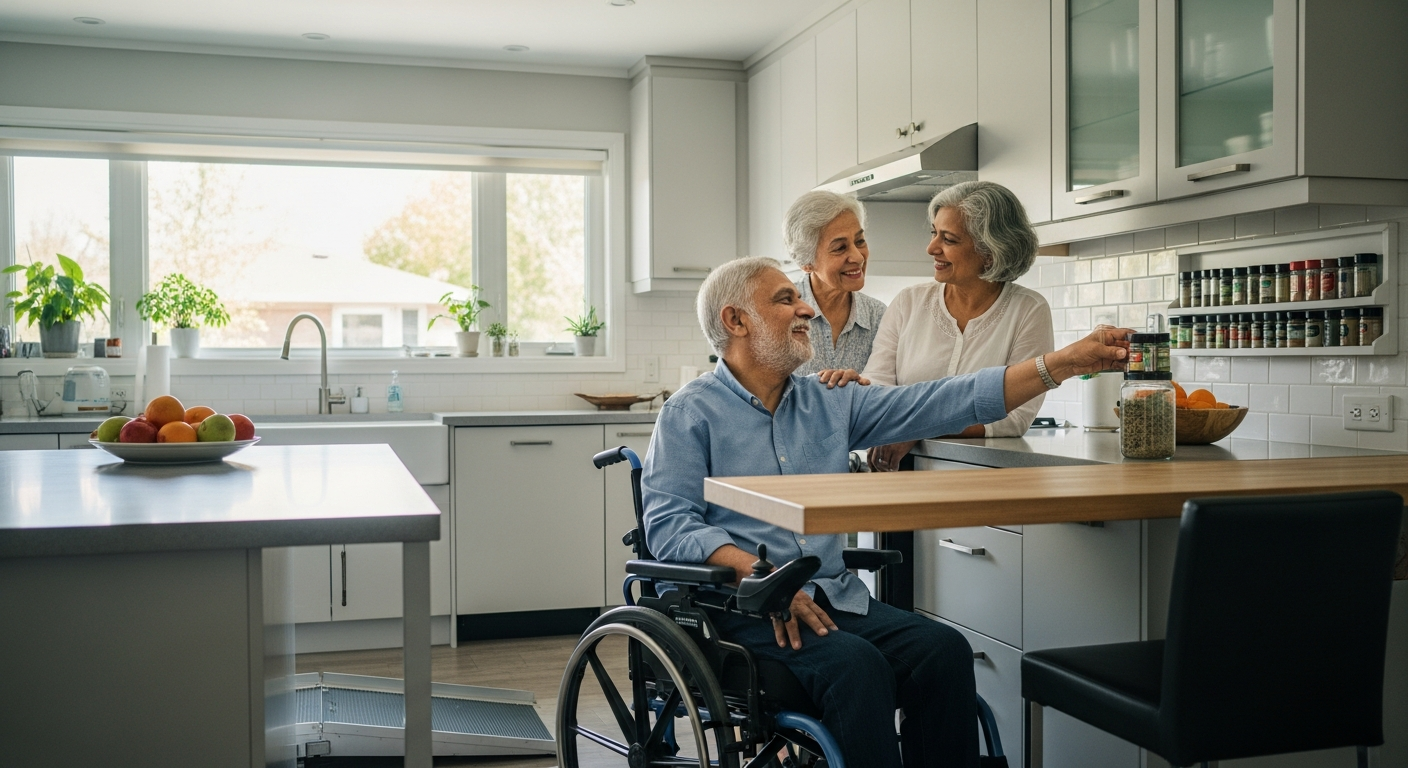
- Kitchen accessibility (counter heights, appliance relocation): $5,000–$12,000
- Widened doorways if needed: $2,000–$5,000
- Phase 2 cost: $15,000–$32,000
Phase 3 (Months 5–12): Long-Term Comfort
- HVAC system upgrade: $6,000–$12,000
- Flooring replacement: $5,000–$15,000
- Lighting improvements throughout: $3,000–$8,000
- Phase 3 cost: $14,000–$35,000 (spread over time as budgets allow)
Impact on Government Benefits
Relocating to an owned home affects benefits:
| Benefit | Impact | Mitigation |
|---|---|---|
| GIS (Guaranteed Income Supplement) | Home ownership doesn't affect GIS | None; GIS continues |
| OAS (Old Age Security) | Home ownership doesn't trigger clawback | None; OAS continues |
| ODSP (Ontario Disability Support) | Home ownership doesn't affect recipients 65+ | None; ODSP continues (age 65+ exempt) |
| Property tax rebates | Some property tax programs require low income | May lose eligibility if home value high |
| Rent-geared-to-income housing | Moves you off wait list if you owned | Consider before selling apartment |
Strategic note: If you're on means-tested benefits, consult with FSRAO before relocating to confirm your benefit status.
Choosing Your Accessible Community in Ontario
Popular accessible communities for relocated seniors:
| Community | Features | Typical Home Price | Accessibility Level |
|---|---|---|---|
| Mississauga | Suburban, accessible transit, newer homes | $350,000–$500,000 | Good (can find accessible homes) |
| Waterloo Region | Aging-friendly initiatives, accessible services | $350,000–$450,000 | Excellent |
| Barrie | Smaller city, affordable, accessible | $300,000–$400,000 | Good |
| Oakville | Affluent suburb, good accessibility support | $400,000–$600,000 | Excellent |
| Niagara Region | Affordable, accessible communities | $300,000–$400,000 | Good |
| Muskoka (towns) | Rural/vacation home accessibility improving | $300,000–$450,000 | Fair (renovations needed) |
Key Takeaways
- Urban seniors in no-elevator apartments face accessibility crises between ages 70–75
- Total relocation costs (down payment, closing, renovations, moving) average $48,000–$82,000 in year one
- Reverse mortgages provide lump sum + line of credit to fund all relocation costs simultaneously
- Accessible homes in Ontario suburbs ($350,000–$450,000) are affordable but require renovation ($20,000–$50,000)
- Reverse mortgage against cottage or other asset allows down payment funding before sale completes
- Government benefits (GIS, OAS, ODSP 65+) generally continue unaffected by home ownership
- Phased renovation approach (phases 1–3) spreads costs and allows budget flexibility
Frequently Asked Questions
Can I get a reverse mortgage against a property I'm about to buy, or must I own it first?
You must already own the property. A reverse mortgage requires title in your name. However, you can obtain a reverse mortgage against your current apartment building (if you own a unit), cottage, or other real estate to fund your new home purchase. Then pay off the reverse mortgage when you sell your original property.
What if the home I buy needs more renovations than I budgeted for?
Access additional funds from your reverse mortgage line of credit. This is why a line of credit (vs. lump sum) works best for relocation—you can draw additional funds as renovation needs emerge. As long as your total borrowing stays within your approved limit, you can access funds for escalating costs.
Will relocating from an apartment to a home affect my CPP or OAS?
No. CPP and OAS depend on your age and contribution history, not property ownership. Relocating to a home doesn't trigger any changes to CPP or OAS. Your benefits continue exactly as before. No application or notification required.
What if I want to relocate but I'm only 55 and most reverse mortgages require 55+?
You qualify at exactly 55. Most lenders (CHIP, Equitable Bank, Home Trust) accept applicants age 55+. Some lenders accept age 50+ (Bloom Financial, in some cases). Call Rick Sekhon Reverse Mortgages to confirm your specific eligibility.
Should I lease or buy in my new community?
If you can afford to buy with reverse mortgage assistance, buying is better long-term. Renting creates new landlord dependencies, ongoing rent inflation, and eviction risk. Buying your accessible home with a reverse mortgage creates stability, eliminates rent increases, and provides asset security. The only exception: if you're uncertain you'll stay 5+ years (then renting may be better).
What happens to my reverse mortgage if I need to move into long-term care?
Your reverse mortgage becomes due when you move into LTC (usually 30–90 days to repay). You can sell the home to repay, or your adult children can inherit and manage the debt. Discuss succession planning with Rick Sekhon Reverse Mortgages before borrowing to ensure you have a clear exit plan.
Ready to relocate to an accessible home? Contact Rick Sekhon Reverse Mortgages to fund down payment, renovations, and moving costs in one integrated solution.
Ready to Learn More?
Find out exactly how much you could unlock from your home — free and no obligation.
Related Articles
Reverse Mortgage After Your Caregiver Retires: Restructuring Care and Rebuilding Independence
Your longtime caregiver is retiring. A reverse mortgage funds the transition to new care arrangements and helps you rebuild independence after years of dependence.
Read →Reverse Mortgage for Rural Ontario Caregiving Deserts: When Attendants Cost 3x More
Rural aging in place costs dramatically more when care attendants are scarce. A reverse mortgage funds premium wages to attract caregivers to remote areas and stay affordable.
Read →Reverse Mortgage for Accessible Community Kitchen: Culinary Training and Aging in Place
Convert your home kitchen into an accessible commercial culinary training space. Reverse mortgage funds renovation while creating community impact.
Read →