
Reverse Mortgage for Elder Co-Housing Communities: Building Community in Ontario
Fund co-housing community living for active aging. Reverse mortgage for shared senior housing in Ontario.
Are you aging alone in a family home that's become isolating and costly? Elder co-housing communities in Ontario offer a third way between staying in a large family home and moving to institutional care. These are intentional communities of 8–25 independent households sharing common spaces, meals, activities, and mutual support—without loss of privacy or independence. A reverse mortgage funds the buy-in, transition costs, and ongoing fees for co-housing that combines affordability, community, and aging in place.
What Is Elder Co-Housing?
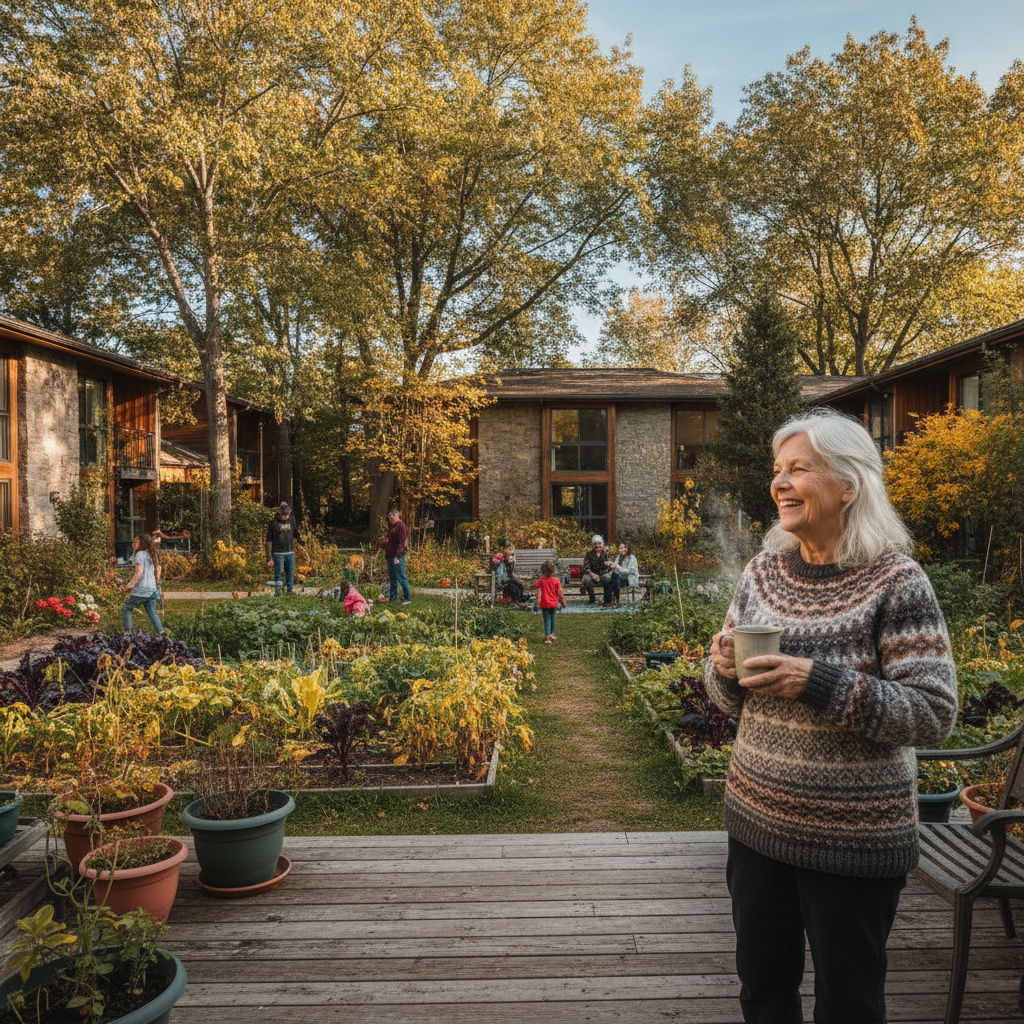
Elder co-housing is distinct from retirement communities or nursing homes. Co-housing communities are owner-occupied (not rental), self-governed by residents, and built around intentional shared values and mutual support. Each person owns a private home/suite but shares dining, recreation, workshops, and childcare (intergenerational communities). It combines independence with built-in social connection and mutual aid.
Key differences from alternatives:
| Model | Ownership | Governance | Privacy | Cost | Community Level |
|---|---|---|---|---|---|
| Co-Housing | Owner-occupied | Resident-governed | ✓ Private suite + shared spaces | Moderate | High (intentional) |
| Retirement Community | Rented or corporate | Corporate-managed | ✓ Private but controlled | High | Moderate (activities programmed) |
| Nursing Home | Corporate | Corporate-managed | ✗ Shared rooms typical | Very high | Low (institution) |
| Aging in Family Home | Owned | Self-managed | ✓ Complete privacy | Variable | Low (isolation risk) |
Co-housing is ideal for seniors who value independence, community involvement, and affordability—without the isolation of solo aging or the loss of autonomy in institutional settings.
According to the Canadian Co-housing Network, 12+ established elder co-housing communities operate across Canada (2026), with 30+ in development. Ontario leads with 4 established + 8 proposed communities.
Ontario's Elder Co-Housing Options (2026)
| Community | Location | Units | Buy-In | Monthly Fee | Status |
|---|---|---|---|---|---|
| Woodstock Green Commons | Woodstock | 18 | $280,000–$420,000 | $850–$1,200 | Operating (since 2014) |
| Cascadia Commons | Toronto (East York) | 12 | $350,000–$500,000 | $950–$1,400 | Operating (since 2015) |
| Meadowridge Cohousing | Cambridge | 20 | $320,000–$480,000 | $900–$1,300 | Operating (since 2013) |
| Common Ground Hamilton | Hamilton | 15 | $260,000–$400,000 | $800–$1,100 | Operating (since 2016) |
| Sunnyfield Senior Cohousing | London | 14 | $240,000–$380,000 | $750–$1,050 | Under development |
| Riverside Coliving | Ottawa | 22 | $300,000–$450,000 | $900–$1,200 | Under development |
Buy-in prices vary by unit size (typically 800–1,200 sq ft). Monthly fees cover shared utilities, maintenance, property taxes, insurance, and community programming.
Real-World Scenario: Joan's Transition to Co-Housing
Joan, 76, had lived alone in her 3-bedroom Waterloo home for 12 years after her husband's death. She had built $520,000 in equity. But the isolation was weighing on her.
Her children lived in different cities. She was managing her home alone, driving less as her vision changed, and feeling disconnected. A nursing home felt premature; staying alone felt unsustainable.
Joan discovered Common Ground Hamilton, an 18-unit senior co-housing community opening in 2026. Buy-in for a 2-bedroom suite: $350,000. Monthly fee: $1,050 (utilities, shared meals, maintenance, activities, property tax included).
Joan accessed a reverse mortgage for $400,000 (age 76, strong home equity). She:
- Used $350,000 for co-housing buy-in
- Used $25,000 for moving costs and furniture for her new 2-bedroom suite
- Reserved $25,000 in her LoC for personal care emergencies
Cost comparison:
| Living Situation | Housing Cost | Isolation Risk | Health Risk | Community Engagement | |---|---|---|---|---|---| | Joan's old home (alone) | $2,500/month (utilities, maintenance, property tax, insurance) | Very high | High (no social connection, fall risk) | Low | | Nursing home | $5,000–$7,000/month | None | Moderate (but loss of autonomy) | Programmed (not chosen) | | Common Ground co-housing | $1,050/month (+ property appreciation) | None | Low (built-in mutual monitoring) | High (self-directed community) |
Joan's outcome:
- Monthly cost: DOWN $1,450 (from $2,500 to $1,050)
- Social isolation: ELIMINATED (9 shared dinners/week, daily activities, built-in friendships)
- Health monitoring: IMPROVED (co-residents check in; medical emergencies are witnessed)
- Autonomy: PRESERVED (owns her suite; participates in governance; sets her own schedule)
- Estate value: MAINTAINED (she owns her suite; it remains in her estate if she predeceases)
Funding Co-Housing With Reverse Mortgage
Step 1: Identify Co-Housing Communities (In Development or Operating)
Visit Canadian Co-housing Network (cohousingcanada.ca) to find communities near you. Most have waitlists; apply early.
Expected timeline: 12–24 months from initial interest to move-in (communities fill as they develop).
Step 2: Calculate Total Move-In Capital
Reverse mortgage funds must cover:
- Buy-in price (typically $250,000–$500,000 depending on unit and community)
- Application fee (usually $500–$2,000)
- Home inspection & appraisal (if required by community; typically $1,000)
- Moving costs (typically $5,000–$15,000)
- Furniture/renovations for your suite (typically $10,000–$30,000)
Total capital required: $270,000–$550,000 (depending on community and your preferences)
Step 3: Apply for Reverse Mortgage
Contact Rick Sekhon Reverse Mortgages or a licensed specialist. Provide:
- Home appraisal
- Co-housing community details (prospectus, buy-in agreement)
- Timeline for move (typically 18–24 months)
Lenders like CHIP, Equitable Bank, HomeEquity Bank, and Bloom Financial approve co-housing transitions as valid reverse mortgage uses.
Step 4: Ensure Monthly Fees Are Affordable
Your monthly co-housing fee (typically $800–$1,400) must be affordable from CPP/OAS/pension. If not, you'll need to draw from LoC or liquidate other assets.
Budget: CPP + OAS + Pension should cover ≥80% of monthly co-housing fee.
Step 5: Complete Move-In & Participate in Governance
Co-housing residents govern together through consensus-based meetings. Budget 4–8 hours/month for community meetings, committees, and decision-making. This is a feature, not a burden—shared governance builds investment in community success.

Co-Housing vs Alternatives: True Cost Over 10 Years
| Living Option | Year 1 Housing Cost | Total 10-Year Cost | Home Appreciation Benefit | Net Cost After Appreciation | |---|---|---|---|---|---| | Aging in own home (alone) | $30,000 | $350,000 | ~$80,000 (home appreciation) | $270,000 net cost | | Co-Housing (reverse mortgage funded) | $12,600 | $126,000 | ~$30,000 (co-housing suite appreciation) | $96,000 net cost | | Nursing home | $70,000 | $700,000 | $0 (rented, no ownership) | $700,000 net cost | | Active retirement community (rental) | $45,000 | $450,000 | $0 (rented, no ownership) | $450,000 net cost |
Co-housing is dramatically more affordable over 10 years—while providing superior community engagement and health outcomes.
Health & Longevity Benefits of Co-Housing
Research on elder co-housing shows:
- Reduced depression: 40–50% lower depression rates vs aging alone
- Fewer hospitalizations: built-in social monitoring catches health issues early
- Delayed care escalation: average 4–7 year delay before institutional care needed
- Higher life satisfaction: 85%+ of co-housing residents report high life satisfaction (vs 60%+ for those aging alone)
- Lower mortality: some studies suggest 3–5 year longevity advantage vs isolated aging
Key Takeaways
- Elder co-housing combines independence, community, and affordability—avoiding isolation of solo aging and cost of institutional care.
- Ontario has 4+ established co-housing communities with 8+ in development; buy-in is typically $250,000–$500,000.
- Reverse mortgage funds provide capital for buy-in + transition costs without monthly payments.
- Monthly co-housing fees ($800–$1,400) are typically 50–60% cheaper than aging alone due to shared expenses.
- Co-housing residents own their suites and participate in governance; it's not institutional care.
- CHIP, Equitable Bank, HomeEquity Bank, and Bloom Financial all fund senior co-housing transitions.
Frequently Asked Questions
How do I know if co-housing is right for me?
You're a good fit if you value community, are independent but appreciate connection, want to stay engaged socially, and don't require 24/7 care. If you're isolated, lonely, and want structure—co-housing may transform your life.
What if I decide co-housing isn't for me after moving in?
You sell your suite (typically a strong market if the community is established) and move elsewhere. Co-housing suites often appreciate similarly to condos in the same area.
Do co-housing communities accept people with cognitive decline (dementia)?
Most established co-housing communities serve independent seniors. As dementia develops, residents typically transition to care facilities. Plan for this eventuality in your long-term care strategy.
Can I rent in a co-housing community instead of buying in?
Some newer co-housing models are exploring rental units, but most are owner-occupied. Typically, you must own your suite to participate in governance and benefit from equity appreciation.
How are co-housing decisions made? What if I disagree?
Communities use consensus-based governance. Decisions are made by all residents together. You can voice objections, but large community decisions favor consensus. If you strongly disagree with community direction, you have the option to sell and leave.
Is a reverse mortgage the best way to fund co-housing?
For seniors 55+ with significant home equity and no monthly income pressure, yes. If you have high income or strong savings, alternative funding (downsizing, HELOC, savings) might be better. Consult Rick Sekhon to compare options.
Build community while aging in place. Explore Ontario's co-housing options. Get your free Ontario Reverse Mortgage Guide →
Ready to Learn More?
Find out exactly how much you could unlock from your home — free and no obligation.
Related Articles
Reverse Mortgage for Social Connection: Building Community in Retirement
Fund social activities, community involvement, and meaningful connections to combat retirement isolation. Create a vibrant social life in Ontario after 55.
Read →Cohousing in Retirement: Using a Reverse Mortgage for Shared Living Communities
Cohousing offers community, affordability, and independence. A reverse mortgage can fund your transition into a senior cohousing community in Ontario.
Read →Aging in Place with a Reverse Mortgage: Home Modification Guide
How Ontario seniors can fund aging-in-place home modifications with a reverse mortgage — costs, top modifications, grants, and a complete planning guide.
Read →