
Reverse Mortgage for Complete Home Conversion: When Adult Child Uses Motorized Wheelchair Full-Time
Fund comprehensive home accessibility modifications for adult child requiring full-time motorized wheelchair use in Ontario.
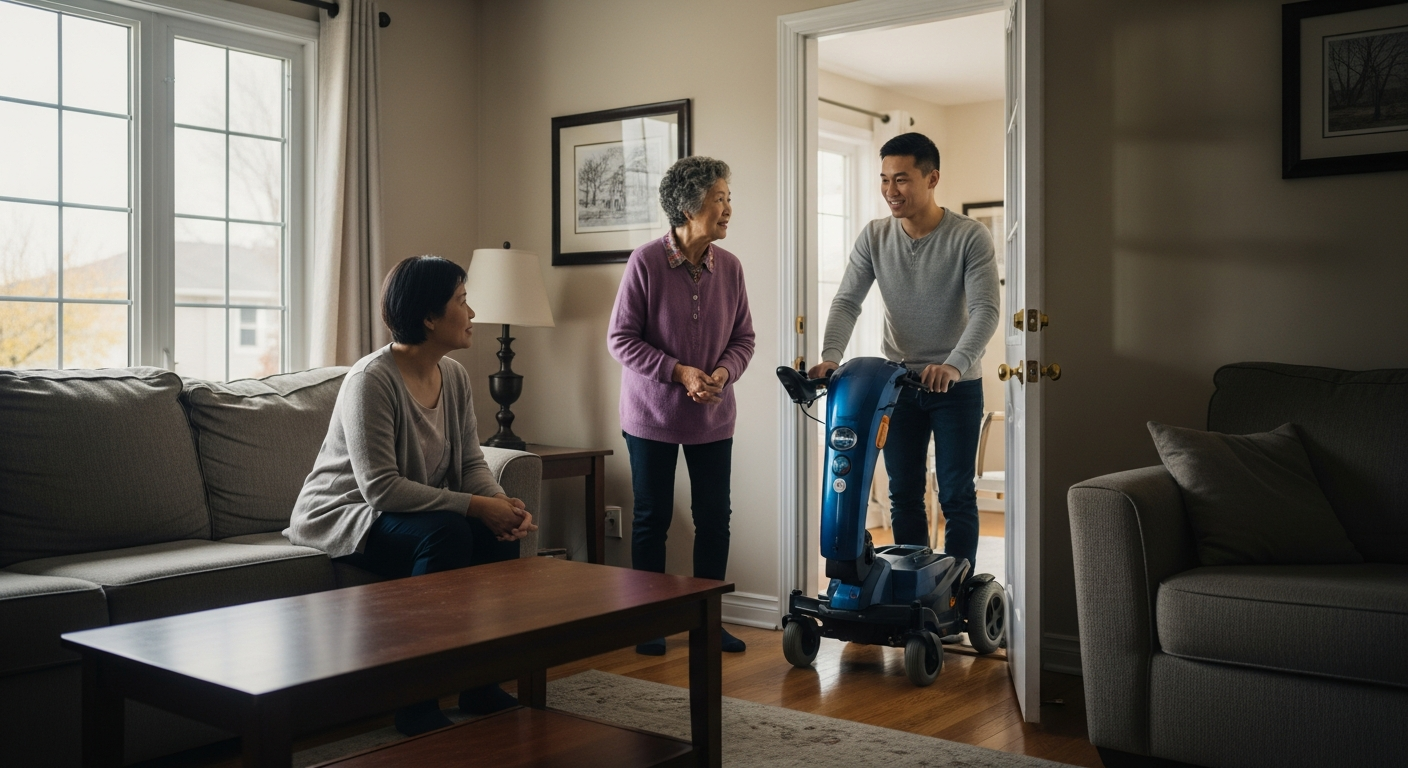
Your adult child now uses a motorized wheelchair full-time due to spinal cord injury, progressive neurological disease, or severe arthritis. Your home—with its stairs, narrow doorways, inaccessible bathrooms, and tight kitchen layout—is suddenly unnavigable. Your child cannot access their bedroom, cannot shower safely, cannot prepare meals. A complete home renovation to motorized wheelchair accessibility could cost $40,000–$100,000+. A reverse mortgage makes this comprehensive renovation financially feasible while keeping your family together in your home.
Understanding Motorized Wheelchair Accessibility Needs
Full-time motorized wheelchair users require fundamentally different home design than manual wheelchair users or those with temporary mobility limitations:
Motorized Wheelchair Specifications:
- Typical width: 26–30 inches (larger than manual chairs)
- Length: 40–50 inches
- Turning radius: 5–6 feet minimum (requires wider hallways, larger rooms)
- Weight: 200–400 lbs (requires reinforced ramps, elevators)
- Charging infrastructure: Dedicated electrical outlets, weather-protected charging areas
- Maintenance access: Space for technician repair/service
Complete Home Conversion Essentials:
| Modification | Cost Range | Essential for Motorized Wheelchair |
|---|---|---|
| External ramp (full-width, reinforced) | $5,000–$15,000 | Absolute must; must support weight/moisture |
| Widened doorways (minimum 36–40") | $3,000–$10,000 | Kitchen, bedroom, bathroom doorways |
| Accessible bathroom (roll-in shower, toilet height, grab bars) | $12,000–$25,000 | Largest single expense; safety-critical |
| Accessible kitchen (lowered counters, under-sink clearance, accessible appliances) | $8,000–$18,000 | Enables independence in food prep |
| Bedroom modifications (bed height, transfer space, charging station) | $5,000–$15,000 | Sleep/rest accessibility |
| First-floor master suite (if applicable) | $20,000–$50,000+ | Eliminates stair dependency; largest investment |
| Flooring replacement (non-slip, accessible transitions) | $4,000–$12,000 | Safety, maneuverability |
| Electrical upgrades (wheelchair charging stations, accessible outlets) | $2,000–$5,000 | Functional necessity |
| Entryway/vestibule modifications | $3,000–$8,000 | Weather protection, safe entry/exit |
Total comprehensive motorized wheelchair home conversion: $42,000–$118,000+
Phased Conversion vs. Complete Renovation
Two approaches exist:
Phased Approach (Incremental Modifications Over 2–3 Years)
- Year 1: External ramp, widened primary doorways, accessible bathroom
- Year 2: Kitchen modifications, bedroom conversion
- Year 3: Additional modifications, flooring, fine-tuning
- Advantage: Smaller annual impact on finances and household disruption
- Disadvantage: Extended construction, ongoing adaptation
Complete Conversion (12–18 Month Full Renovation)
- All modifications completed simultaneously
- Contractor efficiency (single project, coordinated teams)
- Home usable throughout (though disrupted during construction)
- Advantage: Faster path to full accessibility; contractor efficiency reduces costs
- Disadvantage: Larger upfront financial commitment, significant household disruption
A lump-sum reverse mortgage suits complete conversion; a line-of-credit suits phased approach.
Reverse Mortgage Strategy for Motorized Wheelchair Home Conversion
For Complete Renovation (Lump-Sum Approach):
- Obtain $80,000–$120,000 reverse mortgage
- Draw entire amount or in 2–3 large draws over 6–12 months during construction
- Complete all major modifications simultaneously
- Minimal interest accrual (full amount borrowed upfront, interest applies immediately)
For Phased Conversion (Line-of-Credit Approach):
- Obtain $100,000–$130,000 line of credit
- Year 1: Draw $30,000–$40,000 (external ramp, doorways, bathroom)
- Year 2: Draw $30,000–$40,000 (kitchen, bedroom modifications)
- Year 3: Draw $15,000–$25,000 (fine-tuning, additional modifications)
- Interest accrues only on amounts actually borrowed
Lenders like CHIP and Equitable Bank support both approaches, allowing flexibility based on your child's timeline and your preference for construction disruption.
Critical Planning: Structural Feasibility and Municipal Permits
Before committing to renovation, verify feasibility:
Structural Assessment:
- Ramp installation requires stable foundation; rental properties may prohibit ramps
- First-floor bedroom conversion (if needed) requires clear floor space; some homes cannot accommodate
- Bathroom expansion may require moving plumbing/electrical (expensive, sometimes not feasible)
- Bedroom widening may require structural wall removal (contractor assessment necessary)
Get a professional accessibility assessment ($500–$2,000) before reverse mortgage; it identifies feasibility issues early.
Building Permits & Accessibility Standards:
- Doorway widening (36"+ minimum): Municipal permit required
- Ramp installation: Permit required; must meet Ontario accessibility standards (1:12 slope, handrails, etc.)
- Bathroom renovation: Electrical and plumbing code compliance; inspections required
- First-floor bedroom conversion: Egress window (emergency exit) required; fire code compliance
Permits typically cost $500–$2,000 but prevent legal issues and ensure insurance coverage.
Real Ontario Case: The Complete Home Renovation
Sarah, 58, Windsor, Ontario
- Home value: $420,000
- Adult son: Age 26, spinal cord injury (C6 level) requiring full-time motorized wheelchair use
- Currently in rehabilitation facility; family wants him home
The Reality: Sarah's 1970s bungalow is completely inaccessible. No ramp, narrow doorways, upstairs bedroom, small bathroom. Complete renovation estimate: $95,000. Sarah's savings: $40,000. Pension/CPP: $2,800/month. Insufficient to fund renovation without assistance.
The Reverse Mortgage Solution: Sarah obtains a $110,000 reverse mortgage (lump-sum) with CHIP:
- Draws $25,000 for comprehensive accessibility assessment and planning
- Draws $70,000 for primary renovations:
- External ramp (reinforced): $12,000
- Widened doorways throughout: $8,000
- Ground-floor bedroom conversion: $30,000
- Accessible bathroom: $20,000
- Draws $10,000 for electrical upgrades, charging stations, safety modifications
- Keeps $5,000 reserved for unexpected issues
Outcome: Son comes home from rehabilitation to fully accessible house. By year 2, he's attending community college (home is accessible for his learning setup). By year 3, he's employed part-time (wheelchair-accessible work-from-home role). Home modifications enable his independence and future earnings potential. Sarah's reverse mortgage interest (~$5,500/year on $110,000) is manageable on her pension/CPP.
Coordinating with Disability Tax Credits and Accessibility Grants
Maximize non-reverse-mortgage resources first:
Disability Tax Credit (DTC):
- If your child qualifies for CRA's DTC, home accessibility costs may be deductible
- Potential refund of 15–40% of adaptation costs
- Consult a disability tax specialist; documentation critical
Ontario Accessibility Grants:
- Some municipalities offer small accessibility grants ($2,000–$10,000) for seniors or disabled individuals
- Availability varies; contact your local disability services office
- Usually insufficient for complete renovation but helpful supplements
RDSP (Registered Disability Savings Plan):
- If your child is DTC-eligible, RDSP can hold up to $200,000 in liquid assets
- Grants and contributions can fund disability-related expenses
- Maximize RDSP before using reverse mortgage
Lender Comparison for Motorized Wheelchair Home Conversion
| Lender | Large Renovation Support | Accessibility Expertise | Ontario Coverage |
|---|---|---|---|
| CHIP | Excellent | High | Excellent |
| Equitable Bank | Excellent | High | Excellent |
| Bloom Financial | Very Good | Good | Very Good |
| Home Trust | Good | Moderate | Good |
CHIP and Equitable Bank have strong track records funding large-scale accessibility renovations.
Key Takeaways
- Full-time motorized wheelchair users require $42,000–$118,000+ in comprehensive home modifications.
- Complete renovation (12–18 months) is often more cost-efficient than phased approach due to contractor efficiency.
- Lump-sum reverse mortgage suits complete renovation; line-of-credit suits phased approach.
- Structural feasibility assessment ($500–$2,000) essential before committing to reverse mortgage.
- Building permits and accessibility standard compliance required; plan $500–$2,000 for permitting.
- CHIP and Equitable Bank have strongest expertise and support for large accessibility renovations.
- Disability Tax Credit may recover 15–40% of adaptation costs; consult tax specialist.
Frequently Asked Questions
Can I modify my home for motorized wheelchair use myself, or do I need contractors?
Most modifications require licensed contractors (plumbing, electrical, structural work). Attempting DIY can violate building codes, void insurance, and create safety hazards. Budget accordingly; contractor expertise ensures accessibility standards compliance and future usability.
What if my home's layout makes certain modifications impossible?
Some homes genuinely cannot accommodate motorized wheelchair accessibility (tiny bathrooms, poor structural design, rental property restrictions). A professional accessibility assessment identifies true constraints early. If modifications aren't feasible, consider downsizing to an accessible home or exploring accessible rental properties.
Will motorized wheelchair accessibility modifications increase my home's resale value?
Somewhat. Accessibility modifications appeal to a smaller market (people with disabilities, aging seniors) but don't command significant premiums. However, a fully accessible home may sell faster to the right buyer. Most families view modifications as lifestyle investment (enabling their child to live at home), not wealth-building.
Are motorized wheelchairs covered by provincial insurance or disability programs?
Partially. OHIP may cover up to $2,500–$5,000 of wheelchair device cost (varies by program and device type). Most motorized wheelchair costs ($8,000–$20,000+) are out-of-pocket or funded through disability grants. A reverse mortgage can cover home modifications; investigate whether your child's disability benefits include equipment funding.
What if my adult child's mobility needs change (improves or worsens) after renovation?
Accessibility modifications are generally adaptable. If your child regains some mobility, ramps and widened doorways remain beneficial (less strain). If disability progresses, additional modifications may be needed (elevator, lift systems). Reserve some reverse mortgage credit for future adaptations.
Should I tell my adult child about the reverse mortgage, or keep it private?
Transparency is better. Your child understanding the financial investment in their home accessibility may deepen their commitment to living independently and safely in the modified space. Frame it positively: "We've invested in making your home fully accessible; let's make the most of it together."
Ready to Learn More?
Find out exactly how much you could unlock from your home — free and no obligation.
Related Articles
Reverse Mortgage to Stabilize Family Income: When Your Adult Child Works Precarious Gig
Support adult child in gig economy with reverse mortgage financial backstop. Stabilize family income when employment is unpredictable.
Read →Reverse Mortgage to Fund Your Own Mentorship Practice: Teaching the Next Generation
Launch a mentorship or coaching practice in retirement using home equity. Build income while teaching young leaders with a reverse mortgage.
Read →Reverse Mortgage When Your Home Has Never Been Registered as Principal Residence
Reverse mortgage options for homes without principal residence exemption registration. Legal strategies for Ontario homeowners.
Read →