
Reverse Mortgage for Franchising in Retirement: Buying Into a Proven Business Model at 55+
Fund a franchise business acquisition using reverse mortgage at 55+. Leverage home equity to launch franchises with established brand recognition, training, and support systems in Ontario.
What if your retirement income could come from a business that's already proven to work? Many Ontario retirees dream of entrepreneurship but fear startup risk. Franchising offers a middle path: you buy into an established brand with training, operational systems, and support built in. A reverse mortgage can fund the entire franchise acquisition, allowing you to launch a business that provides both income and purpose.
The Franchise Opportunity for Late-Career Entrepreneurs
A franchise is a business arrangement where a franchisor (brand owner) grants a franchisee (entrepreneur) the right to operate a business under their name, using their systems, in exchange for fees and royalties. Unlike startups, franchises offer proven playbooks, reducing failure risk significantly.
Why Franchising Attracts 55+ Entrepreneurs
- Lower failure rate: 80–90% of franchises survive Year 1, vs. 50–60% of independent startups
- Turnkey systems: Operations, marketing, accounting, staffing protocols provided
- Established brand recognition: No need to build customer awareness from scratch
- Ongoing support: Franchisors provide training, troubleshooting, and scale strategies
- Passive income potential: Eventually, you hire managers to run day-to-day operations
According to the Canadian Franchise Association, franchisees aged 55–65 represent the fastest-growing demographic, driven by delayed retirement and desire for meaningful work.

Reverse Mortgage as Franchise Funding Strategy
A reverse mortgage provides capital without requiring employment income or credit checks that traditional business lenders scrutinize. Here's how it works:
| Stage | Action | RM Role |
|---|---|---|
| 1. Discovery | Identify franchise opportunities, review Franchise Disclosure Documents (FDD) | RM provides bridge funding during evaluation |
| 2. Due Diligence | Consult franchise lawyers ($2,000–$5,000), interview existing franchisees | RM covers legal costs |
| 3. Financing Approval | Get RM approved, close within 30–45 days | RM capital ready to deploy |
| 4. Franchise Acquisition | Pay franchise fee ($25,000–$75,000), working capital | RM funds initial investment |
| 5. Setup & Launch | Build/lease location, staff hiring, inventory, marketing | RM covers ongoing startup costs |
| 6. Operations | First 6–12 months break-even phase | RM provides cushion if cash flow is delayed |
Cost Breakdown: Typical Ontario Franchise Investment
| Category | Cost Range | Notes |
|---|---|---|
| Franchise Fee (to franchisor) | $25,000–$75,000 | Non-refundable; grants you license to operate |
| Real Estate (lease deposit + buildout) | $20,000–$60,000 | Depends on location (retail vs home-based) |
| Equipment & Inventory | $10,000–$40,000 | Pre-opening stock, tools, technology |
| Initial Marketing & Branding | $5,000–$15,000 | Grand opening, local advertising |
| Working Capital Reserve (6 months) | $15,000–$40,000 | Cash buffer for payroll, utilities during ramp-up |
| Legal & Accounting Setup | $2,000–$5,000 | Franchise attorney, business registration |
| Insurance & Licenses | $3,000–$8,000 | Business liability, workers' comp, permits |
| TOTAL INITIAL INVESTMENT | $80,000–$243,000 | Typical range for small service/retail franchise |
A reverse mortgage of $120,000–$180,000 covers most franchise launches in Ontario, with room for working capital.
Ontario Franchise Opportunities Suited to 55+ Owners
Home-Based or Low-Overhead Franchises
Advantages: Lower capital, flexible hours, no staffing initially, can grow toward part-time or full-time.
| Franchise Type | Typical Cost | Revenue Potential | Setup Time |
|---|---|---|---|
| Home care services (PSW, companion care) | $40,000–$80,000 | $80,000–$250,000/yr | 3–6 months |
| Business consulting/coaching | $30,000–$60,000 | $60,000–$200,000/yr | 1–3 months |
| Real estate services (boutique brokerage) | $50,000–$120,000 | $100,000–$300,000/yr | 2–4 months |
| Fitness/wellness instruction | $35,000–$75,000 | $70,000–$180,000/yr | 2–3 months |
| Virtual administrative services | $25,000–$50,000 | $50,000–$150,000/yr | 1 month |
Retail/Service Location Franchises
Advantages: Higher revenue potential, franchisor support often includes landlord negotiation, proven customer acquisition.
| Franchise Type | Typical Cost | Revenue Potential | Setup Time |
|---|---|---|---|
| Coffee shop/café | $120,000–$300,000 | $250,000–$600,000/yr | 6–9 months |
| Quick-service restaurant (QSR) | $150,000–$350,000 | $300,000–$800,000/yr | 6–12 months |
| Dry cleaning/laundry | $100,000–$250,000 | $150,000–$400,000/yr | 4–6 months |
| Tutoring/educational services | $60,000–$150,000 | $100,000–$350,000/yr | 2–4 months |
| Spa/wellness center | $150,000–$350,000 | $200,000–$600,000/yr | 6–12 months |
Real Example: Susan's Coffee Franchise Journey
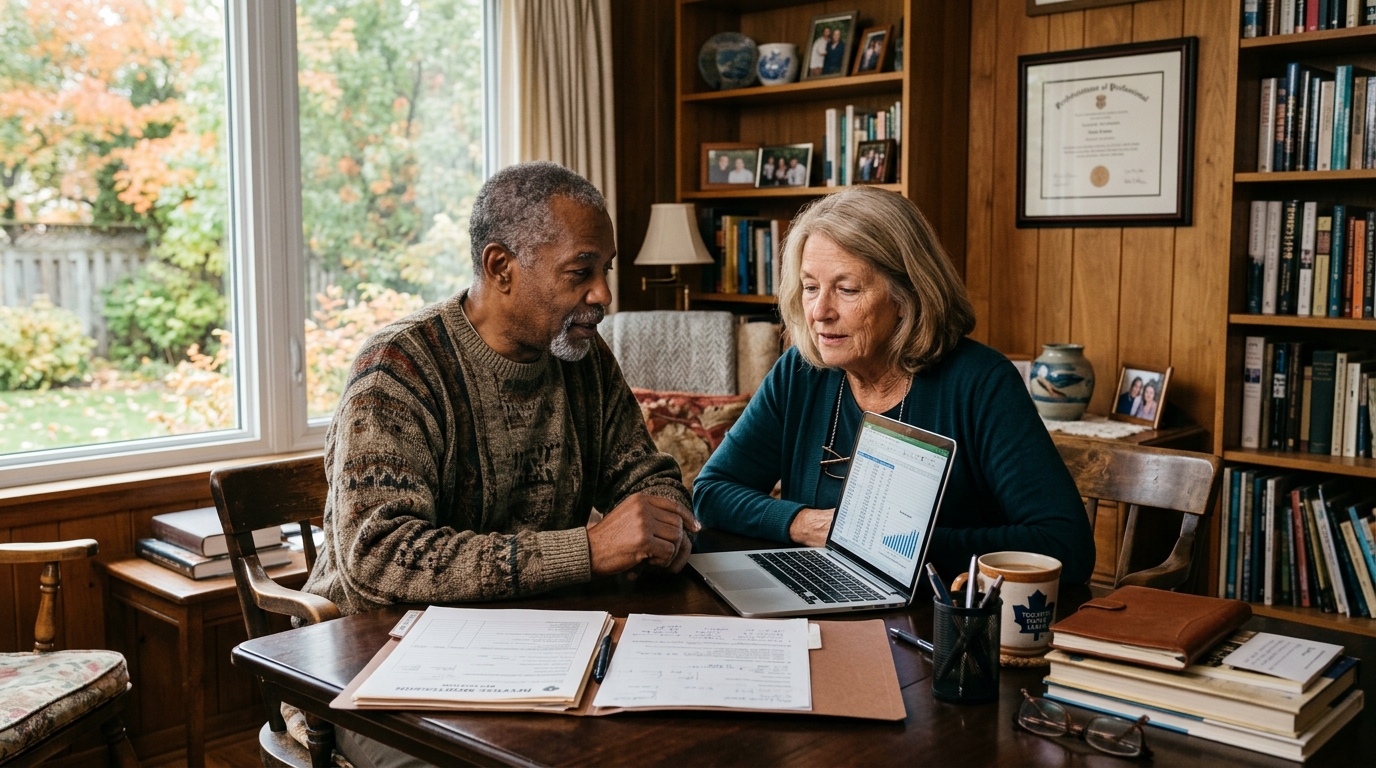
Profile: Susan, 58, retired from a 30-year corporate career with a paid-off $750,000 Toronto home. She receives $22,000 annually from CPP, but misses work and wants additional income plus daily engagement.
Decision:
- Obtains reverse mortgage: $180,000 at 6% interest
- Invests in coffee franchise (brand name, 12 locations in GTA)
- Franchise fee: $50,000
- Lease + buildout: $60,000
- Equipment, inventory, working capital: $50,000
- Reserve for contingencies: $20,000
- Total RM deployment: $180,000
Year 1 Results:
- Revenue: $320,000 (exceeds franchisor average of $280,000)
- Operating expenses: $210,000 (food, labor, rent, utilities)
- Net profit: $110,000
- RM interest cost (6% on $180,000): $10,800/year
- Net cash to Susan: $99,200 (after all expenses and RM interest)
Long-term outlook: Susan pays herself $60,000/year while reinvesting $40,000 annually. By Year 5, she's paid down the RM to $140,000 and profits have grown to $130,000/year. She hires a manager, becomes semi-passive. By retirement at 70, she has a going concern that she can sell, transfer to family, or maintain as legacy business.
Critical Risk Factors: When Franchising Fails
Red Flag #1: Franchisor Has Weak Track Record
Warning signs:
- Franchisor founded less than 5 years ago
- High franchisee failure or exit rate (>20% annually)
- Numerous legal complaints from existing franchisees
- No references willing to speak on record
Mitigation: Interview at least 5–10 existing franchisees (get list from Franchise Disclosure Document). Ask: "Would you franchise again?" Listen for hesitation.
Red Flag #2: Your Market is Saturated
Warning signs:
- Franchisor is opening 10+ locations in your city simultaneously
- Competitor franchises are closing locations nearby
- Market demographics show declining spending power
Mitigation: Conduct independent market research. Contact commercial real estate brokers in your area for market saturation analysis ($500–$1,500).
Red Flag #3: You Underestimate Operational Demands
Reality check: Many franchises require 50–60 hour weeks initially, not retirement "hobby hours."
If you want part-time work but the franchise demands full-time operational presence, you'll burn out or lose your investment.
Mitigation: Shadow a franchisee for a few days. Work the actual hours. If it's unsustainable, that's data.
Reverse Mortgage + Franchise: Tax & Legal Considerations
Tax Deductions You Can Claim
According to the CRA, business expenses related to franchise operations are deductible against franchise revenue:
- Franchise fee (amortized over 5 years as capital expenditure)
- Rent, utilities, equipment
- Employee wages and benefits
- Marketing and customer acquisition
- Professional services (accounting, legal)
- Lease improvements
RM interest is NOT deductible because you're using RM proceeds for business (not investment property). However, if you later refinance and use business profits to pay down the RM, those interest payments may become deductible.
Legal Structure: Sole Proprietor vs Corporation
Sole proprietor (simpler):
- Easier setup, lower accounting costs
- RM in personal name, franchise in personal name
- Less asset protection if franchise is sued
Corporation (more complex):
- Separate legal entity for franchise
- RM remains personal; franchise in corporate name
- Better asset protection, more accounting complexity
Recommendation: Consult an Ontario business lawyer ($1,500–$3,000) before closing your RM. Structure the deal to minimize liability.
Key Takeaways
- Franchises have 80–90% Year 1 survival rates, significantly higher than independent startups, reducing entrepreneurial risk for late-career retirees
- Reverse mortgage funding eliminates employment income verification, allowing retired entrepreneurs to access capital based purely on home equity
- Typical Ontario franchise launches cost $80,000–$243,000, well within range of a modest reverse mortgage for most homeowners
- Home-based franchises ($25,000–$80,000) offer flexibility and lower risk for 55+ entrepreneurs seeking part-time engagement
- First-year profits of $60,000–$120,000 are achievable with established franchise brands, often exceeding RM interest costs immediately
- Existing franchisee interviews and franchise lawyer due diligence are non-negotiable; they uncover 80% of franchise risks before you commit capital
Frequently Asked Questions
Do I need business experience to run a franchise?
Not necessarily. Franchisors provide extensive training in operations, marketing, and staffing. However, you should have some experience in management, sales, or the industry. Many 55+ franchisees successfully transition from corporate careers (accounting, HR, project management) into franchise ownership.
What if my franchise fails after Year 1?
Franchise agreements typically span 5–10 years. If you exit early, you lose the franchise fee (non-refundable) but own remaining equipment and inventory (can be sold or liquidated). The reverse mortgage remains—you're still obligated to repay it from personal assets. This is why working capital reserves are critical.
Can I finance a franchise with only a reverse mortgage, or do franchisors require additional capital?
Most franchisors accept reverse mortgage-financed franchisees. However, they want proof of liquid working capital (typically 3–6 months of operating expenses in reserve). A $180,000 RM can fund initial investment ($120,000) plus working capital ($50,000–$60,000).
Will franchise royalties and fees eat into my profits?
Yes, typically 5–8% of gross revenue goes to franchisor as royalties. In Susan's example (earlier), $320,000 revenue × 6% = $19,200/year to franchisor. This is already factored into the profit projections most franchisors provide. Verify this in the Franchise Disclosure Document before committing.
If I die during the franchise term, what happens to the RM and franchise?
Your heirs inherit both the RM debt and franchise rights. They can either continue operating, transfer it to a new franchisee, or sell the business. The franchise agreement typically has succession clauses. Discuss this with your estate lawyer before closing the RM.
Should I disclose my reverse mortgage to the franchisor?
Yes. Franchisors conduct financial vetting. Honesty about funding source builds trust. They may have specific lender requirements or restrictions, so transparency prevents surprises later.
Ready to turn your home equity into a thriving business? Contact Rick Sekhon Reverse Mortgages to discuss franchise funding options. Then consult an Ontario franchise lawyer to structure your deal for maximum success and asset protection.
Ready to Learn More?
Find out exactly how much you could unlock from your home — free and no obligation.
Related Articles
Reverse Mortgage for Gifting Home Equity to Adult Child's Charitable Work: Funding Mission-Driven Careers
Your adult child chose a mission-driven career with lower pay. Gift home equity to bridge their income gap, remove financial stress, and support the work that matters to them.
Read →Reverse Mortgage for Single Seniors Who Never Married: Estate Planning Without Traditional Family
Plan your legacy when you're single with no spouse or adult children. A reverse mortgage funds charitable giving, friendships, and chosen family while simplifying your estate.
Read →Reverse Mortgage to Fund Adult Child's Strategic Pivot After Startup Acquisition: Launching the Next Venture
Use a reverse mortgage to fund your adult child's post-acquisition pivot, supporting their next startup after equity proceeds are deployed.
Read →