
Reverse Mortgage for Accessible Kitchen Renovation: Maintaining Independence in Meal Prep and Cooking
Fund an accessible kitchen renovation with a reverse mortgage. Stay independent in meal preparation as mobility and vision change with age—essential for aging in place in Ontario.
What happens when arthritis makes turning doorknobs painful, or reduced vision makes stove safety risky, or mobility limitations keep you from reaching upper cabinets? The kitchen—where independence, nutrition, and dignity intersect—becomes a barrier. An accessible kitchen renovation funded by a reverse mortgage can transform cooking from frustration into sustainable independence.
Why the Kitchen Is Critical for Aging in Place
The kitchen is where aging in place succeeds or fails. Your ability to prepare nutritious meals independently affects:
- Nutrition and health: Prepared food is healthier than takeout or processed options
- Cognitive engagement: Meal planning and cooking keep your mind active
- Social connection: Hosting family and friends builds quality of life
- Cost management: Cooking at home costs a fraction of eating out
- Dignity and independence: Preparing your own food is profoundly empowering
When kitchens aren't accessible, aging adults either:
- Eat less nutritiously (relying on takeout or pre-packaged meals)
- Struggle and risk injury (burning themselves, dropping things, falling)
- Become dependent on others for meal preparation (loss of autonomy)
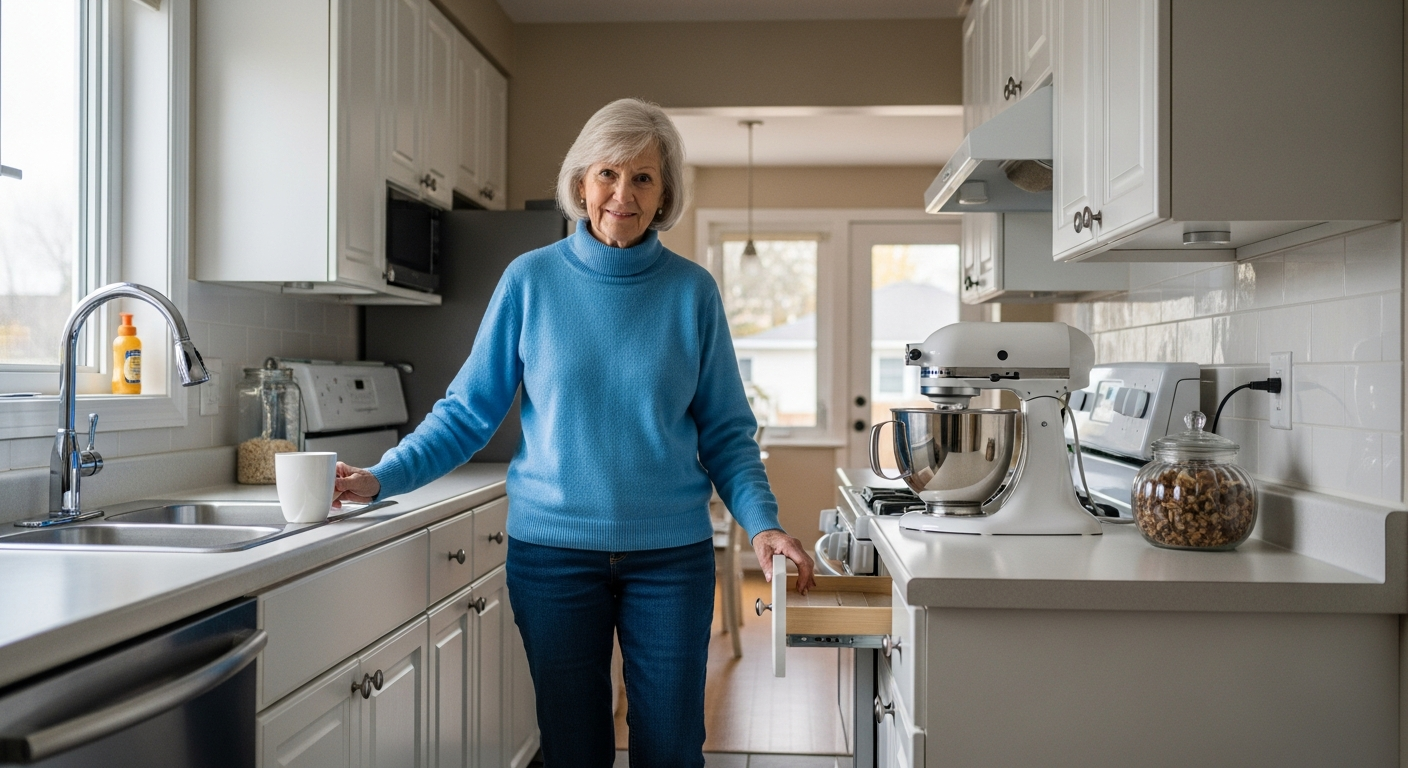
According to Statistics Canada, kitchen-related injuries for seniors 65+ cost the healthcare system over $1.2 billion annually. Many of these injuries are preventable with proper kitchen design.
A reverse mortgage lets you fund kitchen modifications that preserve independence for 10–20 years of active retirement.
Standard Kitchen Challenges for Aging Adults
As you age, kitchen use becomes harder in specific, predictable ways:
| Challenge | Age of Onset | Impact | Accessible Solution |
|---|---|---|---|
| Reaching upper cabinets | 65–75 | Risk of falls, strain on shoulders | Pull-down shelving systems, lower storage layout |
| Bending to lower cabinets | 65–75 | Back pain, difficulty retrieving items | Drawer systems, elevated lower storage |
| Turning cabinet knobs/handles | 60–70+ | Arthritis pain, reduced grip strength | Lever handles (vs. knobs), sensor-activated cabinets |
| Hot surface burns | 60–75 | Reduced sensitivity; vision decline | Induction cooktop (no heat around cookware), visual indicators |
| Stovetop safety | 65–80 | Reduced vision; forgetfulness with knobs | Slide-controls instead of knobs, auto-shutoff technology |
| Reaching countertops | 75+ | Mobility or wheelchair access | Counter height adjustment (30–36" for wheelchair access) |
| Poor lighting for food prep | 60–70+ | Vision decline; difficulty seeing ingredients | Task lighting above prep areas, brightness 300+ foot-candles |
| Slipping and falling | 65+ | Reduced balance; wet floors | Non-slip flooring, grab bars near sink and stove |
These challenges aren't hypothetical. They affect 80% of aging adults by age 75. Addressing them now—before you're in crisis—is smart planning.
What an Accessible Kitchen Renovation Costs
Accessible kitchen renovations range from modest ($8,000–$15,000) to comprehensive ($30,000–$60,000+), depending on what you change:
Budget Option: Accessibility Modifications Only ($8,000–$15,000)
- Lever cabinet handles and pulls: $1,000–$2,000
- Pull-down shelving in upper cabinets: $2,500–$4,000
- Better task lighting and LED undercounter lights: $1,500–$2,500
- Non-slip flooring upgrade (high-traffic areas): $2,000–$3,000
- Grab bars near sink and stove: $500–$800
- Sensor faucet (no knobs to turn): $600–$1,200
Best for: Kitchen is functionally sound but needs aging-friendly modifications
Mid-Range Option: Modifications + Key Updates ($15,000–$30,000)
- All accessibility modifications above: $8,000–$15,000
- Replace old stovetop with induction cooktop (safer, no open flame): $2,500–$4,000
- Replace lower cabinets with drawers (easier access): $3,000–$5,000
- Adjust counter heights where possible: $2,000–$4,000
- New flooring throughout: $3,000–$5,000
Best for: Kitchen needs both accessibility AND functional updates; plan to age in place here for 15+ years
Comprehensive Option: Full Accessible Kitchen Redesign ($30,000–$60,000+)
- Complete kitchen layout redesign for universal design: $8,000–$12,000 (design + labor)
- All accessibility modifications: $8,000–$12,000
- New cabinetry (custom-built for accessibility): $8,000–$15,000
- New appliances (accessible models): $4,000–$8,000
- Flooring, lighting, finishes: $4,000–$8,000
- Professional installation and contingency: $3,000–$5,000
Best for: Kitchen is outdated; you're willing to invest in luxury aging-in-place design; planning to stay 20+ years
Reverse Mortgage as Your Renovation Funding Tool
A reverse mortgage is ideal for kitchen renovations because:
| Advantage | Benefit for Kitchen Project |
|---|---|
| Lump sum available in 3–4 weeks | Can start renovations quickly; no waiting |
| No monthly payments required | All renovation funds go to construction, not debt service |
| Flexible access | Can draw in phases as work progresses (Phase 1: cabinets, Phase 2: appliances, etc.) |
| Age 55+ eligibility | Accessible to exactly the population that needs kitchen renovations |
| Home-based funding | Funds come from your own home equity, not new debt |
Example:
- Home value: $500,000
- Your age: 72
- Reverse mortgage available: ~$200,000
- Draw for kitchen: $25,000 (12.5% of available equity)
- Remaining capacity: $175,000 for future needs (health crisis, home repairs, etc.)
Designing Your Accessible Kitchen: Key Elements
Universal design principles create kitchens that work for ALL ages and abilities. Here are the essentials:
1. Counter Heights and Accessibility
- Standard counter height: 36" (fine for most users)
- Wheelchair-accessible section: 34" height (allows knee clearance underneath)
- Varied heights work: 30", 34", 36" counters serve different needs
- Pull-out work surfaces: At 30–32" for seated work
2. Sink and Faucet Design
- Sensor-activated faucets: No knobs to turn; ideal for arthritis or wet hands
- Lever handles (if manual): Far easier than knobs
- Shallow sink basins: Less reaching and less splashing
- Adequate under-sink clearance: Room for wheelchair or stool
3. Appliance Selection
- Induction cooktop (safest for aging): No open flames; surface cools quickly
- Oven at eye level (not floor-level): Reduces bending; easier to monitor food
- Refrigerator with accessible freezer: Not a standard bottom-freezer model (too low)
- Dishwasher with easy controls: Simple buttons vs. complex digital displays
4. Storage and Reach
- Pull-out shelves in lower cabinets: Access without bending
- Shallow shelving: Don't stack items too deep
- Labeled drawers: Know where things are without searching
- Lazy Susans in corner cabinets: Access otherwise unreachable items
5. Lighting
- Task lighting above counters: 300+ foot-candles for meal prep
- Ambient lighting for general visibility
- Dimmer switches: Adjust brightness for time of day and preferences
- Under-cabinet lighting: Illuminates countertop work areas
6. Flooring
- Non-slip surfaces: Matte tiles, not shiny or glossy
- Low-pile or no-pile: Easier for walkers and wheelchairs
- Seamless transitions: No tripping hazards between rooms
Government Support and Tax Credits
Ontario and Canada offer programs that complement your reverse mortgage:
| Program | Support | Eligibility |
|---|---|---|
| Accessibility for Ontarians with Disabilities Act (AODA) Tax Credit | 15% of eligible renovation costs (up to $20,000/year) recovered at tax time | Ontario residents with permanent disability (includes mobility/vision decline) |
| Home Accessibility Tax Credit (Federal) | Up to $20,000 in eligible renovation costs claimed annually | Seniors 65+ or caregivers for seniors |
| Registered Disability Savings Plan (RDSP) | If you have an RDSP, can allocate funds to accessibility renovations | Must have approved disability |
| Ontario Renovation Tax Credit (varies by municipality) | Some municipalities offer property tax rebates for home improvements | Check your local municipality |
Strategy: Combine your reverse mortgage with these tax credits. If renovations cost $25,000 and you recover 15% via tax credit, your net cost is ~$21,000.
Frequently Asked Questions
How long does a kitchen renovation take?
Typical timeline: 4–8 weeks for standard renovations. Universal design kitchens may take 8–12 weeks if custom cabinetry or significant layout changes are needed.
Do I need to move out during the renovation?
You can stay in your home if renovation is minor (handles, lighting, appliances only). Major renovations often require temporary relocation (2–3 weeks) due to water shutoffs and disruption.
Will the renovation increase my home's resale value?
Accessible kitchens appeal to aging buyers (55+) and anyone valuing universal design. You'll likely recoup 60–80% of renovation costs in resale value, making it a good investment even if you eventually sell.
Can I do the renovation in phases?
Yes. Start with essential accessibility modifications (handles, lighting, grab bars: $5,000–$8,000). Later, upgrade appliances or counters as your mobility needs change.
What if I need the kitchen to be wheelchair-accessible?
Design specifically for wheelchair access: 34" counter height, 36"+ pathway width, open space under sink and stove, side-opening appliances. This costs more ($35,000–$50,000+) but creates full accessibility.
Is a reverse mortgage the only way to fund this?
No—but it's often the best. HELOC, savings, or a personal loan all work. The advantage of a reverse mortgage is no monthly payments, which frees your retirement income.
Moving Forward: Funding Your Kitchen Independence
Your kitchen should support your independence, not threaten it. A reverse mortgage can fund the renovation that makes that possible.
- Assess your current kitchen: What tasks are becoming difficult? Where do you struggle?
- Consult a universal design specialist: They can recommend specific modifications for your situation
- Get renovation quotes: 2–3 contractors, all familiar with accessible kitchen design
- Speak with Rick Sekhon Reverse Mortgages to understand your available capital
- Plan the renovation: Prioritize essential modifications first; phase in luxury upgrades later
- Complete the renovation: Enjoy 15–20 years of independent cooking and meal preparation
An accessible kitchen isn't a luxury—it's the foundation of aging in place with dignity.
Learn about aging in place home modifications →
Explore home renovations for accessibility →
Understand funding home modifications →
Ready to Learn More?
Find out exactly how much you could unlock from your home — free and no obligation.
Related Articles
Reverse Mortgage for Home Renovations: Aging in Place Guide for Ontario Seniors
Learn how to use a reverse mortgage to fund home renovations and modifications that let you age in place safely and comfortably in your Ontario home. Includes cost examples and step-by-step process.
Read →Aging in Place with a Reverse Mortgage: Home Modification Guide
How Ontario seniors can fund aging-in-place home modifications with a reverse mortgage — costs, top modifications, grants, and a complete planning guide.
Read →Reverse Mortgage for Aging in Place With Fibromyalgia: Home Modifications for Invisible Illness
Fund home modifications for aging with fibromyalgia. Reverse mortgage enables accessible design for pain management, energy conservation, and quality of life.
Read →