
Reverse Mortgage When Adult Child Becomes Home Health Aide for Aging Parent: Career Transition Funding
Fund your adult child's career pivot to become a paid home health aide for you. Reverse mortgage covers certification, income gap, and caregiver training costs.
What happens when your adult child decides to leave their current job to become your professional home health aide? This powerful decision can keep you aging safely at home—but it creates a real financial challenge for both of you. A reverse mortgage can bridge that gap.
Many Ontario seniors face a difficult choice: accept a family caregiver without professional training, or pay $50,000-$80,000+ annually for a stranger's in-home care. Your adult child sees this gap and wants to fill it—but their income will drop dramatically during the transition. This is where a reverse mortgage becomes genuinely transformative, not just for you but for your entire family's care plan.
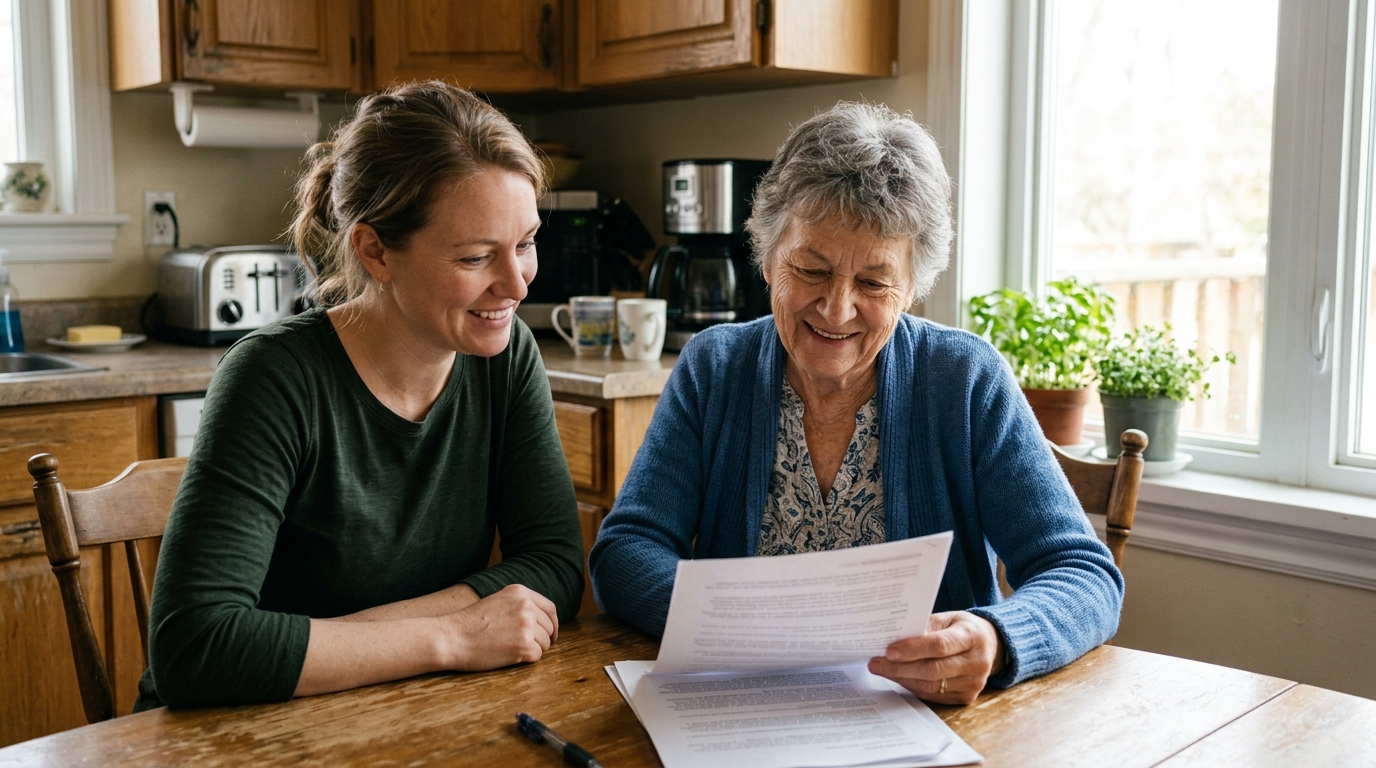
Why Adult Children Are Choosing Health Aide Careers for Aging Parents
The mathematics are compelling. A full-time personal support worker (PSW) in Ontario earns $45,000-$60,000 annually—less than most professionals, but meaningful income combined with direct care expertise you can trust.
For your adult child, the motivation is rarely financial. It's about control: knowing you're getting quality care from someone who loves you, on your terms, in your home. It's about presence: being there when you fall at 3 AM, not hoping the on-call aide arrives in 45 minutes. It's about legacy: building a caregiving relationship that honors both of you.
But the transition costs are real. Your adult child might need:
- PSW certification ($3,000-$8,000)
- First-aid and CPR training ($400-$600)
- 6-12 months of reduced income while training
- Professional liability insurance ($500-$1,500/year)
- Home office/workspace setup
- Loss of health/dental benefits during transition
- Possible co-insurance if they freelance instead of working for an agency
A reverse mortgage converts your home equity into the funding that makes this family plan possible.
How Reverse Mortgage Funding Supports This Career Transition
When you access a reverse mortgage—whether through CHIP, HomeEquity Bank, Equitable Bank, or Bloom Financial—the funds can specifically support your adult child's career shift:
| Funding Category | Typical Cost | Your Reverse Mortgage Role |
|---|---|---|
| PSW Certification Program | $4,500–$8,000 | Direct program payment |
| CPR/First-Aid Training | $400–$800 | Covered in initial funds |
| Income Gap (6 months @ $1,500/month) | $9,000 | Monthly draws or lump sum |
| Professional Liability Insurance | $1,200/year | Annual payment coverage |
| Home Office/Care Station Setup | $2,000–$5,000 | Equipment, desk, supplies |
| Credential Renewal Costs | $300/year | Ongoing from RM access |
| Total Year-1 Support | $17,400–$26,100 | Fully accessible |
Unlike a personal loan—which your adult child would personally owe—a reverse mortgage is your debt against your home. Your child doesn't carry the liability, and repayment only triggers when your home is eventually sold or the estate settles. This is crucial: your adult child can focus entirely on certification and care quality, not loan repayment stress.
The Timing Question: When Should You Apply for the Reverse Mortgage?
The sooner the better. Here's why:
At age 55, your home equity can be accessed via reverse mortgage. If your adult child is already discussing the career transition, waiting creates risk:
- Your health might decline further (triggering faster decline)
- Your eligibility could change (OSFI rules, market conditions)
- The "window of opportunity" for your child narrows as family needs intensify
According to FCAC (Financial Consumer Agency of Canada), "Reverse mortgage applications should be completed while borrowers are in optimal health and decision-making capacity, as eligibility can narrow if cognitive or physical decline accelerates."
Structuring the Reverse Mortgage for Caregiver Support
A smart structure combines lump-sum and line-of-credit access:
| Payment Structure | Amount | Timeline | Purpose |
|---|---|---|---|
| Lump Sum (Certification) | $8,000 | Month 1 | PSW program enrollment |
| Monthly Access (Income Gap) | $1,500 × 6 months | Months 2–7 | Transition income supplement |
| Flexible Line of Credit | $15,000 remaining | Years 2–3 | Insurance, renewal, emergency |
| Total Reverse Mortgage Access | $35,000 | Drawn over 24 months | Sustainable, not wasteful |
This approach means your adult child receives direct support without managing separate payments. You're essentially converting your home equity into professional caregiving infrastructure.
Beyond Income: What Else the Reverse Mortgage Enables
Funding the career transition is only the beginning. A reverse mortgage can also cover:
- Caregiver workspace in your home: Dedicated care station, medical supply storage, client records area
- Communication systems: Smart home technology, emergency alert systems, monitoring devices your child uses professionally
- Respite care backup: When your adult child takes scheduled days off, hiring professional backups is easier with RM-funded reserves
- Continuing education: PSWs must update skills; funding these courses improves care quality
- Equipment your child uses: Transfer assistance devices, mobility aids, specialized furniture—all enable safer, more professional caregiving
Legal and Tax Clarity for Family Caregiving
One critical question: Is your adult child an employee or contractor?
According to CRA guidelines, if your child is working exclusively for you and earning regular income, they may have employee or contractor tax obligations. A reverse mortgage advisor like Rick Sekhon Reverse Mortgages can help coordinate with a tax advisor to ensure:
| Tax/Legal Issue | Employee Status | Contractor Status |
|---|---|---|
| Income Reporting | T4 issued by you | Responsible for T1 |
| CPP Contributions | Both pay into CPP (good for their retirement) | Self-employed CPP deductions |
| Liability Insurance | Homeowner's policy may cover | Professional liability essential |
| Employment Insurance | Potentially eligible | Self-insured |
This isn't a dealbreaker—it's a detail to clarify early. A reverse mortgage funds the care delivery, not the legal structure. You and your child need clear understanding anyway.
The Peace-of-Mind Factor
What makes this strategy powerful isn't just the money—it's the mutual reassurance:
- You know your care comes from someone trained, present, and motivated by love (not contract)
- Your adult child knows they're not sacrificing their financial security to do it
- Your estate doesn't hemorrhage to professional care agencies (typical PSW costs are $25-$35/hour; family arrangement can be structured more affordably)
- Your family dynamics improve because caregiving is structured as professional work, not guilt-based obligation
Will This Affect Your Adult Child's Future Borrowing?
No. The reverse mortgage is your debt, not theirs. If they later want to buy a home, the RM won't show on their credit report or affect their borrowing capacity. Their income as your caregiver is taxable and counts as legitimate earnings for future mortgage qualification.
However, their income dependency on you (their parent) is relevant to their financial stability. Having a documented caregiving arrangement clarifies this relationship for future lenders.
Comparing Your Caregiving Funding Options
| Caregiving Solution | Total Cost (5 yrs) | Your Control | Care Quality | Family Impact |
|---|---|---|---|---|
| Professional agency care (35 hrs/week @ $30/hr) | $273,000 | Low (staff changes) | Varies | Minimal bond |
| Adult child PSW + reverse mortgage support | $35,000–$50,000 | High (your child) | Consistent | Strengthened |
| Adult child unpaid caregiving | $0 formal costs | High | Depends on training | Caregiver burnout risk |
| Assisted living facility move | $60,000–$120,000/year | Minimal | Good | Relocation trauma |
The reverse mortgage option isn't just cheaper—it's the only structure that combines cost-efficiency with professional care quality and family relationship strength.
Key Takeaways
- Your adult child can become your professional PSW with reverse mortgage support covering certification ($4,500–$8,000), income gap ($9,000–$15,000 for 6–12 months), and ongoing professional costs
- A reverse mortgage lets your child transition careers without personal debt liability; repayment only occurs when your home is sold or estate settles
- Structure access as lump-sum for certification plus monthly draws during the transition, leaving a line of credit for ongoing professional support
- Verify tax/employment status with CRA and clarify whether your child will be an employee or contractor before the reverse mortgage funds arrive
- This strategy costs 70–80% less than professional agency care while providing superior relationship continuity and care quality
- Your adult child's future borrowing capacity is not affected, as the reverse mortgage is your debt, not theirs
Frequently Asked Questions
What if my adult child doesn't complete the PSW certification?
You've accessed equity as a reverse mortgage against your home, and the program money is spent either way. However, your child can still provide in-home support without formal certification (many families do). The RM funds remain accessible for whatever caregiving structure works best for your situation.
Can my adult child live with me and earn income as my caregiver?
Yes. Many adult children live with aging parents and receive caregiving income. Ensure the arrangement is documented, your child reports income to CRA, and liability insurance covers the relationship. This is especially common in multi-generational households in Ontario.
If I get a reverse mortgage for my child's PSW training, can they work for me exclusively, or must they work for an agency?
They can work exclusively for you. This is a private caregiving arrangement. However, if they work through an agency, they're covered by the agency's liability insurance. If exclusively for you, they need personal liability insurance. The reverse mortgage funds support either arrangement.
Will this reverse mortgage affect my ODSP, GIS, or other benefits?
The reverse mortgage does not reduce your government pension benefits (CPP, OAS). If you're on ODSP or GIS, the funds received could temporarily affect those means-tested benefits. Consult with FSRAO (Financial Services Regulatory Authority) or a benefits advisor before accessing RM funds if you're on means-tested benefits.
How long can my adult child work as my caregiver before they need to move into long-term care?
That depends on your health trajectory. A reverse mortgage creates financial flexibility for as long as home-based care remains appropriate. When you transition to a facility, the RM balance becomes due (from home sale proceeds or your estate). This is a 10–20 year horizon for many families.
What happens to the reverse mortgage if my adult child gets sick or must leave?
The RM debt is tied to your home, not your child's employment. If they must leave, you'd transition to professional care, and the RM funds already accessed remain your debt. This is why structuring a line of credit (rather than drawing everything at once) is wise—it provides flexibility if caregiving arrangements change.
Ready to Learn More?
Find out exactly how much you could unlock from your home — free and no obligation.
Related Articles
Reverse Mortgage for Aging Parent as Paid Research Subject Matter Expert: Knowledge Work in Retirement
Monetize expertise as aging parent becomes paid research SME for universities. Reverse mortgage bridges income while building knowledge-sharing business.
Read →Reverse Mortgage for Aging in Place With Fibromyalgia: Home Modifications for Invisible Illness
Fund home modifications for aging with fibromyalgia. Reverse mortgage enables accessible design for pain management, energy conservation, and quality of life.
Read →Reverse Mortgage for Adult Child's Executive Coaching and Leadership Development Practice
Fund your adult child's independent executive coaching business. Reverse mortgage provides startup capital for high-value leadership coaching in Ontario.
Read →