
Reverse Mortgage When Your Mortgage Renewal Rate Shocks You: Bridge the Gap in Ontario
Your traditional mortgage is renewing at a much higher rate. Discover how a reverse mortgage can bridge the payment shock and protect your retirement income in Ontario.
When Your Mortgage Renewal Rate Shocks You
If your traditional mortgage is coming up for renewal and you're facing a significant rate increase, you're not alone. Many Ontario homeowners aged 55+ are experiencing "mortgage renewal shock"—the painful reality that interest rates have climbed since your last mortgage term, and your lender is offering renewal rates that could increase your monthly payments by $300, $500, or even more.
For retirees on fixed incomes, this shock can be devastating. Your CPP and OAS payments don't increase to match mortgage payment jumps. Your RRIF withdrawal hasn't changed. But suddenly your housing costs are consuming a much larger share of your retirement budget.
A reverse mortgage can be your solution. Instead of accepting the renewal rate or scrambling to refinance at higher rates, you can use a reverse mortgage to pay off your traditional mortgage completely—eliminating renewal shock forever.

The Mortgage Renewal Rate Crisis in Ontario
Between 2020 and 2026, Canada's prime lending rate moved dramatically. Homeowners who locked in mortgages at 2-3% rates are now facing 5-6% renewals—doubling or tripling their monthly payments.
For a $300,000 mortgage balance at a 2% rate, your monthly payment was approximately $1,432. At renewal at 5.5%, that same mortgage costs approximately $1,703—a $271 monthly increase.
Over 12 months, that's an extra $3,252 in mortgage payments. For someone on a fixed income, that's the difference between financial stability and financial distress.
Ontario homeowners have three traditional renewal options:
- Accept the lender's renewal rate — convenient but expensive
- Shop around with other lenders — slightly better rates but still historically high
- Switch to a variable rate — risky if rates climb further
- Refinance with a new mortgage — requires qualification and often costs $3,000-$5,000 in legal and appraisal fees
But there's a fourth option many retirees don't consider: a reverse mortgage.
| Renewal Option | Monthly Payment | Qualification Required | Best For |
|---|---|---|---|
| Accept lender's renewal rate | Full P&I payment | No | Homeowners with stable income |
| Shop new lender | Full P&I payment | Yes (income/credit) | Those who can still qualify |
| Switch to variable rate | Fluctuates with prime | Yes | Comfortable with rate risk |
| Refinance (new mortgage) | Full P&I payment | Yes | Strong income, good credit |
| Reverse mortgage (55+) | $0 | No (based on age/equity) | Fixed-income retirees |
How a Reverse Mortgage Solves Mortgage Renewal Shock

A reverse mortgage lets you borrow against your home's equity without monthly payments. Here's how it solves the renewal problem:
Step 1: Get a Reverse Mortgage You apply for a reverse mortgage at a fixed rate. Current rates for CHIP and other major Ontario lenders are between 5.99% and 6.49%—often competitive with renewal rates.
Step 2: Use Proceeds to Pay Off Your Traditional Mortgage The reverse mortgage gives you a lump sum or line of credit. You use these proceeds to pay off your traditional mortgage completely.
Step 3: No Monthly Mortgage Payment Your traditional mortgage is gone. You no longer owe a monthly payment. The interest on the reverse mortgage accrues silently—you don't make monthly payments.
Step 4: Stay in Your Home You continue living in your home. The reverse mortgage is paid back when you sell, move, or pass away.
The Financial Impact
Let's work through a realistic Ontario scenario:
Your Situation:
- Home value: $750,000
- Existing mortgage balance at renewal: $250,000
- Renewal offer: 5.5% (increase from 2.0%)
- Age: 68
- CHIP RM rate: 6.19%
Traditional Renewal Scenario:
- Monthly payment: $1,419
- Annual cost: $17,028
- Payment shock from current rate: $271/month increase
Reverse Mortgage Scenario:
- Borrow $250,000 via reverse mortgage
- Pay off traditional mortgage immediately
- Monthly payment: $0
- Interest accrues silently at 6.19%
- After 10 years: Reverse mortgage balance grows to approximately $470,000
- You still own $280,000+ in home equity
The crucial insight: With a reverse mortgage, you defer all payments until you sell or pass away. This protects your retirement cash flow during your active retirement years when you need it most.
| Metric | Traditional Renewal | Reverse Mortgage |
|---|---|---|
| Monthly payment | $1,419 | $0 |
| Rate | 5.5% | 6.19% |
| Balance after 10 years | $250,000 (amortizing down) | ~$470,000 (growing) |
| Cash flow impact | -$17,028/year | $0/year |
| Qualification | Income/credit-based | Age (55+) and equity-based |
Who Benefits Most From This Strategy
This strategy works best if you:
- Are 55+ years old
- Have significant home equity (typically $200,000+)
- Are facing mortgage renewal in 6-12 months
- Have a fixed retirement income (CPP, OAS, pension) that won't increase
- Plan to stay in your home 10+ more years
- Don't have other sources of cash to cover the payment increase
The Trade-Off: Interest Accumulation
The downside is real: interest accumulates on the reverse mortgage balance. After 10-15 years, your total debt might be significantly higher than your original $250,000 mortgage.
However, for many retirees, this is an acceptable trade-off because:
- You're not forced to sell — Without the reverse mortgage, rising payments might force you to sell in 2-3 years when you can't afford the mortgage anymore
- You maintain cash flow — No monthly payment means you can afford your property taxes, insurance, and utilities
- Your home appreciates — If your $750,000 home appreciates to $850,000 over 10 years, you still have significant equity after paying back the reverse mortgage
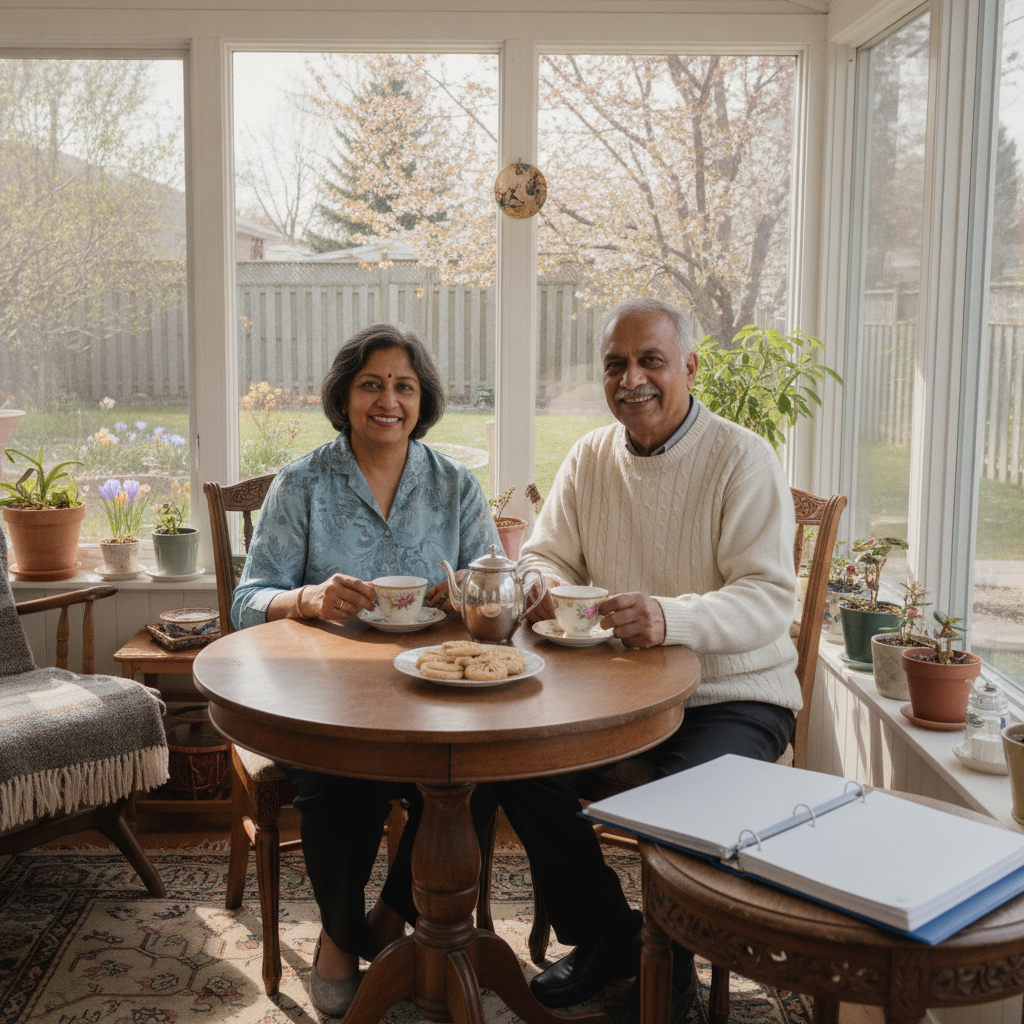
- You stay in your home — Most retirees prefer aging in place over forced downsizing
Alternative Strategies to Consider
Before committing to a reverse mortgage, explore these alternatives:
Debt Consolidation Mortgage: Shop around to see if another lender offers better renewal rates (3-4% less than your current offer).
HELOC Bridge: If you have equity but low mortgage balance, a Home Equity Line of Credit might work. However, HELOCs typically come with variable rates and monthly interest payments, which doesn't solve the cash flow problem.
Downsizing: Sell your home, buy a smaller property in Ontario, and invest the equity difference. This works if you're willing to leave your current neighborhood and community.
Adult Child's Help: Some retirees ask adult children to co-own the home or provide a family loan. This complicates ownership and creates family complications that might not be worth the interest savings.
Steps to Take Before Your Renewal
- Get your home appraised (3-4 months before renewal) — know your current home value
- Request a reverse mortgage quote — see what you can borrow and at what rate
- Compare total costs — renewal rate + payments versus reverse mortgage + interest accumulation
- Consult your accountant — understand tax implications (reverse mortgage proceeds are not taxable income)
- Get independent legal advice — standard requirement in Ontario, ensures you understand the terms
- Make a decision 60 days before renewal — gives you time to process without rushing
Reverse Mortgage vs. Renewal: The Real Numbers
For a 68-year-old Ontario homeowner with $250,000 mortgage and $750,000 home:
- Renewal at 5.5%: 25-year amortization, $1,419/month, $425,700 total paid over 25 years
- Reverse Mortgage at 6.19%: $250,000 borrowed, grows to ~$470,000 after 10 years, then paid from home sale proceeds
If your home appreciates to $850,000 in 10 years, you have ~$380,000 equity remaining after reverse mortgage payoff. If you stay another 10 years with regular renewal, you've spent $170,280 in mortgage payments just to keep a similar equity position.
Protecting Your Legacy
One concern: will your adult children inherit less if you use a reverse mortgage?
This depends on timing:
- If you use a reverse mortgage at 68, stay until 85, then sell: your home has likely appreciated significantly, and your children inherit a net amount after reverse mortgage payoff
- If you forced to sell at 70 due to mortgage affordability: you sell in a worse market position and have less equity to pass on anyway
For many retirees, the choice isn't "reverse mortgage or leave full equity to kids." The real choice is "reverse mortgage and stay in your home, or sell now and move." A reverse mortgage often preserves more equity than forced early sale.
Getting Started in Ontario
To explore whether a reverse mortgage makes sense for your mortgage renewal situation:
- Contact CHIP, Equitable Bank, or Home Trust for a free reverse mortgage consultation
- Request a quote based on your current home value and desired borrowing amount
- Get independent legal advice (required and typically costs $500-$800)
- Review appraisal and terms carefully before signing
- Ask about early repayment options (some lenders allow penalty-free payoff)
The Bottom Line
Mortgage renewal shock doesn't have to trigger a crisis. A reverse mortgage at age 55+ gives you a powerful option: pay off your traditional mortgage, eliminate monthly payments, and protect your retirement income while you age in your own home.
For Ontario retirees, this often means the difference between anxious retirement and secure, stable retirement—all without leaving your home.
Your renewal rate increase isn't inevitable. A reverse mortgage is one path forward.
Key Takeaways
- Mortgage renewal shock happens when a low fixed rate (2-3%) renews into today's higher rates (5-6%+), often adding $270+ to your monthly payment
- A reverse mortgage can pay off your traditional mortgage completely and eliminate the monthly payment entirely, since RM borrowers make no required monthly payments
- Ontario reverse mortgage rates currently run roughly 5.99%-6.49% with major lenders like CHIP, Equitable Bank, and Home Trust
- Reverse mortgage proceeds are tax-free and available to homeowners 55 and older who have sufficient home equity
- Independent legal advice is required in Ontario before finalizing a reverse mortgage, typically costing $500-$800
- Staying in your home and letting it appreciate can often preserve more long-term equity than being forced into an early sale due to unaffordable renewal payments
Frequently Asked Questions
How much can I borrow with a reverse mortgage to pay off my mortgage renewal?
Most Ontario lenders let homeowners 55+ borrow between 15% and 59% of their home's appraised value, depending on age, home value, and location. The older you are, the higher the percentage you typically qualify for.
Will a reverse mortgage rate be lower than my renewal rate?
It depends on market conditions at the time. Reverse mortgage rates have recently run around 5.99%-6.49%, which can be comparable to or higher than some traditional renewal offers, but the key advantage is eliminating the required monthly payment, not necessarily getting a lower rate.
Do I need to qualify with income or credit for a reverse mortgage?
No. Reverse mortgages are approved primarily based on your age (55+), your home's value, and the equity you hold — not your income or credit score, which makes them accessible to retirees on fixed incomes who might not qualify for a traditional refinance.
What happens to my reverse mortgage balance over time?
Since there are no required monthly payments, interest accrues and compounds on the balance, so the amount owed grows over time. The balance becomes due when you sell the home, move out permanently, or pass away, and is repaid from the sale proceeds.
Can I still leave my home to my children if I use a reverse mortgage?
Yes. Any remaining equity after the reverse mortgage balance is repaid goes to you or your estate. Canadian reverse mortgages also include negative-equity protection, meaning you or your heirs will never owe more than the fair market value of the home at the time of sale.
Is refinancing with a new traditional mortgage a better option than a reverse mortgage?
It can be, if you have strong income and credit and can still qualify for and afford new payments. But refinancing typically costs $3,000-$5,000 in legal and appraisal fees and still requires ongoing monthly payments, which doesn't solve the cash-flow pressure that a reverse mortgage eliminates.
Ready to Learn More?
Find out exactly how much you could unlock from your home — free and no obligation.
Related Articles
Reverse Mortgage to Fund Adult Child's Full-Time Executive MBA: Career Acceleration Without Debt
Use a reverse mortgage to fund your adult child's full-time MBA living costs, preventing student debt while they accelerate their career in Ontario.
Read →Reverse Mortgage for Aging Parent's Hidden Property Tax Arrears: Emergency Tax Debt Recovery
Discover your aging parent's underpaid property taxes and resolve arrears before foreclosure using a reverse mortgage in Ontario.
Read →Reverse Mortgage When Adult Child's Spousal Immigration Status Is Revoked: Emergency Family Support
Fund urgent legal defense and family restructuring when your adult child's spouse faces deportation due to immigration status revocation in Ontario.
Read →