
Reverse Mortgage and Capital Gains Tax on Your Principal Residence
How reverse mortgage capital gains tax rules work for your principal residence in Canada. PRE exemption, partial rental, cottage complications explained.
"If I take out a reverse mortgage, will I lose my principal residence exemption and get hit with capital gains tax when the house is eventually sold?" This question surfaces constantly — and the anxiety behind it is understandable. Your home is likely your largest asset, and the Principal Residence Exemption (PRE) is the single most valuable tax shelter most Canadians will ever use. The good news: a reverse mortgage does not change your capital gains tax position. But the full picture involves rental income complications, cottage ownership, and estate timing that every Ontario homeowner should understand before signing.

How the Principal Residence Exemption Works in Canada
The PRE is found in Section 40(2)(b) of the Income Tax Act (Canada). It allows Canadian taxpayers to eliminate capital gains on the sale — or deemed disposition at death — of a property that qualifies as their principal residence.
The key requirements are straightforward:
- The property must be a "housing unit" (house, condo, cottage, mobile home)
- You must have "ordinarily inhabited" the property during the year
- You must designate the property as your principal residence for each year of ownership
- Only one property per family unit (you, your spouse, and minor children) can be designated per year
When all conditions are met, the gain is completely tax-free. For a home purchased at $300,000 that sells at $1,200,000, the $900,000 capital gain disappears entirely under the PRE.
According to the CRA, the principal residence exemption formula under Section 54 of the Income Tax Act eliminates the capital gain proportionally for each year the property is designated. The designation is made when the property is sold or deemed disposed, not when a mortgage is placed on the property.
The PRE Formula
The formula calculates the exempt portion of your gain:
| Component | Description |
|---|---|
| A | Number of years designated as principal residence + 1 |
| B | Number of years owned |
| Exempt gain | (A / B) x Total capital gain |
The "+1" in the formula provides a one-year buffer — important for situations where you sell one home and buy another in the same year.
A Reverse Mortgage Does NOT Affect the PRE
This is the critical point and it cannot be overstated:
Placing a reverse mortgage on your principal residence has zero effect on the Principal Residence Exemption.
The PRE is based on how you use the property (as your home), not on what financial products are secured against it. A reverse mortgage is simply a loan secured by the property. Just as a conventional mortgage, a HELOC, or a secured line of credit does not disqualify a property from the PRE, neither does a reverse mortgage from HomeEquity Bank (CHIP), Equitable Bank, Bloom Financial, or Home Trust.
| Factor | Does It Affect the PRE? |
|---|---|
| Taking out a reverse mortgage | No |
| Amount of reverse mortgage | No |
| Accumulating interest on the reverse mortgage | No |
| Making voluntary prepayments | No |
| Having a CHIP reverse mortgage specifically | No |
| Renting out part of the property | Yes — potentially |
| Ceasing to "ordinarily inhabit" the property | Yes |
| Designating a different property (e.g., cottage) as principal residence | Yes |
The distinction is clear: mortgage products do not affect the PRE. How you use the property does.
Where Capital Gains Tax CAN Arise: Partial Rental Properties
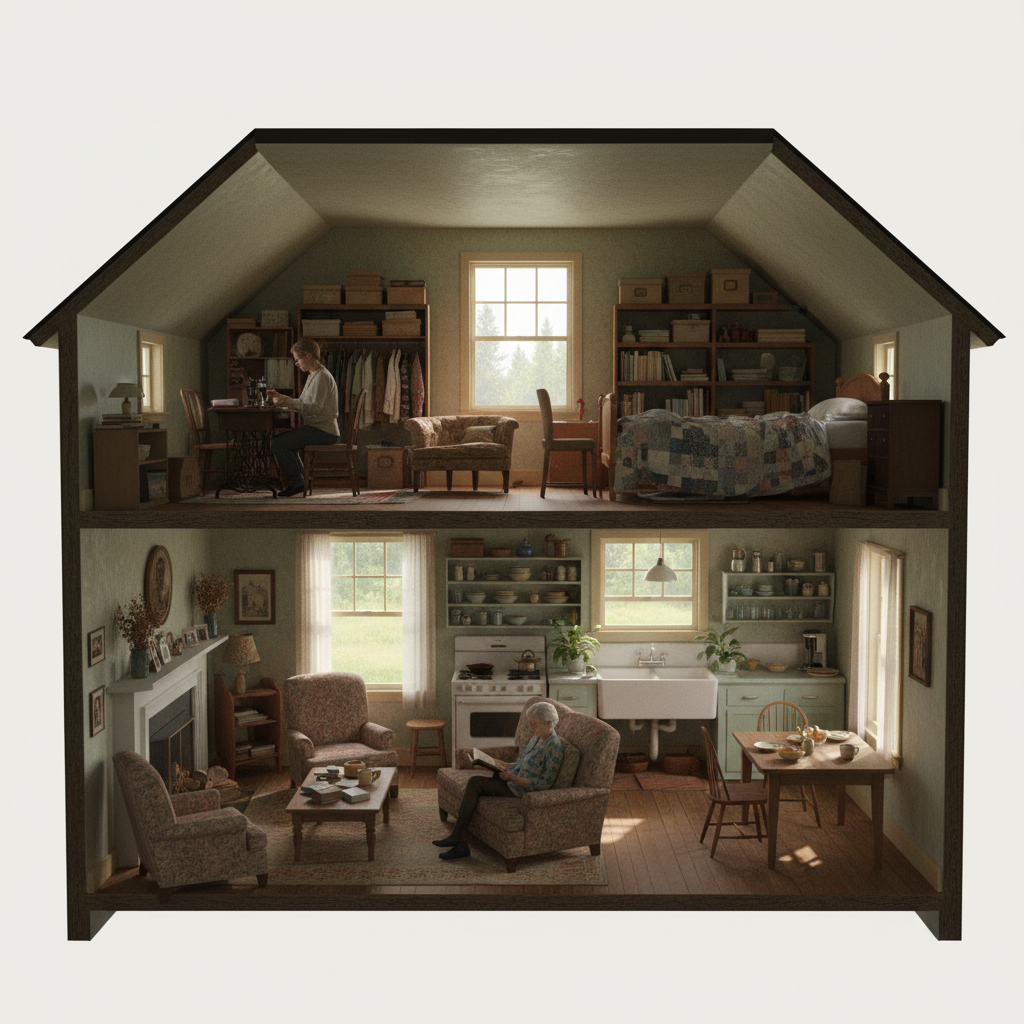
Here is where the analysis becomes more nuanced. If you rent out part of your home — whether a basement apartment, a secondary suite, or rooms through short-term rental — the CRA may consider that portion of the property to be a separate income-producing use.
The CRA's general position on partial rental:
- If the rental portion is ancillary to the main residential use (e.g., you rent one room in a large house and do not claim Capital Cost Allowance), the entire property can still qualify as your principal residence
- If you claim CCA on the rental portion, the CRA considers a deemed disposition to have occurred on that portion at the time you began renting — creating a potential capital gain
The CCA Trap
Capital Cost Allowance (CCA) is the key trigger. Many Ontario homeowners who rent a basement apartment or secondary suite are unaware of this rule:
| Scenario | CCA Claimed? | PRE Impact |
|---|---|---|
| Rent basement suite, no CCA claimed | No | Full PRE typically preserved |
| Rent basement suite, CCA claimed on rental portion | Yes | PRE lost on rental portion; capital gain applies to that percentage |
| Short-term rental (Airbnb), no CCA | No | Full PRE typically preserved (if rental is ancillary) |
| Dedicated rental unit, CCA claimed | Yes | Proportional PRE loss |
According to the CRA's IT-120R6 (now archived but still referenced), a property does not lose its principal residence designation merely because part of it is used for income purposes, provided CCA is not claimed and the income-producing use is ancillary to the main residential use.
If you have a reverse mortgage and are renting part of your property, the reverse mortgage is not the issue — the rental arrangement and CCA claiming are. Speak with Rick Sekhon to understand how your specific property configuration affects both your reverse mortgage eligibility and tax position.
Practical Example: Ontario Homeowner with Basement Suite
Consider Margaret, age 72, living in Ottawa with a home worth $850,000. She rents the basement to a tenant for $1,500/month. She took a reverse mortgage of $200,000 through the CHIP program two years ago.
| Detail | Amount |
|---|---|
| Home purchase price (2001) | $220,000 |
| Current appraised value | $850,000 |
| Capital gain | $630,000 |
| Basement rental percentage of home | 25% |
| CCA claimed on rental portion | None |
| PRE applies to full property? | Yes — because no CCA claimed |
| Reverse mortgage impact on PRE | None |
| Capital gains tax on eventual sale | $0 |
If Margaret had claimed CCA on the rental portion, approximately 25% of the $630,000 gain ($157,500) could be subject to capital gains tax. At the 2026 inclusion rate, this would create a significant tax bill — but it would have nothing to do with the reverse mortgage.
The Cottage Complication: Choosing Which Property Gets the PRE

Many Ontario families own both a city home and a cottage. Under Canadian tax law, only one property per family unit can be designated as the principal residence per year. This creates a strategic decision that intersects with reverse mortgage planning.
FSRAO-regulated mortgage brokers like Rick Sekhon can help you think through the property strategy, but the tax designation decision should also involve a qualified accountant.
The Designation Strategy
When you own two properties, you must decide which years to allocate to each property. The general rule of thumb:
- Designate the property with the higher annual rate of appreciation as your principal residence for those years
- The other property's gain for those years will be subject to capital gains tax
| Year Range | City Home Appreciation | Cottage Appreciation | Optimal PRE Designation |
|---|---|---|---|
| 2005-2015 | $15,000/year | $25,000/year | Cottage |
| 2015-2026 | $40,000/year | $20,000/year | City home |
Reverse Mortgage on the City Home — Does It Affect the Cottage?
No. Taking a reverse mortgage on your city home does not affect the PRE designation for either property. The reverse mortgage is a financial instrument; it does not change the use or designation of any property.
However, there is a practical planning consideration: if you take a reverse mortgage on your city home and later sell the cottage, the capital gain on the cottage (for years it was not designated as principal residence) will be taxable. That tax bill will need to be paid from available funds — and if your liquid assets are limited because you have been drawing on the reverse mortgage for living expenses, the timing could be uncomfortable.
Rick Sekhon can help Ontario homeowners model these scenarios to ensure the reverse mortgage and property strategy work together.
Deemed Disposition at Death: The Estate Scenario
When a homeowner passes away, the CRA treats them as having sold all capital property at fair market value immediately before death. For the principal residence, the PRE typically eliminates the entire capital gain.
The reverse mortgage balance is a debt of the estate — it is not a taxable event. The sequence is:
- The home's fair market value is determined (deemed disposition)
- The PRE is claimed, eliminating the capital gain
- The home is sold by the estate
- The reverse mortgage balance (principal + accumulated interest) is repaid from sale proceeds
- Any remaining funds are distributed per the will
The executor does not pay capital gains tax on the home (assuming full PRE designation), and the reverse mortgage repayment is simply a debt settlement, not a taxable transaction.
What If the Estate Owes More Than the Home Is Worth?
Under the no negative equity guarantee offered by lenders like HomeEquity Bank (CHIP) and Equitable Bank, the estate will never owe more than the fair market value of the home. This protection is separate from — and does not interact with — the capital gains tax rules. The estate's capital gains position is based on the home's value, not the mortgage balance.
OAS, GIS, and CPP: No Interaction with Capital Gains on the Home
Because the PRE eliminates the capital gain, there is no income reported on Line 23600 from the sale of the principal residence. This means:
- No OAS clawback triggered by the home sale
- No GIS reduction
- No impact on CPP benefits
- No impact on Ontario Trillium Benefit or other income-tested programs
If the home sale did produce a taxable capital gain (e.g., because the property was partially rented with CCA claimed), the taxable portion of the gain would be added to Line 23600 and could trigger OAS recovery tax. But again — this is a rental/CCA issue, not a reverse mortgage issue.
What About the 2024 Capital Gains Inclusion Rate Change?
The federal government changed the capital gains inclusion rate effective June 25, 2024. For individuals:
| Capital Gains Amount | Inclusion Rate |
|---|---|
| First $250,000 of annual capital gains | 50% |
| Capital gains above $250,000 | 66.67% |
This change affects gains that are not sheltered by the PRE. If your principal residence is fully designated, the inclusion rate is irrelevant — 50% or 66.67% of zero is still zero. But for a cottage or partially-rented property where the PRE does not fully apply, the higher inclusion rate above $250,000 increases the tax cost.
OSFI-regulated lenders and FCAC consumer protection guidelines do not address tax planning directly, but the financial impact of capital gains tax on a secondary property can influence how much equity you should access through a reverse mortgage on your primary home.
FAQ
Does a reverse mortgage create a capital gain when it is registered on my property? No. Registering a reverse mortgage is not a disposition of property. No sale or transfer occurs. The property title remains in your name. There is no taxable event at the time a reverse mortgage is placed on the property.
If I use reverse mortgage funds to renovate my home, does that affect my capital gains position? No. Renovations may increase the adjusted cost base (ACB) of your property, which would reduce a future capital gain — but this applies whether you fund renovations from savings, a HELOC, or a reverse mortgage. The source of funds does not change the tax treatment.
Can I designate my cottage as my principal residence while having a reverse mortgage on my city home? Yes. The PRE designation and the reverse mortgage are completely independent. You can have a reverse mortgage on your city home and designate the cottage as your principal residence for certain years if it provides a better tax outcome.
My spouse and I each own a property. Can we each claim the PRE on our own property? No. The PRE allows only one designation per "family unit" per year. A family unit includes you, your spouse or common-law partner, and any unmarried minor children. You must choose one property per year, regardless of whose name each property is registered in.
What if the CRA audits my principal residence designation? Since 2016, the CRA has required reporting on the sale of a principal residence (Schedule 3 and Form T2091). If audited, you need to demonstrate that you "ordinarily inhabited" the property. A reverse mortgage on the property is actually supporting evidence that you lived there — lenders like CHIP require the property to be your primary residence.
Does the no negative equity guarantee affect my estate's capital gains tax? No. The guarantee ensures the estate never owes more than the home's value on the reverse mortgage. Capital gains tax is a separate calculation based on the home's appreciation minus the ACB. The guarantee protects against mortgage debt exceeding home value — it does not create or eliminate capital gains.
Speak to a licensed mortgage professional and a qualified Canadian tax professional. Independent legal advice is required before closing a reverse mortgage in Ontario.
Get your free Ontario Reverse Mortgage Guide →
This content is for illustrative purposes only. Rates may vary. Call Rick Sekhon for the best rates and more information.
Ready to Learn More?
Find out exactly how much you could unlock from your home — free and no obligation.
Related Articles
Can I Rent Out Part of My Home with a Reverse Mortgage in Canada?
Can you rent out a room or basement suite if you have a reverse mortgage in Canada? Learn the rules, tax implications, and what lenders allow in Ontario.
Read →CRA Tax Treatment of Reverse Mortgage Proceeds: Rules Explained Simply
How Canada Revenue Agency classifies reverse mortgage proceeds for tax purposes. Complete CRA rule set for 2026: income tax, capital gains, GST/HST, and estate treatment.
Read →Reverse Mortgage Tax Implications in Canada: What Ontario Homeowners Need to Know
Are reverse mortgage proceeds taxable in Canada? How do they affect OAS, GIS, and CPP? A complete guide to the tax implications of reverse mortgages for Ontario seniors.
Read →