
Reverse Mortgage to Launch Accessibility Equipment Leasing Business: Aging Parents as Entrepreneurs
Start accessibility equipment leasing business using reverse mortgage. Serve aging community while generating retirement income. Entrepreneurship at 60+.
You understand aging-in-place needs intimately—you're managing them for your parent or yourself. You see the accessibility gap: equipment is expensive, rarely used long-term, but often essential temporarily. Why not create a business that solves this problem while generating retirement income? A reverse mortgage can fund your startup as an accessibility equipment leasing coordinator.
The Accessibility Equipment Gap in Ontario
Accessibility equipment is expensive and often temporary:
- Wheelchairs/mobility aids: $2,000–$15,000+ to purchase; many needed only 3–12 months during recovery
- Bathroom grab bars and safety equipment: $500–$3,000 to install; often needed temporarily after fall/injury
- Hospital beds and overbed tables: $1,500–$4,000; many used 6 months during recovery then sit unused
- Stair lifts and ramps: $3,000–$8,000; sometimes temporary during injury recovery
- Walkers, canes, crutches: $200–$1,000; multiple needed for different situations
- Commodes and raised toilet seats: $300–$1,000; used during specific health phases
People don't want to buy this equipment—they want temporary access. But equipment rental companies are rare in most Ontario communities; many homeowners must purchase new or go without.

The Business Opportunity: Accessibility Equipment Leasing
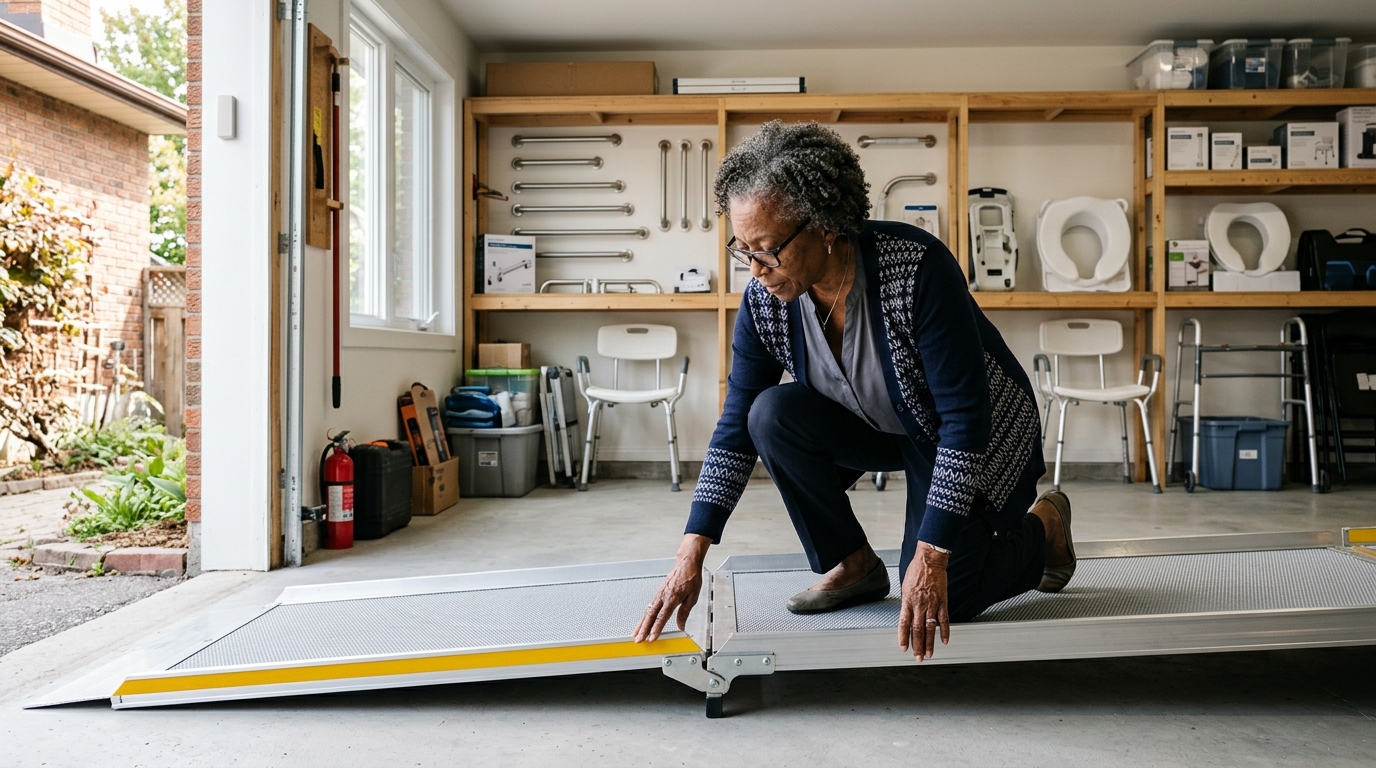
Your business model: Build an inventory of accessibility equipment; lease to homeowners, hospitals, and rehab facilities; collect monthly/quarterly rental fees.
Revenue streams:
- Monthly rentals: $150–$400/month per item (wheelchair, bed, lift, etc.)
- Quarterly leases: $400–$1,200 per quarter for rehabilitation equipment packages
- Installation/setup fees: $100–$300 (grab bars, ramps)
- Delivery/pickup service: $50–$150 per trip
- Equipment sales (for purchase-ready customers): 20–30% markup
Unit economics example:
- Wheelchair purchase cost: $2,500
- Monthly lease rate: $200
- Breakeven: 12–13 months
- Years 2–5: Pure profit ($2,400/year per unit)
- Estimate 50–100 wheelchairs in active rotation = $120,000–$240,000 annual revenue
Accessibility equipment businesses operate at 40–50% gross margins; the industry is growing 8–12% annually as Ontario's aging population increases.
Reverse Mortgage for Startup Inventory Funding
| Inventory Item | Cost per Unit | Recommended Initial Inventory | Total Capital Required |
|---|---|---|---|
| Wheelchairs (manual) | $1,500–$2,500 | 10 units | $15,000–$25,000 |
| Mobility scooters | $3,000–$6,000 | 5 units | $15,000–$30,000 |
| Hospital beds (electric) | $1,200–$2,000 | 10 units | $12,000–$20,000 |
| Grab bars + installation materials | $200–$500/kit | 20 kits | $4,000–$10,000 |
| Walkers/canes/crutches (bulk) | $100–$300 each | 50 units | $5,000–$15,000 |
| Delivery vehicle (used) | $8,000–$15,000 | 1 vehicle | $8,000–$15,000 |
| Insurance, licensing, storage space | Annual | Initial + Year 1 | $3,000–$8,000 |
| Total Startup Capital Needed | $62,000–$123,000 |
A reverse mortgage of $80,000–$120,000 covers initial inventory, vehicle, and working capital for 12 months of operations before revenue stabilizes.
Why Accessibility Equipment Leasing as a Retirement Business
Aging entrepreneurs launching accessibility leasing businesses have several advantages:
- Deep personal expertise — You understand aging-in-place needs intimately
- High trust with target market — Customers trust someone who "gets it" because they've lived it
- Low-technology barriers — Doesn't require coding, data science, or tech startup expertise
- Flexible hours — Can scale operations (hiring delivery people, administrative support) as you age
- Mission-driven profitability — Serving aging community creates meaning alongside income
- Synergy with aging parent — If caring for aging parent, you can source equipment for them and others simultaneously
According to SCORE, aging entrepreneurs (60+) who start service-based businesses have higher success rates (65% reach profitability) than younger cohorts (45% for younger founders).
Market Validation: Is There Demand in Your Area?
Before launching, validate the market:
Demand indicators to research:
- Search online: "wheelchair rental Ontario" + your city — how many results exist?
- Contact occupational therapists in your area — do they refer patients for equipment rentals?
- Hospital discharge coordinators — do they recommend equipment rental services?
- Insurance companies — do they cover equipment rental? (Indicates established market)
- Call 5–10 existing equipment rental services in nearby cities — are they fully booked? (Signals demand)
Market demand reality:
- Urban areas (Toronto, Ottawa, Hamilton): High demand; existing competitors; differentiation needed
- Mid-size cities (Kitchener, London, Barrie): Moderate demand; fewer competitors; easier entry
- Rural/small-town Ontario: Lower demand; less competition; but smaller customer base
If existing equipment rental services in your area report "fully booked" or "6+ week waitlists," that's a strong signal demand exceeds supply—perfect environment for a new entrant.
Competitive Differentiation: Why Your Business Wins
Equipment rental is commodity if not differentiated. Successful accessibility leasing businesses stand out through:
| Differentiation | Implementation | Competitive Advantage |
|---|---|---|
| Delivery + setup included | Your team installs grab bars, sets up beds, explains equipment | Customers choose you over big impersonal rental firms |
| 24-hour availability | Answer calls, support equipment issues during nights/weekends | Customers panic during medical emergencies; you're responsive |
| Specialized expertise by condition | Feature your PSW/OT/nursing background; tailor packages for specific conditions (stroke, hip replacement, amputation) | Medical professionals trust your recommendations |
| Flexible terms | Week-to-month rentals (competitors force 3-month minimums) | Customers choose you for shorter rehabilitation periods |
| Free trial/exchange policy | Customer tries equipment risk-free; exchanges if doesn't work | Builds trust; reduces buyer resistance |
A reverse-mortgage-funded business with personalized service beats big impersonal rental chains in the aging-in-place market.
Operational Reality: Can You Actually Run This?
Before committing $100,000+ of home equity, be honest about operational capacity:
Critical questions:
- Do you enjoy customer service and problem-solving?
- Can you manage a small team (delivery drivers, customer service reps)?
- Can you handle physical inventory management (storing equipment, maintenance, cleaning)?
- Do you have the energy for 40–50 hour work weeks for 3–5 years until it stabilizes?
- Can you tolerate sporadic customer emergencies (equipment breaks, patient falls)?
If you answer "no" to 2+ questions, this business will exhaust you. A reverse mortgage provides capital, not the personal capacity to run operations. Be honest before committing.

Reverse Mortgage Payback Strategy: From Rental Income to Equity
Year-by-year profitability model:
| Year | Revenue | Operating Costs (35% COGS + staffing) | Net Profit | Reverse Mortgage Repayment |
|---|---|---|---|---|
| Year 1 | $45,000 (startup; limited inventory) | $28,000 | $17,000 | $5,000–$8,000 partial paydown |
| Year 2 | $95,000 (growing customer base) | $55,000 | $40,000 | $15,000–$20,000 |
| Year 3 | $150,000 (established; scaling) | $85,000 | $65,000 | $30,000–$40,000 |
| Year 4 | $185,000 (optimal operations) | $105,000 | $80,000 | $40,000–$60,000 |
| Year 5 | $200,000+ (plateau; stabilized) | $115,000 | $85,000 | $60,000–$80,000 full repayment |
By year 5, business profitability has fully repaid the reverse mortgage from operational income. This is unique: most retirees drawing on reverse mortgages are depleting home equity. An accessibility leasing business is restoring it through profitable operations.
Succession and Exit: What Happens to the Business?
The beauty of building an accessibility leasing business is exit flexibility:
Option 1: Family takeover
- Your adult child takes over operations
- Business becomes multi-generational wealth builder
- You transition to advisory role; reduced work stress
- Reverse mortgage repayment accelerates as operations scale
Option 2: Acquisition by national company
- Equipment rental chains (Accora, Blue Chip, others) acquire local operators
- Acquisition price: 2–4x annual EBITDA (earnings before interest, taxes, depreciation)
- $80,000 annual profit × 3 = $240,000 acquisition value
- You receive cash; reverse mortgage is paid off; home equity is restored or exceeded
Option 3: Managed wind-down
- By age 75–80, hire general manager to run operations
- You become passive investor (checking financials; letting manager operate)
- Sustainable income stream continues; business runs without your direct involvement
- Reverse mortgage is fully repaid; business becomes pure legacy income
This is far superior to traditional reverse mortgages where you're slowly depleting equity with no income offset.
Key Takeaways
- Accessibility equipment rental market is growing 8–12% annually as Ontario ages; demand exceeds supply
- Startup capital requirement ($80,000–$120,000) is perfectly sized for reverse mortgage funding
- Business profitability (40–50% margins) enables full reverse mortgage repayment within 5 years through operations
- Aging entrepreneurs with healthcare expertise have higher success rates than younger cohorts
- Business can be transitioned to family, acquired by larger firms, or managed passively in late retirement
Frequently Asked Questions
Do I need a business background to run an accessibility equipment leasing business?
No, but customer service experience helps. Most successful operators started with healthcare backgrounds (nursing, occupational therapy, caregiving) and learned business operations through YouTube, small business courses, and trial-and-error. The domain expertise (understanding accessibility needs) is more valuable than MBA-level business acumen.
What if the business fails in year 1–2? Am I stuck with the reverse mortgage?
Yes. The reverse mortgage remains a lien against your home regardless of business success. However, if the business fails, you still have the equipment inventory (resale value: 40–60% of acquisition cost). You could liquidate inventory and recover $32,000–$60,000 of your initial capital, reducing the reverse mortgage balance.
Do I need special licensing or insurance to lease accessibility equipment?
Yes, both are required: Product liability insurance (covers injuries from equipment), general business liability, and industry-specific certification depending on equipment type (medical device leasing may require licensing). Budget $3,000–$8,000 annually for insurance and compliance.
Should I bootstrap with savings instead of reverse mortgage?
Consider a hybrid approach. Use savings for insurance, licensing, and initial operational costs ($10,000–$15,000). Use reverse mortgage for equipment inventory ($60,000–$100,000). This limits reverse mortgage exposure while funding the high-capital-requirement aspects.
Can I run this business part-time while still working?
Possibly in year 1, but unlikely long-term. Initial customer acquisition, delivery coordination, and inventory management demand significant time. After year 1, you can hire staff to handle operations, allowing you to shift to part-time management. Most successful operators go full-time in year 1 to establish operations.
What happens to my reverse mortgage if I sell the business?
Consult your reverse mortgage lender. Most allow business sale proceeds to be used for reverse mortgage payoff. If you sell the business for $240,000 and your reverse mortgage balance is $90,000, you pay it off and keep $150,000. The home is then free and clear.
Do you have deep expertise in aging-in-place needs and dream of entrepreneurship? Contact Rick Sekhon Reverse Mortgages to explore how reverse mortgage capital can fund an accessibility equipment leasing business that serves your community while building retirement wealth.
Ready to Learn More?
Find out exactly how much you could unlock from your home — free and no obligation.
Related Articles
Reverse Mortgage for DEI Consulting Practice: Launching Diversity, Equity, and Inclusion Consulting in Retirement
Start a diversity and inclusion consulting practice. Help corporations and nonprofits build equitable cultures; reverse mortgage funds training, business setup, and market entry.
Read →Reverse Mortgage for Residential Sustainability Auditing Practice: Certifying Aging in Place
Launch a professional home energy and sustainability auditing business. Help Ontario homeowners certify efficiency; reverse mortgage funds training, tools, and market entry.
Read →Reverse Mortgage for Archival and Digital Preservation Consulting: Preserving Institutional History and Heritage
Launch archival consulting practice preserving records for institutions. Help libraries, archives, nonprofits; reverse mortgage funds training, tools, and market entry.
Read →